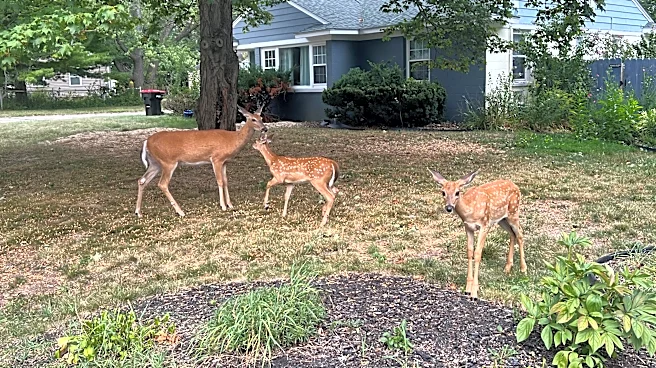







The deer herd in Metro Detroit keeps growing and so does the pressure on local officials to find a way to manage the animals in the suburbs.
Both Livonia and Beverly Hills city councils are discussing a deer cull, following the lead of Southfield, Farmington and Farmington Hills, which held the region’s first cull earlier this year.
But reducing the deer population is proving to be more of a challenge than expected, and the clock is ticking.
“We are on a wait list for a deer cull,” Livonia City Council President Kayleigh Reid said during a late July council meeting in response to several residents who asked what was being done regarding city deer.

Council member Martha Ptashnik said the city was “next in the queue,” due to staffing issues at the Department
of Natural Resources, which issues permits for deer culls, and her fellow council member, Carrie Budzinski, said cuts have also been made to the U.S. Department of Agriculture, or USDA, which executes the culls.
Brent Rudolph, deer, elk and moose specialist for the DNR, acknowledged the department has been “a little short-staffed,” and there may have been delays. However, he said there is not a backlog of permits. Up to mid-August, Rudolph had received a few deer cull permit requests for airports and proving grounds, and one from the City of Lansing.
“We are on the cusp of seeing them come through,” Rudolph said, adding he expected staff to be busy in September and October.
Deer cull permit requests come through the DNR, but they do not perform the culls.

The largest contractor for deer culls is the USDA.
In an Aug. 21 email, Tanya Espinosa, public affairs specialist for the USDA Animal and Plant Health Inspection Service, wrote that multiple Metro Detroit communities “have expressed interest, but at this time we do not have a cooperative agreement in place to conduct operations.”
“Although several additional communities have reached out regarding deer damage management, our program does not maintain a ‘list’ of communities interested in assistance,” she continued. “When communities request assistance, we meet with them and provide information and assistance as available.”
Beverly Hills Village Manager Warren Rothe said he expects the village council will decide whether to move forward with a cull in the next month or two, but said the USDA is fully booked for winter 2027.
A cull this winter could be done with contractors in the private market, he added, or the village could have the USDA perform a cull next fall.
“Winter is more popular for deer culls, but (the USDA) said they could do it earlier than winter 2028,” Rothe said, such as in the spring. “I anticipate that a deer cull would have to be done at least several years in a row if not an ongoing thing. … All the communities are looking to see if that is a viable solution. We’ll all figure it out together.”
Village officials held a public hearing regarding a deer cull in June and recently released the results of a deer management survey to which more than 1,000 residents responded.
Nearly 85% of respondents said they would support partnering with neighboring communities for deer management.
Respondents’ top concern about deer was damage to gardens and landscaping (78%), followed by deer-vehicle accidents (57%); tick and tick-borne diseases (56%); aggressive deer (36%) and decline in deer health (18%). Many also complained about deer poop in their yards.
On Aug. 31, Farmington Hills asked residents to participate in the 2026 Deer Management Pulse of the Region Survey.
The regional survey, conducted in partnership with the Southeast Michigan Urban Deer Coalition and the Southeast Michigan Council of Governments (SEMCOG), aims to gather localized information about deer-related issues across Southeast Michigan. The survey will be open Sept. 1 through Nov. 1, 2026.

Farmington Hills, along with Farmington and Southfield, contracted with the USDA for a regional deer cull earlier this year in which the goal was for sharpshooters to take 400 deer. Instead, dealing with obstacles including weather and limited land on which to operate, only 70 deer were taken, with venison donated to local food banks.
When asked whether a cull was scheduled for this winter, Kayla Wimbush, a spokeswoman for the city, responded in an email: “Given the City Council's adopted resolution supporting ongoing deer management operations, Farmington Hills will follow all state-mandated regulations for deer culls. At this time, no operations are scheduled.”
Janell Hearns, Community Relations Director for the City of Southfield, said the city does plan to pursue a deer cull in 2027. However, as of Aug. 27, she was unable to confirm whether a permit had been applied for from the DNR.
This article originally appeared on Detroit Free Press: Want a deer cull in your southeast Michigan suburb? Get in line.