






The Poweshiek skipperling, a small prairie butterfly, was once so abundant across the Midwest and Plains, scientists doing nature inventories didn't bother to count them, said Tamara Smith, a biologist with U.S. Fish and Wildlife Service.
"It was just like, 'Oh yeah; it's here. There are two of them on every flower,' " she said.

Then the population began to rapidly crash, spurred by loss of the very particular habitat the butterfly needs and the use of certain agricultural pesticides that also killed butterflies. By 2014, the federal government listed the Poweshiek skipperling as endangered. By 2022, only nine of the butterflies were counted anywhere in the United States, in one prairie fen complex in Oakland County.
David Pavlik, a research assistant
with Michigan State University's Haddad Lab and its endangered butterfly program, said that when he joined the Poweshiek Skipperling International Partnership, a coalition seeking to preserve the species, "it was almost expected that this butterfly was going to be gone soon; I mean, the population trajectories were just so bad."
Bill Flanagan, conservation manager at the John Ball Zoo in Grand Rapids, said that when he and the zoo were approached about lending a hand to save the Poweshiek skipperling in 2020, he had to do an internet search to learn what it was.
"The more I learned, the more I realized this is probably one of the most critically endangered animals, period," he said. "When I got that email from Dave [Pavlik], there were something like 10 times as many giant pandas as there were Poweshiek skipperlings."
From those dark days on the knife's edge of extinction, fast-forward to today, and things are looking up for the Poweshiek skipperling.
A program at the Minnesota Zoo and John Ball Zoo raises and breeds Poweshiek skipperlings in captivity before reintroducing the butterflies to their natural habitat in Michigan just as they are ready to take flight in their short mating window. From two breeding pairs creating 32 fertilized eggs in 2020, the program now has 48 pairs that resulted in more than 4,500 eggs. This July, researchers released nearly 1,300 butterflies in Michigan, and are tracking to see whether they mate in the wild and continue the recovery.
"This was by far the best year in 20-plus years for Poweshiek skipperlings," Pavlik said. "The sites that we are releasing them are having numbers that they haven't seen in a very, very long time — and we are only talking about wild butterflies here. Several days this summer, [researchers] saw well over 100 butterflies on a single survey at a single site."
For the first time this summer, the recovery effort expanded to a new location in Michigan, a restored fen in Jackson County, where 675 Poweshiek skipperlings were released this July.
"It seems to be doing very well, and so now we need to see what happens over the course of the next few years," Pavlik said. "Can they now do it on their own without our intervention? That's ultimately what we want.
"I think everything that the Poweshiek Skipperling International Partnership has done has undoubtedly saved the species."
Crawling all year, then only a week or so in the air
Seeing a Poweshiek skipperling is no easy task, and not just because of its scarcity.
"The Poweshiek skipperling is actually on the landscape for the entire year; you're just not going to see it except for a few short weeks, usually in the beginning of July," Pavlik said. "The vast majority of the time, the Poweshiek skipperling is a caterpillar that's out in those prairie fens."
By mid- to late-July the Poweshiek's eggs hatch, and the caterpillars, only an inch in length or less, start feeding on nearby vegetation. The caterpillars grow little heading into the fall, and as temperatures change and plants decline in quality, the caterpillars go to the bottom of plants near the leaf litter and enter a type of hibernation known as diapause, where they are not eating, moving or expending much energy. The leaves provide some protection from the harsh winter elements.
As things start to warm up and plants start to regrow in the spring, the caterpillars end their diapause, and grow quickly. From around mid-April until the beginning or middle of June, they enter their pupa phase. A Poweshiek skipperling caterpillar attaches itself to a blade of grass using silk, sheds its final larval skin to form a chrysalis, and spends about two weeks internally reorganizing its body to transform into an adult butterfly.
Around the first week of July, Poweshiek skipperlings emerge as butterflies, and the race is on to mate, lay fertilized eggs and restart the cycle.
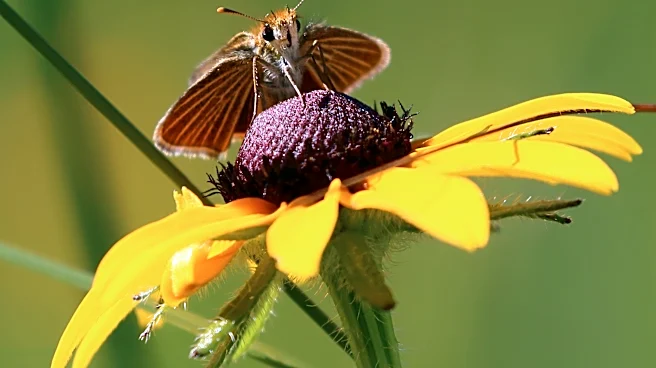
In its butterfly form, Poweshiek skipperlings have about a 1-inch wingspan. They feature dark brown upper wings with a bright orange stripe along the front edge, and lower hindwings marked by striking white veins that create a frosted, sparkling look.
A loss of very specific habitat and a deadly pesticide
The Poweshiek requires prairie fens, a very specific wetland and meadow habitat dominated by sedges, grasses and other graminoids, herbaceous, grass-like plants with narrow, blade-like leaves and small, wind-pollinated flowers. The habitat forms in areas with moderately alkaline organic soil and marl and occur where cold groundwater-fed springs reach the surface with water that's calcareous, containing calcium carbonate, lime or chalk.

As Poweshiek skipperling were abundant in North and South Dakota, Iowa, Minnesota, Wisconsin, Illinois, Indiana, Michigan and on into southern Manitoba, Canada, so was that prairie fen habitat. But over the 1800s and 1900s, it was systematically lost to development and agriculture, with some of the only remaining prairie fen habitats in southern Michigan.
"These species are such specialists that when you take that habitat away, they are not going to be able to survive anywhere else," Pavlik said. "Unfortunately, if you take those prairies and those prairie fens away, you take away what they need to survive and they disappear."
The population crash reached near-extinction levels in the early 2000s, which researchers traced to the use of a class of agricultural pesticides known as neonicotinoids. "These neonicotinoids persist in the environment for a really, really long time, and they can end up in unintended areas through aerial drift," Pavlik said.
As invasive plant species began to choke out the few remaining prairie fens, the extinction event was almost complete for the once-ubiquitous little butterfly.
"It came dangerously close to being completely eliminated from the United States; the last remaining populations were in Oakland County, really just in one little area," Pavlik said.
Zoo-raised butterflies save the species
Smith, the Fish and Wildlife Service's national lead recovery biologist on the Poweshiek skipperling and other endangered species out of the service's Midwest Regional headquarters in Bloomington, Minnesota, said a plan emerged to react to the Poweshiek's vanishing from the landscape.
"Our first goal was to prevent extinction of the species," she said. "I mean, it was just so bad. The numbers were so small, that was our first goal. We need to stop this from going extinct."
The second goal, she said, was to stabilize and eventually expand existing populations. Researchers tried something new in 2015: captive rearing of the butterflies. Researchers would carefully collect mating pairs of butterflies and fertilized eggs and bring them back to the Minnesota Zoo in the suburbs of the Twin Cities to attempt to raise Poweshiek skipperlings in an environment that might help them to survive at better rates than in nature, Smith said.
The John Ball Zoo joined the captive rearing effort in 2021.
"By 2021, we got our first few butterflies from the Minnesota Zoo, and we started breeding those with the idea that by 2022 we would have butterflies for release into the wild," Flanagan said. "And 2022 was the darkest year for them in the wild — our partners at Michigan Natural Features Inventory, they do all of the monitoring for the butterflies in the wild, and I think they say [they documented] a grand total of nine butterflies in all of the U.S. in that year."
The John Ball Zoo keeps the Poweshiek caterpillars outside in hoop houses, a curved, tunnel-like enclosure covered in fine mesh or netting instead of plastic film. Conservationists and gardeners use these structures to safely raise, protect and study butterflies and caterpillars while keeping out predators and pests.
"We keep them exposed to Michigan temperatures and the same climate as those butterflies in the wild," Flanagan said.
The zoo released 100 Poweshieks in 2022 to the Oakland County prairie fen, and now is able to release 1,200 butterflies due to the success of the captive mating program, he said.
"We are collecting eggs and pairing butterflies together," Flanagan said. "We will actually put them in little enclosures with a host plant and some flowers, and we will move them around so that they get the best light from outdoors. We will have staff watch them so that we know what pairs are breeding and what pairs aren't breeding."
It all culminates around the start of July, when zoo-raised butterflies must be ready for the one- to two-week period when wild butterflies are active and mating. Researchers put colored spots on the captive butterflies' wings, color coding that lets them know the day of release, to better track what butterflies are interacting with their wild counterparts, where they are going and how long they are living in the wild.
"It's really exciting and also really challenging," Flanagan said. "It means that all of the field work, all of the egg collection, all of the captive breeding, a lot of the work that we have to do with this butterfly, happens all at the same time," he said.
Added Pavlik: "When we first started working with Poweshiek in 2021, nobody had ever consistently bred them in captivity. So that was really the first goal: Can we even do this? And luckily, we did. We figured it out."
Trying new areas and pausing in old ones
The zoo-raised reintroductions expanded to other areas of Oakland County in 2024, to an area where the Poweshiek was once known to flutter, Pavlik said.
"The site got taken over by invasive species, especially glossy buckthorn," a woody shrub from Eurasia that's a chronic problem species in Michigan, he said. "We worked with the land manager there to completely restore that habitat, take out those invasive species, let that prairie fen recover."
Researchers introduced 500 Poweshiek skipperlings to the restored area in 2024, and waited.
"Then going back out there in 2025 and seeing those butterflies flying there gave us the first indication that what we are doing can work, that reintroductions may be possible not only in Michigan but, hopefully, eventually throughout their historic range."

The project was expanded this July to a restored habitat area in Jackson County — with researchers keeping mum on more specific location details to avoid potential disturbances of the endangered butterflies. Some 675 butterflies were released there again with the hope that nature will take over and butterflies will still be there late next spring.
"It's the first time that Poweshiek has flown outside of Oakland County in a long time," Pavlik said.
Can the Poweshiek work its way off the endangered species list?
In a milestone, researchers this summer chose to not augment that remaining stronghold site in Oakland County where zoo-raised butterflies have been stocked over the past several years.
"Now we are going to study what happens to that site: Are those population levels remaining stable? Are they increasing? Are they decreasing? Do we need to step in again or not?" Pavlik said.
"That is also going to be a big part of the story — if we can get those populations now to be self-sustaining, and if we can get the butterflies back across their historical range, then we can start talking about downlisting or delisting" them from the endangered species list.
"That's really what we are working towards."
U.S. Fish and Wildlife Service's 2022 Poweshiek recovery plan sets targets for the species, which includes seeing healthy, sustaining populations in previously occupied regions throughout the Midwest and Plains. And making sure the habitat the butterflies need is similarly present and healthy.
Meanwhile, the success of the zoo breeding program has expanded to other threatened insects. The critically endangered Mitchell's satyr butterfly, raised in captivity at John Ball Zoo, was reintroduced this summer to meadows at the U.S. Army's Fort Custer Training Center in Kalamazoo County.
"We are taking what we've learned from Poweshiek and now we are applying it to these other endangered butterflies in Michigan," Pavlik said. "Time will tell if it is successful or not, but the early indications are that this is something that can definitely be replicated."
Contact Keith Matheny: kmatheny@freepress.com.
This article originally appeared on Detroit Free Press: A butterfly nearing global extinction gets new hope in Michigan