
It's safe to eat salad again.
The U.S. Centers for Disease Control and Prevention declared the months-long, national cyclosporiasis outbreak officially overas of Sept. 11 — marking the end to the summer
scourge that triggered explosive, watery diarrhea in thousands of sufferers.
"At this time, there is no risk of people getting sick with cyclosporiasis from this source," the agency said an online food safety alert. "The best-by dates for all product(s) linked to this outbreak have passed and it is no longer available in stores or restaurants.
"In addition, CDC has seen a significant decrease in recent infections linked to this outbreak. At the peak of the outbreak, before the recall, more than 1,000 infections occurred in a single day. Fewer than two infections per day on average occurred in August."

The wave of illnesses was caused by the cyclospora parasite, which makes people sick when they consume food or water contaminated with feces.
No state had as many cases of the gastrointestinal illness linked to the outbreak as Michigan, where at least 14,718 people were infected, 366 were hospitalized and two people died, according to the Michigan Department of Health and Human Services'latest data, which was updated Sept. 6.
As case numbers swelled in late June and early July, some Taco Bell restaurants in Michigan stopped serving lettuceand cilantro, the Detroit Free Press reported.

Soon after, MDHHS announced it was zeroing in on lettuce and other salad greens as a potential source of the outbreak.
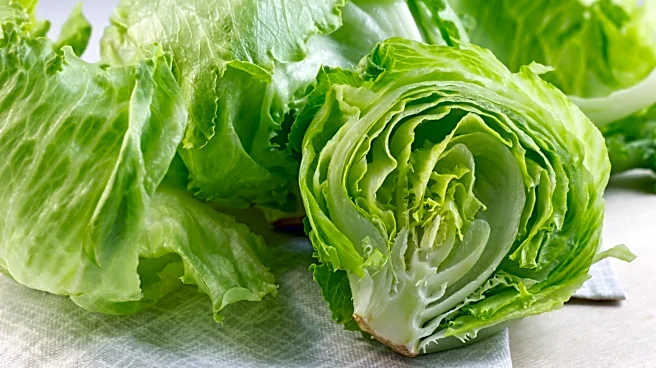
State and local health departments assisted with the federal investigation, providing an analysis of food exposure details from 190 people in Michigan who reported eating at Taco Bell prior to their illnesses. That led to the identification of iceberg lettuce as the likely common source.
The U.S. Food and Drug Administration and the CDC announced on July 17 that traceback investigations had tied cases of the parasitic infection to iceberg lettuce distributed by Taylor Farms de Mexico.
"Ingredient level analyses on meals eaten by these cases indicate that 90% of those interviewed reported eating iceberg lettuce," the FDA's website said. "FDA’s traceback investigation has identified convergence on a single supplier of iceberg lettuce from Mexico used by Taco Bell locations where sick people ate before becoming ill."
The same day, Taylor Farms de Mexico, based in Guanajuato, Mexico, voluntarily pulled iceberg lettucesourced from central Mexico off the U.S. market, the FDA announced.

Since then, the pace of new infections has dwindled, even though the tally of cases continues to grow nationally.
That's because it takes about six weeks for the CDC to receive reports of new cases, and the federal agency says it takes time to ensure those cases are laboratory confirmed and connected to the U.S. outbreak.
As of Sept. 11, the CDC linked 12,883 cases in 21 states to the outbreak using epidemiologic and traceback data. However, the agency noted that it continues to investigate the causes of 9,355 laboratory-confirmed cases to determine whether they were acquired in the U.S. or during travel. There are at least 6,149 additional cases of cyclosporiasis, which include those that are not laboratory confirmed as well as cases pending patient interview and submission.
"CDC is working closely with states to update surveillance data as additional cases are confirmed," the agency reported.
The FDA also is continuing its investigation.
"FDA remains confident that all recalled iceberg lettuce related to this specific cyclospora outbreak is off the market," the agencyposted on its website. "Although the outbreak is over, FDA’s outbreak investigation remains ongoing. FDA will continue to work with federal, state, and international partners to complete its investigation and will provide updates as they become available."
Contact Kristen Shamus: kshamus@freepress.com. Subscribe to the Detroit Free Press.
This article originally appeared on Detroit Free Press: CDC declares cyclospora outbreak over. Michigan hardest hit