






Across a screen split four ways, four different drivers experience the same car crash.
In the first window, a mid-stature female with a body mass index (BMI) of about 20 (considered a “healthy weight” by the Centers for Disease Control and Prevention’s BMI calculator
) who's in a midsize SUV meets a rigid barrier traveling 35 mph. At the point of impact, her hands and wrists collide with the steering wheel.In Window 3, the body of a short female driver with a BMI of about 40 (considered “obese”) collides with the steering wheel. Knees strike the steering column.
Window 4 has a 6-foot-3 man with a BMI of 40. His body crumples around the steering wheel, kneecaps straight into the base of the column. His head makes direct contact with the dashboard.
But in the second window, a body measuring that of a median man a half a century ago ― which, in 1976, was 5 feet 9 inches and 171 pounds ― meets the airbag perfectly, which expands at the exact angle to absorb his weight. His legs are cushioned from the vehicle’s hard surfaces. That height and weight would create a BMI of 25.2, just barely over healthy weight (into the overweight category).
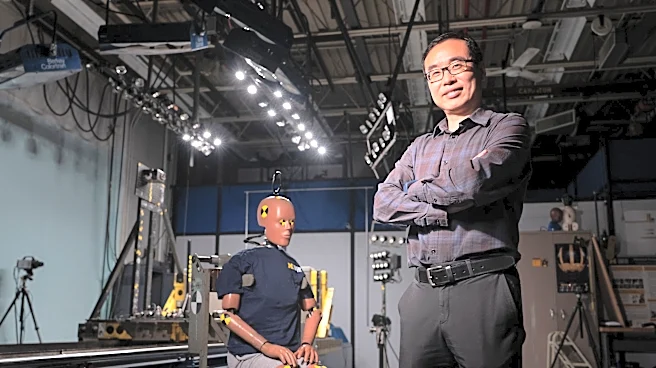
These crash scenarios play out in a PowerPoint presentation created by Dr. Jingwen Hu, a research professor at the University of Michigan Transportation Research Institute and a pioneer of parametric computational human models for vehicle crash testing.
Hu's research aims to draw attention to the ways in which vehicles are less safe for any human smaller, fatter or taller than the Hybrid III crash test dummy that remains the industry standard.
“If you are a customer looking to buy a vehicle and if you happen to be a midsized male, congratulations, that’s probably the most safe person sitting in the vehicle,” Hu told the Detroit Free Press. “But if you are not, likely the injury risk in certain impact conditions will be a little bit higher.”

Vehicles sold with five-star safety ratings ― the metric deployed by the National Highway Traffic Safety Administration to help consumers decide which are the safest vehicles to purchase ― only need to protect an “average-sized adult male” and a “small-sized adult female” in the front seat. Yet the average-sized adult male and female driver is much larger, and heavier, today than when regulators first deployed the dummies.
Attention in recent years to the specific injuries female drivers sustain in the driver’s seat led to the Department of Transportation to accelerate the design of more sophisticated crash test dummies last December in the smallest size. But the use of larger, heavier dummies that more closely align with the modern American population are not required to pass federal safety tests.
Knowing that vehicles today are designed to be safest for one body type, Hu asks: “Do you want to pay the same money for that vehicle? That’s the question, right?”
“Is the vehicle still worth the same money for you? Do you feel that’s fair?”
Why we don't use bigger dummies
Currently, federal standards do not specifically address taller or heavier body types. This is a problem, safety experts say, as the diversity of drivers has expanded at a faster clip than the tools the industry relies on to measure their safety.
The more advanced dummies recently touted by NHTSA aim to address safety issues facing the fifth percentile of women, who measure 4-foot-11 in height and weighs 108 pounds. There’s no movement to incorporate dummies into federal standards that match the majority of modern Americans, which, for women, is about 161 pounds standing at 5-foot-4, and 193 pounds and standing at 5-foot-9 for men.
The weight and height of the current 50th percentile male is about 30 pounds heavier than the federal dummy, Hu said. That’s because the average body mass index, the most common method to calculate a person’s weight relative to height, has changed drastically in the United States since NHTSA began conducting five-star ratings tests in 1993.

Because it is a simple calculation of height and weight, the BMI cannot distinguish fat mass from lean body mass, which includes muscle and bone, nor can it indicate where fat is located in the body, according to the Centers for Disease Control and Prevention website.
Still, through that metric, the CDC projects from August 2021 to August 2023, the most updated data available, 40.3% of U.S. adults age 20 and older were considered obese, including 9.7% with severe obesity and another 31.7% who were overweight. The CDC classifies a BMI between 25 and 30 to be overweight while any BMI over 30 is classified as obese. A BMI over 40 is considered severe obesity.
Obese occupants, according to Hu, face greater risks to lower extremities and their chests in car crashes than those with smaller BMIs because vehicle safety systems, which include the seat belt and airbags, do not restrain larger bodies as successfully as the federal average.
Meanwhile, that same system could restrain smaller occupants more than they can tolerate, also causing chest injuries from seat belts gripping too tightly or airbags expanding too closely to a driver’s face.
What the industry knows that regulators don’t
There’s a disconnect between what is known in universities that conduct crash test evaluations and what is federally required, according to Dr. Cynthia Bir, professor and chair of the biomedical engineering department at Wayne State University.
More evolved dummies like THOR, which stands for test device for human occupant restraint, have not been adopted into the federal test despite wide availability and NHTSA’s own endorsement.
“Automakers have looked at obese individuals, but getting it into actual regulation, and then into a dummy, is very difficult,” she said. “I don’t know why it takes so long for some things to get through. But unfortunately, that seems to be our timeline.”

Historically, data collected from all different types and sizes of cadavers that were used in tests (many of them died of natural causes) would be normalized back to that 50th percentile male, she said.
“Now we're realizing that we really should be looking at all those different body types and incorporating them into our models,” Bir said. “There's been some push for a pregnant dummy. There's been a push for, you know, a 50th female dummy. But all those things take time and money.”
The U.S. auto industry has access to larger dummies ― there’s just little incentive to use them.
Christopher O’Connor, president and CEO of Humanetics Group based in Farmington Hills, said their company produces more advanced dummies for automakers in other countries.

“But the question is, ‘Is it really safe enough?’ The five-star ratings … address one body size, one gender, and say that should work for everybody. It clearly doesn’t work for everybody.”
Industry trade groups like the Alliance for Automotive Innovation have said upgrades to the existing Hybrid III dummy would streamline safer policies than requiring the use of more advanced models.
Yet advocates like O’Connor claim the Hybrid III dummy is woefully out of date compared with the latest THOR models that NHTSA has championed but has not yet required automakers to use. The Hybrid III dummy may cost about $100,000 per model, while more advanced dummies can cost around $1.5 million. That’s because THOR has more than 150 sensors placed in areas more aligned with what is seen in real world car accidents.
“It’s like having a rotary phone. It’s analog, it’s old, it does not meet any modern criteria,” O’Connor said. “We can’t continue to use a test device that was made 40 or 50 years ago when the technology wouldn’t even allow us to detect injuries we now see in 2026.”
About 40,000 Americans die each year in car crashes, though an estimated 36,640 traffic fatalities in 2025 that NHTSA reported in April was, according to the agency, a record low.
Why aren't we using more dummies?
While most stakeholders agree that the crash test dummy programs at the federal level can improve, there is conflict over how, or when, changes should take place.
In the past, the Alliance for Automotive Innovation, a trade group representing General Motors, Volkswagen, and other automakers, has suggested the federal agency moved too quickly to implement more expensive technology or rigorous testing standards.
In September 2025, NHTSA said it would delay changes to its five-star safety rating program at the Alliance’s request after the trade group said the agency failed to give adequate notice that would allow automakers to implement vehicle design changes needed to meet those higher standards which included pedestrian automatic emergency braking.
Earlier that year, in June, the Alliance sent a letter to NHTSA that said more advanced THOR dummies for small female occupants “are still largely in a developmental phase and have not yet been demonstrated to provide clear improvements in crash safety. This is primarily due to limitations in their ability to predict real-world injury risks.”
Rather than “waiting until research on alternative test dummies is complete,” the trade group suggested expanding the use of the current female dummy in different seating positions for federally required tests.
“Safety is a top priority of the auto industry, which is constantly working to improve vehicle crashworthiness to help save lives and prevent injuries on the roads,” the Alliance noted in a statement provided to the Detroit Free Press by spokeswoman Audrey LaForest. “This includes crash testing under multiple scenarios using dummies that represent a range of human body types.”
However, in a 2026 report to Congress, NHTSA urged the swift implementation of the new dummies, insisting that the research on their efficacy had reached a maturation point.
“The Committee understands that developing, testing, and fully vetting an advanced anthropomorphic test dummy is complicated and time consuming. However, NHTSA has been working on such research and development for almost 15 years,” the report said. “The Committee is anxiously awaiting the adoption of the Test Device for Human Occupant Restraint (THOR) 50th percentile test dummy, as well as the eventual adoption of the THOR 5th percentile female and the Worldwide Harmonized Side Impact Dummy (WorldSID) side impact test dummies. In order to adequately address the gender inequities in crash testing data, the updates must ensure equitable frontal crash tests for both male and female drivers.”
NHTSA’s progress on diverse dummy implementation has also been scrutinized by the U.S. Government Accountability Office. A 2023 report noted that the range in body types among American drivers has shifted substantially beyond what is covered by the current models.

“Given that vehicle occupants fall into a wide range of demographic groups, the extent to which the dummies currently used in tests provide information to help improve vehicle safety for all vehicle passengers, including those in various demographic groups, is unclear,” the report said.
“According to NHTSA, vehicle safety has improved over time, in part due to advances in vehicle safety technologies such as airbags. Such safety advances benefit all vehicle occupants. However, according to literature we reviewed and stakeholders we interviewed, certain demographic groups, including females and older individuals, are at greater risk of death and many injury types in vehicle crashes. Less is known about differences in risks for individuals with a higher body mass index (heavier) and children, though those individuals can face some increased injury risks.”
NHTSA is behind on implementing several Congressionally mandated updates, a recent Automotive News investigation found, including the use of the newest dummies. The updated THOR 50th-percentile adult male dummy was initially supposed to have been incorporated into testing in 2019, was pushed back to 2022 or 2023. It was delayed again, with proposed implementation starting in the fourth quarter of 2027.
Now, the current proposal is to start using the more advanced dummy in the New Car Assessment Program (NCAP) evaluations in the fourth quarter of 2029. NCAP is the program through which NHTSA administers its 5‑star safety ratings.
Michael Brooks, executive director at the Center for Auto Safety, told Automotive News that the NCAP program is “on life support,” and that, “Other countries and even private testing groups like (the Insurance Institute for Highway Safety) have been far outpacing (the program) now for well over a decade.”
Meanwhile, the European version of the NCAP tests began using the advanced THOR male test dummies in 2020.
What Hu can do
The emergence of parametric computational human models is allowing experts like Hu to assess injury and fatality risks for a broad range of body types in ways only theoretical before ― or, only exposed after car crashes.
Using AI, Hu’s research gives engineers and designers the ability to examine the same crash thousands of times with hundreds of different body types all at once.
If the same crash can be tested over and over again, concurrently, on models that encompass more of the population, vehicle manufacturers and suppliers could close the safety gaps that separate drivers who receive minor injuries and those who perish behind the wheel.
Yet dummies still require updating, even as skilled researchers perfect artificial intelligence models with more detailed body parameters from real world volunteers, Hu said. Without checking the results of the virtual test with a physical one, there’s no way to gain true confidence in the model’s accuracy.
“It will never happen that virtual testing will be the only way to evaluate the vehicle,” he said. “How accurate is accurate enough for the model is a very challenging and controversial question that we will have to answer in the future. My vision is that the model will be valuable enough to tackle the problems that the dummy cannot, which is the diverse human population.”
Real world consequences
Just because the automaker isn’t using larger dummies doesn’t entirely shut engineers off from how larger occupants fare in car crashes. Many automakers partner with universities to supplement the safety tests performed at proving grounds and inside company laboratories.
Automakers can access data from the Crash Injury Research Engineering Network (CIREN), a government-industry-academia research consortium that learns from real world car accidents.

General Motors is among the automakers that partner with UMTRI to learn from Hu’s data. The automaker also taps sources like the CIREN program for field data, according to Lisa Furton, a vehicle performance owner for occupant protection.
“The age, the size, the seating placement of an individual in the vehicle ― that’s all important to us to understand how our restraint systems are responding out there in the field,” she said. “Even though our crash test dummies are discrete, the field data supplements everything that we’re doing.”
Breakthroughs on the horizon
While there remains a long road ahead, it is worth noting that a lot of progress has already been made to improve vehicle safety.
Jessica Jermakian, senior vice president for vehicle research at the Insurance Institute for Highway Safety, an auto insurance-funded safety organization, noted that consumers should expect incremental changes in the coming years rather than massive leaps.
The industry is steadily improving things like seat belts on its own, Jermakian noted. Volvo Cars last year said it developed the world’s first multi-adaptive safety belt that can adapt to traffic conditions and the person wearing it using real-time data from the car’s sensors.
And adopting a multiadaptive seat belt broadly in the United States is just one example but could meaningfully change crash outcomes for any driver that doesn’t align with the federal standard, Bir said.
“A lot of people don’t wear their seat belts or wear them incorrectly because they’re not comfortable. We don’t really have the ability to adjust our belts ― you may be able to move it up and down a little bit, but that’s it,” she said. “Belt fit is a huge issue that could help with a lot of these problems we’re seeing with the inequalities and understanding how belts should be designed and adjustable.”
Jackie Charniga covers General Motors for the Free Press. Reach her at jcharniga@freepress.com.
This article originally appeared on Detroit Free Press: One-third of Americans are overweight. Why aren’t crash test dummies?