






A Michigan judge’s negligence could have led to a wrongful arrest.
In another instance, a judge pushed a court worker to quit, and multiple judges left cases languishing for years.
Those are just some of the bad deeds committed by the 14 jurists reproved and reprimanded in private in 2025 – their names never formally released to the public − after probes by the state oversight body called the Judicial Tenure Commission, according to a recently published JTC report.
As the Free Press has reported extensively, the commission’s work is largely done behind closed doors and only the cases deemed most problematic are allowed in the public eye. However, the annual report published in June sheds light on the state’s closed-door discipline of 13 judges
and one referee, along with two retired judges. None of the jurists were named in the report.
The details of the problematic conduct are included in the report “primarily for educational purposes,” said Glenn Page, interim executive director and general counsel for the commission, in an email.
“So judges can see the types of behaviors and issues that can get them in trouble,” he said. “Also, so the public can see what types of problems the commission can address.”
The private scoldings were doled out to sitting judges who, for example, handed out more than a year in lockup for contempt and privately reached out to another judge when their adult child was a victim in a case. A retired judge also wound up on the commission’s radar for a drunken driving arrest.
A bench warrant and corrective training
The commission is a constitutionally crafted body composed of five judges, two lawyers and two laypeople. In 2025, it made five misconduct cases publicand continued to handle two public cases from prior years.
Meanwhile, the commission issued private dismissals with explanations to five judges, private cautions to seven judges and private admonishments to two judges.
The admonishments are the most serious form of the private punishments, and Page confirmed that, in 2025, the two judges received them for a series of problems.
One admonished judge’s “lack of attention” cost the court, according to the report. That judge:
- Failed to properly report that someone no longer needed to pay child support “resulting in the improper issuance of a bench warrant.” It is unclear from the report if an arrest was, indeed, made.
- Failed to hold hearings and make decisions in a timely manner.
- Signed conflicting orders.
- Signed orders that, in effect, ordered nothing.
The report makes it unclear which of these next acts were committed by which of the two admonished judges:
- The situation with the court administrator who resigned, in part, because the judge treated them so poorly.
- Making derogatory comments to an employee and engaging “in inappropriate and disrespectful conduct around court staff” multiple times. The commission ordered the judge in that matter to complete training on respecting others in the workplace within 60 days.
- Failing to follow the law on contempt, committing multiple procedural misdeeds, misrepresenting the law and not allowing someone to explain themselves while repeatedly interrupting them.
- Campaign violations related to their role with their own campaign committee and directing payments for advertising.
Court cases left to languish
Nearly half of the 14 unnamed judges took too long with their work.
Aside from the judge admonished for their delay, one took nearly four years to rule on a bench trial. That same judge also let a motion to suppress linger for two years.
Then there was a judge who failed to terminate parental rights as required by court rules, waiting three-and-a-half years to make a final ruling. Attempts to reunite the parent and child were seemingly behind the delay, based on the description in the report.
Two judges reported that limited resources held them up, according to the report.
Judge infamously sentenced man to 558 days for contempt
At least one judge is identifiable in the annual update because the reported misdeed matches previous media coverage.
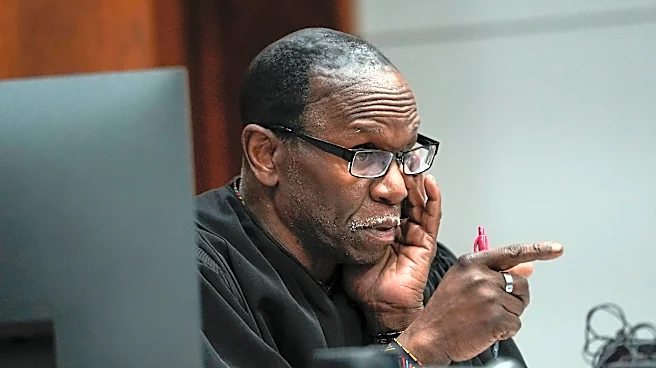
Washtenaw County’s 14A-1 District Court Judge J. Cedric Simpson most recently was in the news for his commentary during the sentencing for ex-Michigan football coach Sherrone Moore. That case was tied to Moore’s confrontation with his affair partner and former executive assistant after he was fired.

But in 2024, Simpson went viral on social media when a defendant in his courtroom kept cursing and Simpson repeatedly gave him 93-day stints in jail for contempt. Simpson later lowered the contempt sentences to just one 93-day stint.
The commission issued a caution in 2025, stating in its report that judges aren’t allowed to give more than 93 days for contempt or make the stints consecutive.
“The judge subsequently worked to gain a better understanding of contempt powers and shared those insights with the local bar,” the report stated.
Simpson declined to comment.
Previously, Simpson vigorously defended himself in a public misconduct case tied to the 2013 drunken driving arrest of his intern and raised numerous concerns with the commission along the way.
Ultimately, the Michigan Supreme Court ordered that he be suspended for nine months for interfering in the intern’s case and making misleading statements that their numerous calls and texts were about work.
Judge handled case he defended before taking office
Other judges who got cautions and explanations in 2025 included:
- One judge who presided over a case he’d been a defense lawyer in.
- A judge whose adult daughter was a victim in a criminal case. The judge wrote a letter to the case’s presiding judicial officer to give details to influence the defendant’s bond. It was improper ex-parte communication because the judge didn’t send the letter to the lawyers in the case.
- A judge who held a lawyer in contempt and had them removed from the courtroom. While the judge did appoint another lawyer to handle the case during the hearing, the defendant did not have counsel during allocution. Allocution is generally described as the defendant’s chance to speak and try to lessen their sentence.
Another judge improperly transferred a case while a mother’s objection was in limbo regarding a motion suspending her parenting time.
A referee also used wording that could have created the impression that they were using someone’s religion against them.
Retired Michigan judges in hot water
The commission generally doesn’t investigate accusations against retired judges, but there were unique circumstances in two cases.
One judge was accused of making unfair and disrespectful allegations against another judge, refusing to aid with cases after their bench mate died, and refusing to schedule any cases on the fifth week of a month.
That judge retired during the commission’s process, but the body plans to reopen the case if the judge ever gets a judicial position again.
Separately, a retired judge was arrested and eventually pleaded guilty to misdemeanor operating while visibly impaired, according to the report.
Retired judges can still serve as visiting judges; this retired judge agreed not to take such positions in the future.
Most accusations against judges dismissed without action
In 2025, the commission wrapped up 556 grievances filed against 180 judges, according to the report.
It determined that the majority – 540 – had accusations that, if true, would not be misconduct, were unfounded or unprovable, or were adequately explained by the judge, the report stated.
Many times, these filings ask the commission to review the merits of a court case, which is outside its authority.
Still, the commission brought more cases into the public eye than in prior years. It also had a significant influx of grievances brought to its attention, if not closed, in 2025 – just under 700. The commission hadn’t breached 550 since 2017.
The increase could be tied to the extra public cases bringing awareness to the commission’s existence and work, the report suggested.
This article originally appeared on Detroit Free Press: Your judge may have been privately disciplined in 2025