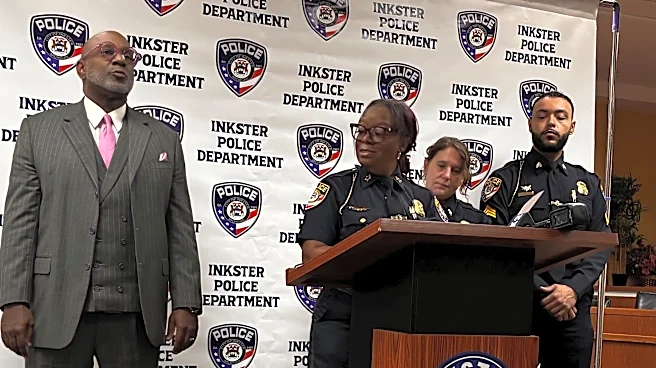









On Tuesday morning, Inkster officials gathered in the City Council chambers to explain that they are all in on Flock camera technology as part of what they call Safe City Inkster.
"This program represents our ongoing commitment to modernizing how we approach public safety by giving our officers and first responders the tools, data and technology they need to do their jobs effectively and safely," Mayor Byron Nolen said.
Twenty four hours later, U.S. Rep. Rashida Tlaib, D-Detroit, gathered a group of local leaders from some neighboring communities at a nearby intersection where a Flock camera is located. She was there to tout a bill she's sponsoring in Congress that would ban the use of such technology.
'We introduced the Get the Flock Out of Our
Communities Act, which would prohibit any federal funds from being used for automated mass surveillance systems," Tlaib said. "The bill would ban federal agencies from using AI powered automatic license plate readers, biometric surveillance systems, and facial recognition technology."
The dichotomy of the two gatherings, in the same city just 2 miles apart, show the starkly different view of Flock cameras.
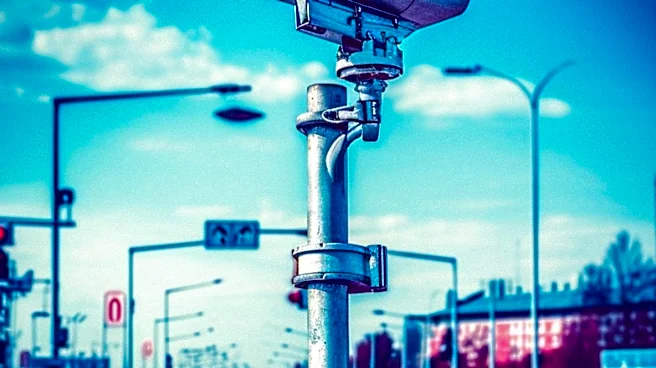
The cameras are formally known as automatic license plate readers or ALPRs. Several companies provide them, though Flock appears to dominate the market. Typically installed near intersections, the cameras photograph passing vehicles and their license plate numbers, log the time, date and location, and store them in a database that police can search when looking for a car involved in a crime, a missing person or other reasons.
Many police insist they help prevent and solve crimes.
Civil libertarians insist they are part of a growing surveillance state that is ripe for abuse.
Residents in communities across metro Detroit and around the country have been pressing their elected leaders to end their contracts with Flock in the name of personal privacy.
In recent months, Clawson, Eastpointe, Ferndale, Independence Township, Lincoln Park, Madison Heights, Milford, South Lyon, St. Clair Shores, Sumpter Township and Westland have either ended their Flock contracts or covered up their cameras while their lawyers look to terminate the contracts.
Lawmakers in Lansing have taken notice, too, and bills pending in the Legislature would regulate the cameras and the data they collect. Even Congress has picked up on the voter concerns. Sen. Josh Hawley, R-Missouri, last month launched an investigation into Flock and its data practices.
In addition to Tlaib's bill, Independent Sen. Bernie Sanders of Vermont, has joined with Sen. Jeff Merkley, D-Oregon, and Rep. Alexandria Ocasio-Cortez, D-NY, and introduced a bill Oct. 2 that would ban federal agencies from using such technology and cutoff funding to state and local governments that use them.
Tlaib's bill would go further, prohibiting completely the use of automated mass surveillance technology, including biometric surveillance systems and facial recognition technology.
'Full suite of tools'
In Inkster, officials have signed a 10-year contract with Flock Safety to pay about $241,000 a year for license plate reading cameras, gunshot detectors and a soon to be launched drone program.
At a news conference Tuesday, Inkster Police Sgt. Montreal Clary described what he termed success stories the department has had since it installed its first Flock cameras in 2023.
He said that in February 2025, a woman was sexually assaulted. In December, a public official was threatened. Last month, there was a shooting at a liquor store.
Flock cameras were used in all of those investigations and led to arrests, Clary said.
Just last week, two people got into a shoot-out in a neighborhood where children were playing. Gunshot detecting microphones, provided by Flock, alerted police who hurried to the location before anyone had called 911, Clary said.
Under the new contract with Flock, Inkster will increase the number of license plate readers from six to 20. It will also have 48 gunshot detection devices, five video security cameras and a drone, which will serve as a first responder.
"With this program, we're deploying a full suite of tools that will work together across the city," said Police Chief Tamika Jenkins.
The drone program is expected to launch later this year and officers in the police station will be able to launch it from a port that will be installed on the roof of a building in town. The drone is equipped with a thermal imaging camera. It can fly in about a 3-mile radius for about 45 minutes at a time. It can fly in rain and snow, though high winds can force it to land.
Flock spokeswoman Courtney Terlecki said it will not be used to patrol, only to respond to calls for service. She used examples of things like a person with a gun, a downed power line or a building fire. It can get to most corners of the city before officers and provide video of the scene to commanders as well as to officers via their phones, she said.

'Those incidents will occur'
Asked about officers using Flock to stalk their ex's and other abuses that have been reported in other communities, Jenkins said that hasn't been a problem in Inkster. She acknowledged that the technology is only as honest as the people using it.
"Those incidents will occur, we can't say that they won't," she said. "You're always going to have people that lack integrity ... or high moral standards. But we have put safeguards in place to deal with those type of things. We would love to be able to catch those things ahead of time, but let's be realistic, we can't always do that. But in the city of Inkster, if someone is found violating, they would no longer be employed with the city of Inkster."
Inkster Mayor Byron Nolen said he's heard the arguments against the technology, but he believes they are unfounded.
"You have no expectation of privacy in the public." said Nolen, a lawyer who specializes in personal injury law. "People talk about privacy. You have privacy in your home. You have privacy in public bathrooms or private bathrooms. Now I'm driving down the street, there's no expectation. You want privacy, you stay home."
'Moment to educate'
Tlaib disagrees.
"Flock cameras and similar technology have already been used to stalk women, track down patients who received abortions, repressed protesters and those exercising the First Amendment right, and wrongfully arresting people in our community," Tlaib said. "Our residents don't want Flock cameras and we're making our voices heard loud and clear. It will take people like us here that tell black to get out of our communities."
Tlaib noted that Inkster recently signed a new Flock contract. Dearborn uses the technology as well. She said Detroit spends about $6.25 million annually on 449 cameras operated by Flock and other providers. Her bill would require cities to remove all of those cameras and delete the data they've collected or lose out on the chance to receive federal grants for law enforcement.
"A lot of my Inkster residents, my Dearborn residents, my Detroit residents, don't know enough about this technology," Tlaib said. "We need to use this moment to educate them to make them understand because right now, they are hearing from their law enforcement, their mayors and others, gaslighting them to make them believe that this is somehow supposed to stop again the shootings and all of the issues."
Tlaib said that money could be better spent on housing, mental health care, clean water and affordable electricity.
Westland City Council President Mike McDermott attended the news conference with Tlaib. He said that he voted to approve a two-year trial of Flock cameras in 2024, but soon came to regret it.
"I made a mistake," McDermott said. "And I think our community made a mistake by signing up for a trial contract for two years with the Flock organization."

McDermott said that residents made their opposition clear and the more he learned about how the data is shared across the country, the more opposed he became. Westland eventually voted to end its contract with Flock.
He said he understands that most people carry cell phones and have social media accounts, which also collect data on users. But Flock is different.
"The difference there is those are not your public roadways paid for with your public tax dollars," McDermott said. "You can have the choice to have a Google account or not. You can have the choice to sign it with Facebook and accept their terms and conditions. You don't have the choice to drive on public roadways that all of our tax dollars collectively pay for."
Contact John Wisely: jwisely@freepress.com. On X: @jwisely
This article originally appeared on Detroit Free Press: Inkster becomes ground zero in Flock camera debate