





If four Detroit cops braced a Black man with his young son on a city street 25 years ago, there's no chance the Detroit City Council would have kept silent.
If an activist accused the police chief of weaponizing officers against citizens, it's unlikely the Board of Police Commissioners would have failed to at least remark upon the allegation.
Nevertheless, for the past three weeks neither of the city's slate of elected officials — whose duties include oversight of Detroit's chief executive and Michigan's largest police force — saw fit to comment on either situation, let alone demand answers.
Other city officials were concerned enough about the allegations of impropriety involving Mayor Mary Sheffield when she was a councilwoman and her interactions
with a former boyfriend and a former friend of his who posted photos of Sheffield and her ex on social media that they turned information over to the FBI, according to a source close to the matter.
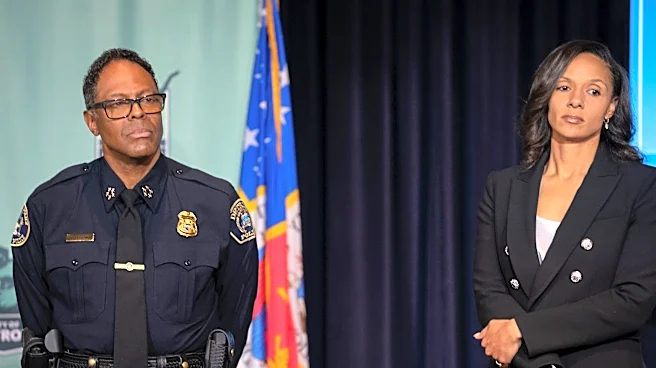
And the city's Office of the Inspector General is investigating Police Chief Todd Bettison's actions, which include visiting the former boyfriend to reportedly ask him about possible criminal conduct and calling the man who posted the photos on social media to take them down.

One former Detroit police chief told me last week that Bettison's decision to get involved in a personal matter is so outrageous that he should lose his job.
Yet, the silence that speaks so loudly about how lightly our elected officials take their role in our system of checks and balances was only broken on Sept. 17, when the Board of Police Commissioners cast a nearly unanimous vote to support Bettison.
You read that right: The board created 52-years ago to provide civilian oversight and investigate possible police misconduct never asked the chief to explain his actions, didn't wait for the Inspector General to complete their investigation, and ignored both the concerns of citizens and former board members who said rushing to give Bettison a vote of confidence looked bad and potentially undermined confidence in the board's ability to fulfill its constitutional duty to act as a watchdog.
Sheesh!
Bettison told Bryce Huffman and Jasmine Snow of Bridge Detroit "I did nothing wrong" after the police commissioners absolved him of sins they never even asked about.
“If the citizens listen to the full conversation (between Bettison and Smith), they’ll have a better appreciation for it. And I look forward to going through the investigative process,” Bettison said at the commission meeting.
I listened to the full conversation. And like a lot of my neighbors — and several former Detroit police chiefs — "appreciation" was not a word that came to mind afterward.
A matter of perspective
Recently departed mayor Mike Duggan — don't worry, he's not dead; he's just a rainmaker at a local law firm now — and I vehemently disagree on his greatest accomplishment during 12 years in city hall.
He thinks it's improving relations between the mayor's office and the city council, which was once derisively called the "Clowncil" for its often, er, spirited discussions. (Like when one council member called another "Shrek.")
I think it's a seven-way tie between reducing police and EMS response times, turning city parks from pits to paradises, demolishing or rehabbing tens of thousands of homes, making municipal government work, leaving a bankrupt city flush with surplus cash, reversing the city's population decline, and devising ways to mitigate the effects of a once-a-century (we hope) pandemic that became a model for every other city on earth.
The downside of our transition from dysfunctional dead-end city to dynamic metropolis is that some of Detroit's elected officials seem to have become complacent "yes" men and women.
Instead of battling the mayor for diminishing dollars, council members demanded that he increase funding for their pet projects. Duggan, freed from some obligations by the bankruptcy settlement and flush with hundreds of millions in federal dollars and rising city revenues, often complied.
Shame may have also been a factor.
Council members may have found it, ahem, uncomfortable to question the conduct of others when, at one point in 2021, four of the nine council members were the subject of FBI investigations. (Two of them, Andre Spivey and Gabe Leland, resigned and pleaded guilty to public corruption charges.)
I started covering Detroit city government 20 years earlier, in 2001, when then-Councilwoman Sheila Cockrel and her colleagues grilled then-Police Chief Benny Napoleon for topics ranging from lethal use of force to keeping track of cops who abused citizens.
Until Duggan took office in 2014, I'm pretty sure the most dangerous professions in America were astronaut, hydroplane pilot and mayor's liaison to city council. And not necessarily in that order.
Council members Kay Everett, Maryann Mahaffey, Brenda Scott, JoAnn Watson and Kwame Kenyatta acted as if one of their most important duties was to challenge the mayor, the chief, department heads and other city officials to explain themselves whenever they got even a whiff something was amiss.
They are all dead now, along with our sense that accountability is a priority for the city council.
“In my era, pulling over a young man with his child; are you kidding me?” Cockrel told me. “That would have started a conversation the very next morning.”
"There's no way this would not have been discussed," she said, adding that "more than one" council member would have brought the matter to the council table.
Not one of our current city council members has said a syllable at the council table about Sheffield rumors or Bettison's conduct.
"Everything is not always done publicly," President James Tate told me, adding that accountability is "not about city council making public statements to appease folks."

Tate acknowledged that the reports about Sheffield and Bettison's alleged conduct are serious matters worthy of investigation, but he said the council's role is "not just for a sideshow."
"At this time, we are allowing the agencies that are currently investigating to conduct their analysis and investigations, and from their findings we will make any necessary statements," he added.
Tate is a former police department spokesman, and served on the council for 12 years with Sheffield — including the last four years as council president pro tem while Sheffield was council president. Including Tate, seven of the nine council members served at least one term with Sheffield on the council.
"It's imperative that we don't allow relationships to get in the way," Tate said, adding that independent city agencies like the Office of the Inspector General can get to the bottom of things without the council appearing "to put the thumb on the scale — either way."
Still, until the Inspector General's investigation became public knowledge Sept. 16, many Detroiters spent weeks wondering whether council members either had their heads in the sand, or stuck in the clouds up on the 13th floor of city hall.
"I think what we're doing right now is appropriate," Tate said. "The revolution is not always televised."
When I told Tate that I saw Gil Scott-Heron perform "The Revolution Will Not Be Televised" many years ago, the council president reminded me that another of Scott-Heron's songs is "We Almost Lost Detroit."
Bored of Police Commissioners
Sometimes someone tells you something you felt was nothing, only to later wonder if they said way more than you thought.
To help unravel that riddle, let me tell you I'm now wondering whether the chairman of the Board of Police Commissioners told me more than I realized after I asked him why the commission had not said anything about Bettison's predicament.
"I have no comment at this time," Robert Jones told me around 1:15 p.m. Thursday, Sept. 18.

Several hours later, the commission voted to express their confidence in the chief, making me wonder if Jones was telegraphing that the board would say something later in the day when he ended his brief comment with "...at this time."
Either way, Detroiters were left for weeks wondering whether commissioners were aware that they have, according to the city's website, a "Charter-mandated supervisory control and oversight of the Detroit Police Department."
Bettison's conduct has been a topic of debate since last month, in the wake of revelations that the chief contacted Marvin Walker on July 11 and Jahdante Smith on Aug. 5. Bettison copped to asking them to take down romantic photos of Walker and Sheffield that were posted on Facebook.
Five former Detroit police chiefs I contacted told me Bettison should not have gotten involved in what they deemed essentially a personal matter between the mayor, an ex-boyfriend and a gadfly who had a beef with both of them. Their opinions ranged from sympathy for the chief to questions about whether Bettison bowed to political pressure, to concerns that his actions would undermine officers' confidence in his leadership, to fears that the department would again get caught up in city hall controversy.
On Tuesday, Sept. 15, former chief James Craig expressed skepticism that Bettison acted on his own. He said Bettison should resign.
Former police commission chairman Willie Bell defended commissioners for keeping their peace when news of Bettison's actions broke.
"You're trying to be patient about the whole public comment thing," Bell told me, adding that it could be some time before the Inspector General and FBI conclude their investigations.
Bell, who spent three decades as a Detroit cop, said he supports Bettison.
Rather than speak up, Bell said he thinks commissioners should hold their tongues until any of the proper authorities looking into the alleged shenanigans gives them something to talk about.
It's hard to argue against keeping your mouth shut when you don't know what you're talking about, but that's what questions are for.
Even if our elected officials' barks are often worse than their bites, they'll have to make at least a little noise to prove that our supposed watchdogs are more than 'fraidy cats.
M.L. Elrick is a Pulitzer Prize- and Emmy Award-winning investigative reporter, director of student investigative reporting program Eye On Michigan, and host of the ML's Soul of Detroit podcast. Contact him at mlelrick@freepress.com or follow him on Facebook at ML Elrick and Instagram at ml_elrick
This article originally appeared on Detroit Free Press: Public silence of Detroit officials speaks volumes during controversy