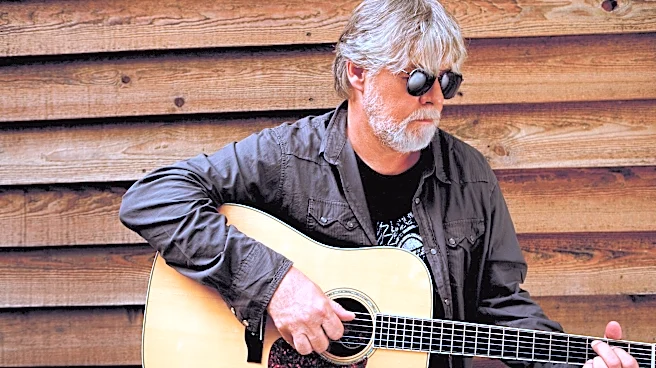

In September 2006, Bob Seger emerged from a decade-long hiatus to win widespread acclaim for an album harking back to his roots.
Now, as “Face the Promise” turns 20, Capitol Records is spotlighting the Michigan rocker's comeback record with multiple vinyl and CD releases, a digital streaming debut and several never-heard bonus tracks. The “Face the Promise” reissue includes an expanded four-disc vinyl edition, along with an Amazon-only colored vinyl version and a CD that includes a Walmart specialty release. The music is also hitting streaming platforms for the first time.
The Detroit Free Press has dipped back into the archives for a pair of stories from the week of the album’s original release. Below is a deep-dive interview with Seger, and
we've also reposted the track-by-track rundown.
∼∼∼∼
Originally published Sept. 10, 2006.
Bob Seger: He's back, upbeat and ready to roll

By Brian McCollum
You knew he'd come around again.
Bob Seger's legacy was too big, too deep, to abandon forever. The passionate fans, especially the loyalists in his native Michigan, were getting too restless and noisy. And Seger himself, you wanted to believe, simply loved music too much to let it go.
He's back.
On Tuesday, Capitol Records will release "Face the Promise," Seger's first album of new material in 11 years. The dozen-song collection, which arrives amid a torrent of promotion and talk of a concert tour, places the 61-year-old star back in the thick of a rock 'n' roll game he'd walked away from to home in on family life.
It's not just a new Seger album, though at this point the diehard fans would have taken whatever they could get. It's a decided return to form for the red-blooded rocker who stumbled through his last recorded effort, 1995's "It's a Mystery," a clinical-sounding disc he now concedes was "trapped in drum-machine hell." The new album is organic, heartfelt, occasionally feisty and more than occasionally rocking.
After two years of on-again-off-again release plans, the rush is firmly on for Seger and his staff. At his rehearsal studio near Clarkston, a souped-up cabin in the middle of the woods, Seger has been logging long hours five days a week, running through new and old songs with an ensemble that includes longtime players from his Silver Bullet Band. Interviews are spilling into interviews. At his management offices in Birmingham, marking e-mail correspondence as "HIGH IMPORTANCE" became redundant about two months ago.
A date on "The Tonight Show with Jay Leno" is lined up for Thursday, and Seger is talking as if a winter tour — the part that fans are really waiting for — is all but booked.
It's a burst of creative energy that had been simmering for several years, getting a kick start with Seger's 2004 induction into the Rock and Roll Hall of Fame. His toddler son and daughter were the reason he'd backed away from the spotlight 10 years ago, after wrapping up one of the biggest tours of his career. Today, at 13 and 11, they're a big part of the reason he's stepping back in: They've pushed harder than anybody, he says, to see Dad be Bob Seger.
Seger, perhaps Michigan's most famous nice guy, knows his fans have been hungry, and he sounds almost apologetic when he recites his now-familiar lines about the time away with his wife, Nita, and family: "I was working on the kids, my wife and I, and I became addicted to that. It was too much fun watching them grow up. I just didn't want to miss that."
Until he re-emerged for the hall of fame hoopla, an oddly charming affair that put Detroit's blue-collar hero into crisp black attire at the Manhattan Waldorf-Astoria, "Where is Bob Seger?" had become a perennial question around his home state. Decades into a career that had launched at Detroit sock hops in the 1960s, Seger's most devoted followers began to puzzle. Their occasional glimpses of him — at Detroit Pistons games, on his sailboat Up North — didn't include concert stages or the new record racks.
Seger, though, never quit making music. At home in West Bloomfield and at the cabin studio, he wrote, and wrote, building a stockpile dozens of songs deep. He recorded as he went; when Seger and his advisers sat down this summer to select tracks for the new album, they had more than 40 to choose from.
The new album is named for the oldest song on it: "Face the Promise" was written several years ago, inspired by the artist he has long described as his biggest lyrical influence.
"I always loved the album by Leonard Cohen — I think I've got five copies of it — called ‘The Future.' When I bought that album, I just looked at it and thought, ‘Wow, what a cool title for a record,'" Seger says. "I guess when you have kids, you think about the future a lot. You think about their future. And so ‘Face the Promise' became that idea — facing the promise of the promised land."

To Seger, it was a simple but gripping concept, and for a songwriter who has adhered to the adage "write what you know," it was an appropriately pure theme for the moment. He plunged ahead with "Face the Promise" as a conscious design, sketching songs that served the motif.
"But after a while, it became too restricting," he says. "Initially, it was going to be a thematic album, and you can hear ‘Are You' in that theme, ‘Between,' ‘Face the Promise' in that theme. But it became a little limiting. So I said, ‘Just write songs, and try to make 'em good.' "
The result is an album that vaguely sticks to its initial premise — tackling "commercialism, ecology, politics," as Seger puts it — while making room for friskier cuts such as his duet with fellow Michigan rocker Kid Rock. Their cover of "Real Mean Bottle" was recorded in an afternoon with Rock in the producer's seat, heating up the leathery country feel of Vince Gill's original.
It's the lone cover tune on an album of songs for which Seger proudly claims ownership, including a pair -"No Matter Who You Are" and "Simplicity"- that were written after the record's September release date was set in the spring.
"The songs aren't that much different. You know how I write; they're all right about the same kind of thing," he says. "But I do think over that period, from '97 to now, the writing has gotten just a little better each time."
Eleven years equal several life cycles in popular music, where the pace is brisk, the turnover high, the memory short. Even in today's thriving classic rock 'n' roll world — an era when old hands like Bob Dylan and Johnny Cash can score No. 1 albums — 11 years is long enough that when you come back around, they call it a comeback.
His record company is certainly happy that Tuesday is at hand. At Capitol Records in Los Angeles, label president Andrew Slater says he's thrilled with "Face the Promise"- as a fan and record executive.
He has known Seger for 25 years and led the music-industry effort to get the Detroit rocker into the hall of fame. "This record, to me, is important because when great writers write about the universal, they make it personal, and when they write about the personal, they make it universal," he says. "He's made a long career writing those kinds of records. There are aspects of Hemingway and Steinbeck in his work. Every word seems carefully chosen, yet none of it seems belabored.
"Sonically, the architecture of the sound, it feels like a record that we know, and yet it's not. It's not trying to be anything modern — it's effortlessly cool and timeless. Like your favorite pair of jeans. It's that kind of comfort when you put the record on. And that's a rare thing in today's marketplace, which is why it has so much importance to us."
For his part, Seger is downplaying commercial expectations for the new album. While "Wait for Me," the leadoff single released in July, earned play at adult-contemporary radio and even cracked the country charts, he's not banking on radio programmers to sell the record.
"Who's going to play it? Hah!" he says, laughing. "I don't know who's going to play it. I don't have a clue. Honestly, I'm not expecting it to get play. A classic-rock artist is limited to classic-rock radio — and then classic-rock doesn't want to play new stuff."
But there's an upside to working on the relative fringes of the modern rock world.
"The beauty of it is you don't have to pander to anybody," Seger says. "You just make a record that you like. If you get played, that's wonderful. That's a plus."
Primarily recorded at Nashville's Ocean Way Studios with longtime engineer David Cole, the album found Seger actively trying to avoid a retro feel: "I actually railed against that in a way. I wanted to just go somewhere else. That's the thing about having a lot of time to work. You can explore. You can say, ‘Yeah, that's pretty unusual. I'll use that,' " Seger says.
"That's the thing I loved about this," says Cole, who has worked with Seger since 1978. "This guy has made so many records, but he was still willing to go out on a limb and try stuff, adding parts and sounds. Just to test the waters to see what else was there.
"A lot of times, we'd strip it off and go back to the original, or keep some of it and go down another path. He wasn't afraid to reinvent himself, but at the same time keep true to what he's all about as a songwriter and storyteller."

Still, you can't take the Seger out of Seger, and "Face the Promise" can't help but evoke the traditional Midwestern rock sound he helped popularize, where "big" is the operative word: big backing vocals, big drums, big guitars.
"I think it's just my sensibility of what I like," he says. "You're going to hear the girls because I love the girls. You're going to hear a certain fatback drum sound because I like the drums to be thick. And I like great guitar players. I like a blues-based style on guitar. If I have any signatures, that's probably it."
There is also, of course, his voice — the soaring, husky vocal that became one of rock radio's most familiar features in the 1970s and '80s. At 61, he says, it's not as easy tackling vintage fare such as "Hollywood Nights," "Sunspot Baby" and "Fire Down Below," songs that gave his upper register a workout even in younger days. "Face the Promise" contains a handful of vocal performances in that vein, including album opener "Wreck This Heart," sung in the same key as 1979's "Old Time Rock & Roll."
"There's a sweet spot in my voice that everybody likes. I can almost show you by the songs that they keep playing on the radio," he says. "And if that's where people want to hear me, that's where I've got to sing."
Seger is in visibly high spirits these days. He seems energized because of life's tempo right now, not despite it. And although he speaks humbly about his enduring presence across the country — where he hears his chestnuts on the radio during his frequent leisure road trips — he talks with genuine pride about his stature in the place where Seger is a healthy obsession.
"It's amazing. I'm just very fortunate. I keep knocking wood because radio keeps playing those songs," he says. "I guess it's the strength of those songs, the strength of the performances. Whatever it is. The band, me, I don't know. I've been very, very fortunate that I keep getting heard. And obviously here it's the strongest of all."
Contact Detroit Free Press music writer Brian McCollum: 313-223-4450 or bmccollum@freepress.com.
This article originally appeared on Detroit Free Press: From the 2006 archives: Bob Seger is back, upbeat and ready to roll