





Maybe, you'd expect a journalist to jump on a chance to chat with anyone. Maybe, you'd expect most people to be thrilled by a text that suggests a chat when so many these days feel disconnected from all sorts of social circles.
"Is it convenient for a brief talk now?"
The text just popped up on my phone shortly before 10 a.m. one Friday morning.
I did not respond. Nope. Not when I know a "brief talk" easily leads to a long-winded exchange that could result in a fraudster ultimately finding a way get me to go out and buy them gift cards. Or maybe it will turn into a conversation that enables scammers to engineer a scheme to steal my hard-earned cash out of my bank account.
Frankly, it should never be convenient for anyone to strike up a conversation
with a crook. And there's no doubt in my mind that a scammer was hiding behind the 416 area code for Toronto associated with that text, likely spoofed to appear legitimate.
Watch out, the scammers have a new script.
Opening lines vary. Phrases appear quite harmless when they are not. It might be a text about a chat. Or an innocuous text that asks: "What time are we meeting?" Or another friendly question, such as: "Are we still on for lunch?"
One huge scam script lately starts with a text or email asking: "Can you do me a favor?"
Money lost after a scam text is skyrocketing in 2026
Responding to a scam-related text could end up costing you enough to cover nearly a mortgage payment.
When consumers reported losing money after receiving a scam text message, the average loss reported was $1,960 per incident through the first half of 2026. That's up $508 per incident or 35% compared with the first half of 2025, according to a new report from U.S. PIRG Education Fund's new report called "Ringing in Our Fears 2026." The losses are based on an analysis by U.S. PIRG of Federal Trade Commission data.
Consumers are likely losing more money because scammers use artificial intelligence and personal information about the targeted victim at some point to make these scams even more believable.
The type of fraud also may play a role in the size of the losses, according to the PIRG report released Tuesday, Oct. 20.
Last year, for example, the FTC started seeing significant increases in losses stemming from scammers posing as banks and government agencies, according to the PIRG report.
More consumers complaining about impostors asking for favors
Amy Nofziger, senior director of victim support for the AARP Fraud Watch Network, reports an uptick of consumer complaints involving texts that request favors.
Nofziger told the Detroit Free Press that many recent texts and emails asking for favors involved scammers impersonating church pastors reaching out to the faithful. The ruse could be a mission to come to the aid of someone in the congregation who cannot afford food.
Nofziger expects that "favor" requests could take off around the holidays as the spirit of giving builds in communities.
Someone who is impersonating the boss, for example, might request that you go out and buy gift cards for the staff or an ailing colleague.
It might sound believable, especially if the "boss" claims to be on vacation or working remotely.
The problem: You're going to lose all your money if you buy those gift cards. Your so-called "boss" or "pastor" will ask you to read the codes off the cards — which will give the crooks easy access to the money on those cards.
We've seen a surge in gift card fraud across the country as scams have grown even more sophisticated. State lawmakers, including those in Michigan, have taken action to beef up penalties relating to gift card fraud.
Crooks sound completely convincing
The thing is that crooks know how to sound believable once they start chatting you up. They may already have access to a long list of employee emails or cell phone numbers, making it easier to impersonate someone you know.
Their strategy is to pose as someone that people respond to regularly, such as executive or employee at the company or a leader at a house of worship.
The "Can you do me a favor" emails sent by your boss were hot back in 2020, as well, when scams skyrocketed during the COVID-19 pandemic once many people ended up working remotely.
New hires can be particularly vulnerable now.
If you update your LinkedIn profile with a new employer, for example, the scammers have more information and might reach out with the name of your new boss to request that you buy gift cards for some reason.
One consumer who complained to the Better Business Bureau Scam Tracker in June said their so-called boss claimed to be in a meeting and needed them to handle an "urgent task."
The scammer who impersonated the boss then asked the employee to go to a grocery store and get Xbox gift cards. No money was lost in this case because the employee didn't buy the gift cards.
How do the scammers even know the name of your boss or religious leader?
Con artists might be using an organizational chart that is found online for a school or small business. Or maybe an online directory for those who attend a specific church, mosque or synagogue.
Scammers use technology and the personal information we put online to trick us into handing over our money.
How do con artists get the money off the gift cards?
In some cases, con artists ask you to take photos of the numbers on the back of the gift cards and text them the photos. Maybe, you'll be told the photo is needed so you can be reimbursed for the money you end up spending on the gift cards.
Fraudsters need those numbers to download the value on the gift cards quickly.
Millions of dollars are lost to gift card scams
In 2025, consumers reported about losing$233.4 million to fraud involving payments via gift cards and prepaid cards, according to the Federal Trade Commission Consumer Sentinel Network's data. The network received 35,321 reports involving fraud relating to gift cards and reloadable prepaid cards last year.
In the first six months of 2026, consumers nationwide reported losing $154.1 million to fraudsterswho obtained money via gift cards or reloadable cards, according to FTC data.
Gift card scams aren't the only way to lose money, of course.
Consumers lost far more money to scams last year that involved several other payment methods: Dollars lost via wire transfer, $335 million; payment apps and services, $430.8 million; dollars lost through cryptocurrency, $1.78 billion; and money lost via bank transfer or payment to scammers, $2.28 billion.
Watch out for holiday gift card scams
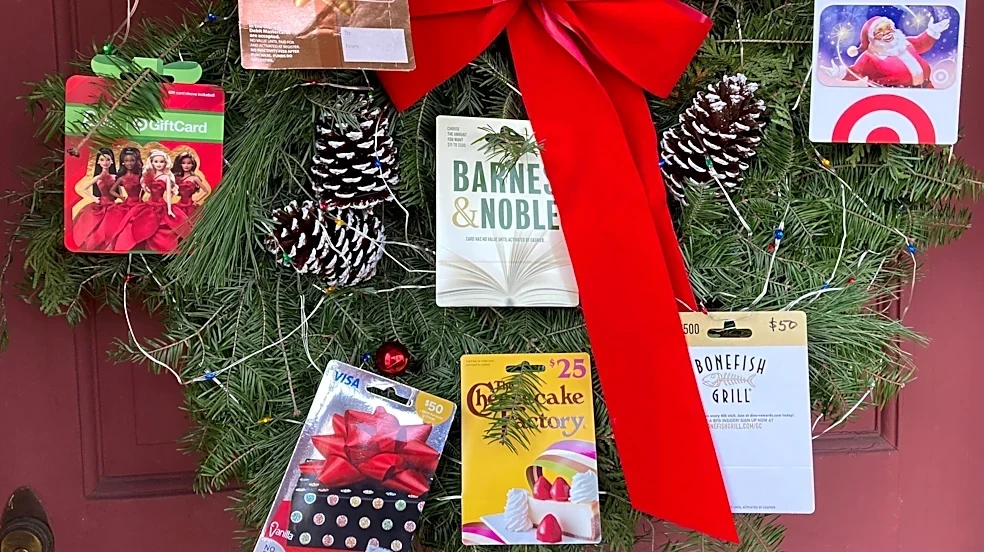
As the holiday season approaches, consumers need to be aware that they've got to watch out for two kinds of gift card scams — the one where crooks get you to buy them gift cards to cover a bill or so called emergency and the one where criminals tamper with gift cards at the store before you buy them.
The risk of scams goes up in November and December as more shoppers buy gift cards as holiday stocking stuffers and easy to grab gifts.
Gift cards ranked as the second-most popular gift during the holiday season in 2025, and total spending on gift cards was expected to reach $29 billion last year, according to a forecast by the National Retail Federation. Clothing or accessories ranked No. 1. The trade group has not released its 2026 forecast as of Oct. 19.

Sophisticated scam rings know how to quickly wipe a gift card clean — and gain access to that cash — shortly after the card is purchased by a shopper and activated.
The complex crime involves several steps that take place before a consumer buys a gift card. Crooks tamper with the gift cards displayed in stores, including copying card numbers and PINs.
Then, they'll pounce after a customer buys and activates the gift card. Once funds are loaded onto the card, criminals quickly use the stolen information to make online purchases, obtain cash, or resell merchandise for profit.
Bad actors are able to use technology to monitor when the compromised cards are bought by shoppers and then activated.
The value of the gift card can end up being drained without the card leaving your hands. In some cases, the money is gone even before you tuck that gift card into a box or greeting card to hand over to a loved one or friend.
I've talked with consumers over the years who were astounded when they went shopping only to see their gift card declined because of a zero balance after crooks mysteriously drained money off the card.
Once you realize there's no money on a card, you can try to reach out to the card issuer or the retailer where you purchased it. But typically, there are no guarantees that you'll get your money back.
Keep records when you buy a gift card. Often, you'd need to show the receipt and the ID number on the card if you need to attempt to recover any money stolen by crooks.
Michigan fights criminals who steal gift cards
This year, a bipartisan effort in the Michigan legislature ultimately led to cracking down on gift card fraud by amending the Organized Retail Crime Act to make gift card fraud a felony.
On Oct. 5, Gov. Gretchen Whitmer signed House Bills 4598 and 4599, sponsored by state Rep. Mike Harris, R-Waterford, and state Rep. Samantha Steckloff, D-Farmington Hills.
We're talking about tougher penalties in cases where bad actors knowingly intend to engage in fraud by:
- Acquiring possession of a gift card or gift card redemption information.
- Altering or tampering with a gift card or gift card redemption information.
- Exploiting a gift card holder, issuer, or seller.
- Obtaining money, goods, services, or any other thing of value with a gift card or gift card redemption information that was wrongly acquired.
The objective is to make it easier to prosecute these criminals. Organized retail crime is a felony punishable by imprisonment for up to five years or a fine of $5,000, or both, in addition to restitution to the victims.
The National Conference of State Legislatures noted earlier this year that lawmakers from 22 states introduced at least 30 bills targeting gift card scams and fraud in 2025.
Best bets for protecting your money: Don't engage with anyone who suggests you need to buy gift cards for any cause. Don't reply to texts that pop up out of the blue. Don't believe anyone who suggests that you can pay your taxes or other bills with gift cards.
And don't just grab a gift card off the shelf when shopping for the holidays — carefully check the packaging.
Another key tip: Only use the website listed on the gift card to check the balance. Unfortunately, like a lot of cases, scammers create fake websites that appear at the top of search engine results. The phony sites are designed to steal your card number, security code, and money loaded on the gift card.
Contact personal finance columnist Susan Tompor: stompor@freepress.com. Follow her on X @tompor.
This article originally appeared on Detroit Free Press: Gift card scams on the rise as crooks text: 'Can you do me a favor?'