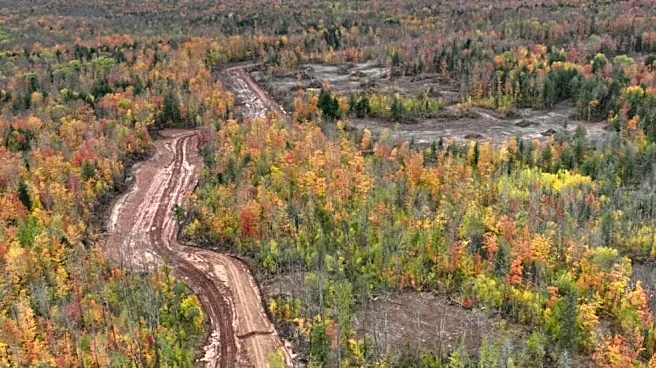





A Canadian mining company's proposed copper mine in the western Upper Peninsula's Gogebic County is nearing all required permitting approvals and recently received a $50 million boost from the Michigan Economic Development Corp. But the Copperwood Mine is proposed less than 2 miles upstream from Lake Superior and in the shadows of Porcupine Mountains Wilderness State Park, leading some to question whether the potential environmental cost to treasured natural resources is worth the economic stimulus.

Canadian-based Highland Copper started site preparation for the Copperwood Project in 2023 through its U.S. subsidiary, Copperwood Resources Inc. The project proposes a "room and pillar" method of mining, an underground extraction technique where
a horizontal network of "rooms" is carved out to remove in this case copper ore, while solid columns or "pillars" of untouched material are left behind to support the weight of the roof. The mine expects to extract up to 6,600 metric tons per day of ore, with "payable copper" − the specific percentage of copper in a mined ore or concentrate for which a smelter or buyer actually pays the mining company, after accounting for processing losses − at nearly 31,000 U.S. tons per year.
The company estimates a nearly 11-year lifespan for the mine with potential to extend its life into other nearby suspected copper ore deposits. Highland Copper officials, in an emailed statement to the Free Press, said the project "will create approximately 700 direct and indirect jobs."
Ironwood Township Supervisor Jay Kangas, whose township would co-host the mine, welcomes it.
"It sure would be a pleasure to see this open because the economic conditions in the area now are pretty down; jobs are few and far between here," he said.
The area has a long history with mining, Kangas said, noting both his father and father-in-law worked in nearby copper mines.
"Everybody should share those concerns [about potential environmental impacts]," he said. "But Michigan has very strict rules as far as environmental protection goes. The economic development can work hand-in-hand with the environmental protections through EGLE," the Michigan Department of Environment, Great Lakes and Energy.
But some in the community, including local tribes and environmental groups, see the potential for irreparable environmental damage to some of Michigan's most highly valued natural features.
"There is no need for a copper sulfide waste mine in a water-rich, beloved outdoor recreation area. It just doesn't make any sense," said Tom Grotewohl, executive director of Protect the Porkies, a nonprofit seeking to protect nearby Porcupine Mountains Wilderness State Park and surrounding beloved natural areas from impacts of the mine.

$50 million grant for mining project called into question
The Michigan Strategic Fund Board, the primary decision-making and funding body for the Michigan Economic Development Corp., on Aug. 25 approved a Strategic Site Readiness Program grant of just under $45 million for the Copperwood project, with another just over $5 million grant to the Gogebic County Road Commission for mine-assisting road and infrastructure projects.
The funding was praised by the region's Republican state lawmakers.
"This investment is a critical step toward the prosperous future our residents deserve," said state Rep. Dave Prestin, R-Cedar River. "We refuse to be left in the dust by nonresidents and their political ideologies. I am proud that we are bringing this investment home for the western Upper Peninsula."
But the Michigan Legislature declined to subsidize the mine project with public funds in 2024 and 2025. The Strategic Fund Board in August used a workaround to get Copperwood the money: repurposing Strategic Outreach and Attraction Reserve (SOAR) fund money already approved by the Legislature in 2022 for another unspecified company but never used. The vote on the nearly $45 million to Copperwood was 7-2, with members of Gov. Gretchen Whitmer's cabinet helping push through the grant. They are:
- Quentin Messer Jr., CEO of the Michigan Economic Development Corp.
- Susan Corbin, director of the Michigan Department of Labor & Economic Opportunity.
- Michael Kapp, economic development administrator for the Michigan Department of Transportation.
- Lance Wilkinson, chief deputy state treasurer.
That didn't sit well with some of Whitmer's fellow Democrats in Lansing. State Sen. Jeff Irwin, D-Ann Arbor, in a September 2025 Facebook post called the proposed money to Copperwood "corporate welfare at its worst." In an Aug. 26 Facebook post after the MEDC approval, he criticized the Whitmer administration's involvement.
"It looks like the Governor's team took money that was designated for a microchip manufacturing facility and are trying to repurpose those dollars to support a mine," Irwin said.
"They did this because this project didn't have support in our legislature, but they wanted to do it anyway. So, the way they did this was wrong and possibly illegal. It is also simply a bad project for public funds. That's why the project couldn't get support through the normal process. Legislators like me, who are reluctant to give taxpayer money to private businesses, want to see a real and obvious benefit to the public for projects like this."
Whitmer has not commented publicly on the Copperwood project. Said Messer at the time of the grant approval, "The Copperwood Mine will create at least 380 long-term, high-wage jobs in a community that is eager to welcome them, and in doing so, it helps fortify an entire region's tax base."
Grotewohl called the grant to Copperwood "profoundly uncreative."
"Why is it that the only time $50 million comes to the western U.P. it's to help a foreign mining company?" he said. "There's so much you could do with that money; they could parcel it up into small business startup loans of $1 million each, or $500,000. They could totally revolutionize the economy out here in a way that invites people to move in, to start families, to retire, and to stay here for longer than 10.7 years," referencing the expected life of the Copperwood mine.
"But that's not what they are doing because the folks with the money have the connections, and they have the megaphone."
Protect the Porkies is challenging the SOAR grant to Copperwood in Ingham County Circuit Court.
"This sets a very dangerous precedent for future handouts of public money to foreign corporations without oversight from lawmakers, and it needs to be challenged," Grotewohl said.
Mining wastes stored on-site for years to come
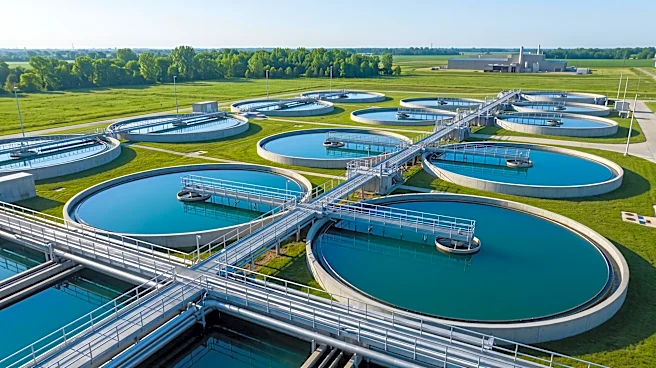
The main site for the mine's proposed wastewater and stormwater discharge — up to 504,000 gallons per day — is the west branch of Namebinag Creek, which flows directly into Lake Superior. That has attracted the attention of environmentalists because downstream from the creek in its main branch are populations of redside dace, a state-designated endangered species. Multiple segments of Gipsy Creek are also located on the site of the proposed 320-acre tailings (mining waste) disposal facility, as well as other tributaries, with the Presque Isle River and its scenic area adjacent to the mine's surface operations.
"It would be the closest metallic sulfide waste facility to Lake Superior on record that we know of — we've tried to search for a closer one," Grotewohl said.
"It would be less than 2 miles from Lake Superior, and all of that topography slopes downwards toward the lake."
Highland Copper officials said any collected water would be reused in ore processing "or treated to the stringent water quality standards approved by EGLE."
"Before discharge, the treated water will be conditioned so it can be readily assimilated into nearby streams and creeks. Through the Copperwood permitting process with EGLE, the project completed extensive analysis of the redside dace population and other flora and fauna species and is confident that there will be no impact."
The mine plans to dispose of tailings in facilities on-site in three stages during operation, with up to 29.12 million dry tons of tailings ultimately planned for on-site storage. Copperwood's tailings disposal facility also plans for a capacity to hold water from the tailings slurry, underground workings and precipitation which will be reclaimed and reused as much as possible to support the mill's operations, said EGLE spokesman Scott Dean.
"Prior to construction, the permittee must submit detailed engineering plans to be reviewed and approved by EGLE," Dean said. "A contingency plan is required under the mining permit that includes an assessment of risk to the environment and public health and safety associated with potential accidents or failures, including natural events like flooding." Those contingency plans must be updated as needed during the company's annual reporting requirements while operating, Dean added.
Charles Brumleve is a U.P. resident with a master's degree in geological engineering from Michigan Technological University in Houghton. He worked in underground mining in multiple U.S. states as well as in Africa, and for a number of years worked in the Keweenaw Bay Indian Community's Department of Natural Resources, providing technical support to the tribe's opposition to the Copperwood project.
"The tribe's big concern with this one, just like the Eagle Mine, is that they regard water as Mother Earth's lifeblood, so they are very concerned with pollution to water and particularly water that's going to the big lake, Lake Superior," he said.
Brumleve questioned Copperwood's massive tailings storage proposal.
"These [copper ore] deposits are only a percent or two, or even less, of the rock," he said. "So you have 98% of the rock that you still have to do something with, and what the Copperwood mine is proposing to do with their tailings is simply not acceptable."
Brumleve believes the mine should redeposit the tailings in the open, underground spaces it will create with its room-and-pillar mining. That will help prevent subsidence, the sagging of surface layers often over years, that can lead to cracks and pollute aquifers.
"There are ways of doing the backfilling, but that's more expensive than the way they want to do it, creating a giant tailings pile," he said.
Near-pristine natural views may be affected by mine
Portions of the mining operation are near the western border of Porcupine Mountains Wilderness State Park. The Copperwood tailings waste storage facility would be visible from nearby Copper Peak and the famous Lake of the Clouds Overlook within the state park, Grotewohl said. A segment of the North Country Trail will be within 500 feet of the mine, he said.
"The viewshed is maybe more trivial compared to impacts to the water and the land, but it is important to how people perceive their experience when they are coming to be in pristine nature," Grotewohl said.
EGLE is currently considering Copperwood's National Pollution Discharge Elimination System permit, which will set the terms of how the mine can release wastewater into streams and rivers and what levels of contaminants will be allowable to protect public health and the environment.
"We are working through a lot of public comments, because there have been a lot of them," EGLE Director Phil Roos said. "We are trying to make sure those are addressed to inform the decision.
"I can tell you that we will make sure that the highest standards possible are there and anything that comes from the mine will be handled in a way that does not affect the Porcupine" Mountains Wilderness State Park.
Contact Keith Matheny: kmatheny@freepress.com.
This article originally appeared on Detroit Free Press: Copperwood mine plan proceeds near Lake Superior, Porcupine Mountains