





Ford Motor Co. CEO Jim Farley has a lot on his mind as the company prepares for an unprecedented launch of an all-new vehicle in a few months that he admits is a "risk," he expects Ford to take a hit to its third-quarter sales due to a supplier issue disrupting F-150 pickup production and the auto industry awaits what Farley believes is a critical need to win a bilateral trade agreement with Canada and Mexico.
On top of all that, "October's our largest month of production, so literally every morning, I call (COO) Kumar (Galhotra), and Bryce (Currie, chief manufacturing officer) and I go, 'How did we do yesterday?' And so far, so good."
In fact, there is a lot of good happening at Ford this year despite the challenges. Farley described Ford as
being in "expansive mode," hiring white collar workers.
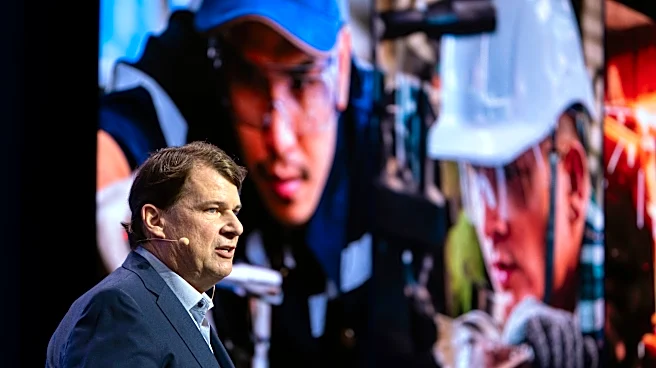
"We're in huge expansive mode," Farley said on the sidelines of the Ford Accelerate conference at Michigan Central Station in Detroit on Sept. 30. It is Farley's second year hosting Accelerate, a conference that gathers business and community leaders together to find solutions to the shortage of skilled trades workers in the U.S.
"We have Ford Energy, a whole diversified business and all the adjacencies," Farley told a small group of reporters. "Our parts business is huge year this year, thanks to wholesale. We're now doing fleet management to compete with Enterprise of the world. Our integrated services software business is up, like, 30% this year. And our vehicles are solid without a lot of new lineup. We actually got rid of Escape, and our revenues are staying really solid."
The comment comes just days after crosstown rival Stellantis confirmed its white-collar hiring is on pause at its North American headquarters in Auburn Hills as that automaker looks to save money. Earlier this year Stellantis went on an ambitious hiring spree, bringing on at least 2,000 new engineers. Similarly, automaker Volvo Cars imposed a global hiring freeze for white-collar jobs and said it was reducing outside spending, according to Automotive News.

But Farley said Ford is in a "big investment mode" that includes retooling some plants such as Louisville Assembly Plant in Kentucky, where Ford had made the Escape and Lincoln Corsair small SUVs. Ford ended production of those cars to retool that plant to build the new Fathom all-electric midsize pickup which starts at about $29,000 when it launches in 2027.
Ford also is starting production at Blue Oval Michigan in Marshall to build EV batteries and residential battery storage systems for new company subsidiary Ford Energy. Ford intends to hire some 1,700 people at that facility once it is in full production, expected by year-end.
"I don't know about those companies (referring to Stellantis and Volvo), but for Ford, we're getting ready for another rejuvenation at Ford," Farley said.
'We did take a lot of risk'
But Farley said he does have concerns that keep him up at night. The first being the launch of Fathom on an all-new platform that will use a new assembly process in which the vehicle is built in three parts and then it all comes together for final assembly at the end. It's revolutionary, and risky.
"This is a breakthrough product," Farley said. "We've never built a vehicle in three pieces. We've never had two large unicasting. Everything from flat wiring, everything about this vehicle, is new. We're in the middle of it right now. We're doing all the testing. We have prototypes on the road, and Louisville is getting converted as we speak."

Farley said Ford has started trial production and has built the first prototype of the Fathom on the assembly line.
"We're doing all of the electric architecture testing on public roads now," Farley said. "So we're in the heart and soul of this, and we're really finding, that we did take a lot of risk. We got to make sure that the testing with suppliers, especially, is done robustly."
He said the progress is going "according to plan, but I'm sure we're gonna have surprises along the way."
F-150 and aluminum update
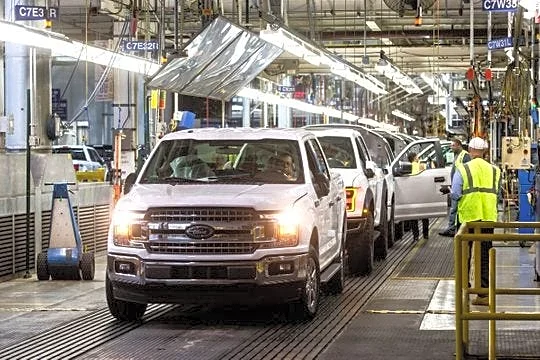
Another headache has been making sure Ford can keep production humming along on its best-selling and profit-making F-150 pickup built at Dearborn Truck Plant and Kansas City Assembly Plant in Claycomo, Missouri. On Sept. 24 Ford halted all production at Dearborn Truck Plant due to a supplier issue and some plant repairs. It restarted production on Sept. 29. The truck's production at Kansas City has been spotty all month, being canceled some 15 times since Sept. 1.
Ford has struggled since late last year with keeping its F-150 production going to meet demand after two fires at its key aluminum supplier, Novelis, created a shortage. Ford uses aluminum in the bodies of many of its vehicles, including its top-selling F-150 pickup. But Ford leaders have assured the market that the company was on course to make up the lost production by year-end.
Farley said on Sept. 30 that Ford F-150 production is "back up and running" and the "supplier issue, we have ways to address it."

But he added, "It is impacting our third quarter wholesale, but I'm very optimistic." That's because Ford's supply chain team solved "the problem with that supplier" and "built some resilience around" it to protect future production.
When asked if Ford has recovered from the Novelis fires, Farley said yes.
"We're fully recovered," Farley said. "We made our way through with other people's aluminum, and the mill came up in upstate New York. We've tested all of the aluminum. We got it all certified. We've been building for about four weeks with all the new aluminum coming out in November."
'50-50 chance' of a new USMCA
Another open-ended issue Farley and the industry face is a renegotiated United States-Mexico-Canada Agreement. President Donald Trump signed the original USMCA agreement in 2020 during his first term and it was up for review this year, but instead of that happening, the government decided there will be an annual review process that keeps the agreement in force through July 1, 2036.
The agreement has helped to mitigate some of the 25% tariffs Trump put in place for imported cars and auto parts. But Ford was hit with a $2 billion bill for tariffs in 2025. Ford expects tariffs to cost it another $2 billion this year. General Motors paid $3 billion and expects a similar bill in 2026.
When asked if he thinks USMCA will get updated or not, Farley said, "Let's say it's 50-50 chance. The bilateral agreements with Mexico and Canada are really important because they'll serve as the foundation for whatever happens in USMCA. We have a great relationship with D.C., both lawmakers and the executive branch and we're really hopeful that they find a deal with Mexico and Canada as soon as possible. That will be a great bridge to USMCA."
If there is no new USMCA agreement, Farley said the bilateral agreements will be a "kind of auto tariff regime for a whole region," which matters because of the integrated supply chain and manufacturing system that runs through the North American market.
"Everything crosses the border, especially here, between Windsor and Detroit," Farley said. "So you know, this has to work. We have to find a solution to this. I'm very optimistic that everyone knows how important this is."
Jamie L. LaReau is the senior autos writer at USA TODAY Co. who covers Ford Motor Co. for the Detroit Free Press. Contact Jamie at jlareau@freepress.com. Follow her on Twitter @jlareauan. To sign up for our autos newsletter. Become a subscriber.
This article originally appeared on Detroit Free Press: Jim Farley says Ford is expanding as others press pause on new hires