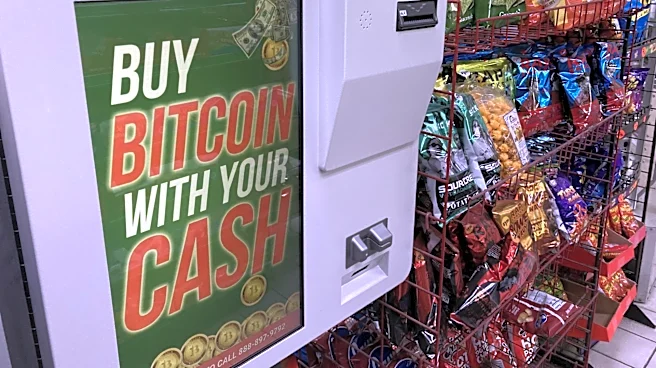






Michigan has a shot at taking on scammers right there in the party store, the grocery, hookah shop, gas station, restaurant lobby and more by cracking down on cryptocurrency kiosks.
And as someone who has been tracking these scams for years, I'd say Michigan cannot act soon enough to kick these nefarious ATMs to the curb. At the least, Michigan must start regulating bitcoin ATMs to require that these machines post signs warning about fraud and be registered to make sure we know exactly how many are in a community.
Unlike a traditional ATM, cryptocurrency ATMs lack oversight and regulation in now a limited number of states, including Michigan.
That includes Detroit and other cities in the state.
Picture someone, maybe your mom or aunt, standing in a liquor
store feeding one $50 or $100 bill after another into a bitcoin ATM. Dollar after dollar gone, never to be seen again. In one troubling scamthat I reported last year, a then 51-year-old metro Detroit woman pulled out two envelopes stuffed with $17,500 from her purse and put all of that cash into a bitcoin ATM over what she estimated turned out to be roughly 30 minutes or more.
Up until a few years ago, cryptocurrency kiosks went largely unregulated throughout the country.
But we're seeing more backlash and demand for change, as more victims of fraud lose money. In 2024, the Federal Trade Commission dubbed these ATMs as a "payment portal for scammers."
In 2026, bills were introduced in the Michigan House and Senate that would crack down on cryptocurrency kiosks in some fashion to address the uptick in fraud.
In absence of state regulation, a few individual communities in the state have adopted city ordinances to attempt to make these ATMs less attractive for criminals engaged in fraud.
Detroit council member eyes regulation for bitcoin ATMs
Detroit City Councilman Scott Benson told the Detroit Free Press that he's working with the city's law department to draft an ordinance to regulate bitcoin ATMs.
Benson told me that he doesn't plan to call for banning cryptocurrency kiosks from Detroit, but he definitely wants to put regulations in place, such as requiring registering these ATMs with the city clerk and mandating that warning signs be places on kiosks to alert consumers about scams.
The objective, he said, is to protect Detroit residents and to know where the cryptocurrency machines are located.
It's possible, he said, that the proposed ordinance could include requiring a dollar limit on how much money could be deposited into a cryptocurrency kiosk each day as a way to prevent consumers from losing a large chunk of their life savings at once.
Benson acknowledged that it's unlikely that a proposal could be approved by year's end, but he expects that such measures could be addressed in 2027.
The Detroit City Council member indicated that the city's law enforcement officials and legal staff agree that such kiosks are abused by criminals behind scams, and the lack of regulation is a serious issue.
"We're working on it," Benson said.
He said he does not know how many cryptocurrency kiosks are in Detroit, as these ATMs are not required to be registered.
"Who has these machines? Maybe we should know that," Benson said.
Ironically, Benson said, he's only seen one of these kiosks — in Harper Woods at a gas station.
Searching online you will spot several cryptocurrency kiosks in Detroit in gas stations and liquor stores on Joy Road, Jefferson Avenue, East Seven Mile Road, Schaefer Road, Grand River Avenue, Greenfield Road and more.
One crypto kiosk is located at a liquor store on Mack Avenue in Detroit. That spot is just a few miles away from Grosse Pointe Farms, which became the first community in Michigan to roll out restrictions on digital-asset ATMs in the summer of 2025.
Detroit residents could be targeted more by scammers as other communities adopt restrictions. And, of course, scammers can always direct suburban targets to kiosks in Detroit.
"We don't want to become the easy path of least resistance," Benson said. "Let's make sure that everybody's protected. They will just go right across Mack to Detroit from the Farms."
What exactly is a bitcoin ATM?
Most consumers walk by what appears to be just another ATM as they grab a bag of chips and a six-pack at the gas station or convenience store. Unfortunately, con artists treat bitcoin ATMs or cryptocurrency kiosks as a tool for easily snatching tens of thousands of dollars at once from their victims as part of a romance scam or other scheme.
Odd as it sounds, it works.
The losses to these practically invisible kiosks are staggering. According to FBI data, 368 Michigan consumers reported losing more than $11.9 million to cryptocurrency kiosks in 2025. Many of those reported losses are due to scams, but some complaints about transactions may be for other reasons, the FBI notes.
Nationally, in 2025, consumers reported losing more than $388 million through cryptocurrency kiosks, according to reports made to the FBI's Internet Crime Complaint Center. The IC3 center received more than 13,400 complaints reporting the use of cryptocurrency kiosks last year.
Complaints were up 23% year-over-year in 2025; dollar losses reported rose 58%.
More than half of the complaints involved individuals over age 50, with losses totaling more than $302 million, according to FBI data. One can go to www.ic3.gov to report fraud, including online extortion.

In its 2024 report, the Federal Trade Commission noted that scam victims reported a median loss of $10,000 during the first six months of 2024 when bitcoin ATMs were used to send cash to con artists. The vast majority of frauds are not reported.
"Scammers claim that depositing cash into these machines will protect your money or fix the fake problem they’ve concocted. They’ve even called BTMs 'safety lockers,' " according to the FTC report.
Most people couldn't tell you where to find a crypto kiosk. But scammers give victims directions.
The fraudsters send their victims to the bank first to withdraw cash. Then, they tell them where to find the nearest crypto kiosk. They make sure you stay connected on the phone and then talk victims through the process involved with depositing dollar after dollar into a bitcoin ATM.
One bitcoin is notoriously expensive, trading at more than $86,000 as of Oct. 6. But scam victims aren't being asked to buy one bitcoin. Instead, they're able to use bitcoin ATMs to buy a fraction of a bitcoin.
Scammers apply psychological pressure to manipulate someone into thinking that they must act quickly to resolve a crisis, such as avoiding arrest, dealing with a hacked bank account or coming to the aid of someone who is in trouble, such as a grandchild in jail.
Michigan is vulnerable, as dozens of states crack down on crypto ATMs
As of mid-September, 35 states across the country have taken some sort of action to regulate cryptocurrency kiosks to protect both young and older consumers, according to AARP’s policy and government affairs experts. The AARP has been leading a major push for more than a year for more regulation of crypto ATMs.
"I would hate for Michigan to be one of the last states to take action to protect their residents," Cassie Thierfelder, manager of advocacy for AARP Michigan in Lansing, told the Detroit Free Press.
A real fear, she said, is that Michigan consumers could become even bigger targets, as many other states are now banning or adding regulations to cap the dollars that could be lost to scams through cryptocurrency kiosks.
"Michiganders are sitting ducks for these scammers," Thierfelder said. "We're completely exposed."
Thierfelder remains hopeful that action will take place at the state level soon, given some bipartisan interest.
Realistically, it's unlikely that we'd see any action in 2026 due to the intense level of political gridlock in Lansing. Yet some remain optimistic that tougher regulations could be enacted in 2027 with a new Legislature.
Since these cryptocurrency ATMs are not licensed, the Michigan Department of Insurance and Financial Services does not maintain a list of their locations, said Chelsea Lewis, director of communications for DIFS.
The online site called Coin ATM Radar put the number of bitcoin ATMs and tellers at 967 in Michigan as of Oct. 1, including about 625 in metro Detroit.
"We see them in every corner of the state," AARP's Thierfelder said. "We've been able to find them in nearly every community that we've looked in. Even the smallest communities in Michigan usually have one located in a convenience store, gas station or pharmacy."
Not surprisingly, cryptocurrency kiosk operators do not want to see a ban on these machines.
"Banning crypto kiosks won't stop fraud," Amy Patti, senior director of communications for Chicago-based CoinFlip, told the Detroit Free Press.
Instead, she said, CoinFlip wants to work with lawmakers on a statewide standard that would regulate cryptocurrency kiosks and hold the industry to the same requirements as other money transmission services.
Patti noted that what she called a "patchwork of local ordinances" creates confusion for Michigan consumers and operators alike.
CoinFlip has 89 kiosks in Michigan, including four in Detroit; the locations are listed on CoinATMRadar.com.
What's happening elsewhere with crypto kiosks
This year, five states launched full bans on cryptocurrency kiosks — Hawaii, Indiana, Minnesota, Tennessee and Vermont. Hawaii is the latest state to ban crypto ATMs and other digital asset kiosks beginning Oct. 1.
"This is very much not a red or blue issue," said state Rep. Matt Koleszar. The Plymouth Democrat introduced companion pieces of legislation, House Bills 5986 and 5987, to ban cryptocurrency kiosks and mandate a 90-day suspension of a state lottery sales agent license if the licensee violates the Cryptocurrency Kiosk Prohibition Act.
"People could lose everything they have," Koleszar said, calling the kiosks "inherently predatory."
"There's just no good, productive reason to have these machines."

He noted that the fees are incredibly high — from 6% to 20% in some cases — even for consumers who use cryptocurrency kiosks to buy bitcoin for legitimate reasons. By contrast, he said, online platforms might have fees that range from 0.1% to 1.5%.
Koleszar dubbed his proposed legislation as consumer protection bills.
Michigan State Sen. Jeff Irwin called the cryptocurrency kiosks a "straight-up scam." The Ann Arbor Democrat told the Detroit Free Press that the kiosks are "overwhelmingly being used in a fraudulent way."
Irwin introduced Senate Bill 980 in May, which would ban the installation and operation of crypto kiosks.
Initially, he didn't see the danger if someone wanted to buy bitcoin at an ATM. But he discovered that the ongoing scams were more of a threat to consumers than he realized.
"We do want people to have their freedom, but there are a lot of bad actors out there," Irwin said.
After doing more research, he said, it became clear to him that a ban is needed to protect consumers from the frequently irreconcilable nature of scams. "The perpetrators and the funds they've absconded with are long gone," Irwin said.
If law enforcement isn't able to recover the money lost, he said, it can make sense to ban these cryptocurrency kiosks.
Changes ahead as Bitcon Depot files for bankruptcy
In May, Bitcoin Depot, a major Bitcoin ATM operator and leading fintech company, initiated a voluntary Chapter 11 process in the U.S. Bankruptcy Court for the Southern District of Texas. The company said the bankruptcy process will involve winding down company’s operations and facilitating the sale of its assets.
Bitcoin Depot blamed the increased regulation in many states for the shift in its business and financial position.
Alex Holmes, CEO of Bitcoin Depot, said in a company press release filed with the Securities and Exchange Commission that Bitcoin Depot had continued to strengthen its procedures to combat fraud and protect customers.
The efforts, he said, included enhanced identity verification, customer fraud warnings and a more recent adoption of lower transaction limits for customers.
“Nevertheless, the regulatory environment for BTM operators has shifted significantly: States have imposed increasingly stringent compliance obligations, including new transaction limits, and in some jurisdictions, outright restrictions or bans on BTM operations," Holmes said.
"Under these circumstances, the company’s current business model is unsustainable," he said in the statement.

Bitcoin Depot — which went public in 2023 and was list on the Nasdaq stock exchange — had more than 140 kiosks in Michigan in September 2022, including at liquor stores and small markets in Detroit, Hamtramck, Hazel Park and Warren.
Bitcoin Depot reported in May that it had kiosks in 47 states and operated at thousands of name-brand retail locations in 31 states through its BDCheckout product. The company said it had the largest market share in North America and operated more than 9,000 kiosk locations globally as of August 2025.
At that time, Bitcoin Depot said it has more than 7,000 ATM locations in the U.S. and Canada.
But the AARP Fraud Watch Network, which hears from consumers across the country, saw an uptick in digital-asset ATM complaints relating to scams in 2024.
After that, AARP began making a major push in the states to move forward state-level legislation to combat fraud involving depositing cash at crypto ATMs.
"AARP supports first and foremost bills that would ban cryptocurrency kiosks," Thierfelder said. "We know that is the best way to protect Michiganders."
Jackson bans crypto ATMs
Right now, Michigan is seeing limited attempts at the local level to require oversight of crypto kiosks.
In late September, the city of Jackson became the first community to initiate an outright ban of cryptocurrency kiosks to protect consumers from scams.

Among other restrictions, retailers and others are prohibited from installing, operating or hosting a virtual currency kiosk anywhere in Jackson. Existing kiosks must shut down within 90 days after the ordinance takes effect around Oct. 22.
The Grosse Pointe Farms ordinance, which went into effect Aug. 4, 2025, set limits on how much money new customers could put into a virtual currency ATM over a 14-day window.
In Grosse Pointe Farms, the limit is up to $1,000 during any 24-hour period and up to $5,000 in all during the 14-day window that someone is deemed to be a new customer.
Sterling Heights and Port Huron took action to regulate these kiosks, too.
Late last year, the city of Sterling Heights disclosed that its police department had investigated or was investigating 23 fraud cases tied to approximately 27 cryptocurrency machines operating within city limits. The losses, according to the city, totaled more than $542,000. Most victims were seniors.
Heartbreaking losses through crypto kiosks
Stories of dollars lost — big and small — are heartbreaking.
Personally, I will never forget meeting a 51-year-old Troy woman who lost $17,500 in 2025 to a scam.
I sat with Stacy Hazinski at her high-top dining room table, and we talked about how the scam simply started out with an annoying text message that claimed she was about to be charged $114.02 for something she didn't buy.
She called the number, supposedly for her Apple Pay account, to make sure that she didn't get stuck with the bill.
But soon she found herself driving across town and later withdrawing money from two branches of her credit union to somehow protect that cash from crooks. She ended up at a Bitcoin Depot ATM that stood near the front register at a party store called BB's of Troy.
She had no idea how to use a Bitcoin ATM or set up an account. The con artist remained on the phone to walk her through the steps.
"He's telling me exactly what to do," Hazinski said.

At one point, the ATM asked her for a QR code. And the con artist told her: "I'll send you the QR code."
In 2022, I wrote about a young woman named Jacquelyn Halushka, who told me how weird it was to be feeding five $100 bills into a bitcoin ATM at a liquor store. The then 27-year-old woman had never bought bitcoin before but was convinced by the scammers that this step was necessary as part of her new job to prove that she lived in the area before any laptop was sent.
In this complex scheme, what turned out to be a fake $6,548 check was overnighted to her home in Oakland Township by Federal Express for her to supposedly buy Apple computer products to work remotely as an administrative assistant for a biopharmaceutical company. Somehow, the bitcoin was to prove where she lived even though a check was already sent.
In Grosse Pointe Farms, council members who supported the proposed ordinance decided that something needed to be done after an elderly Grosse Pointe Farms resident withdrew $20,000 in cash from a Chase branch and then sent that money to scammers via a Bitcoin Depot ATM located in a Buffalo Wild Wings in neighboring St. Clair Shores.
Scammers know too well how to get the targeted victims thrown off course enough that they're willing to rush to the bank to withdraw cash — which will later be sent to scammers through a cryptocurrency kiosk.
Bryan Drake, supervisory special agent with the FBI field office in Detroit, said many victims are women over age 60 who end up withdrawing money from their bank accounts to deposit the cash in Bitcoin ATMs or cryptocurrency kiosks after they've been drawn into some scam.
"What we're trying to do is get the state of Michigan to do something about it, legislatively," Drake said June 15 as part of a "Protect Your Money" program for area consumers held at the Matrix Center on Detroit's east side hosted by Fifth Third Bank.
Preferably, he said, Michigan could follow states, such as Indiana and Tennessee, and ban the cryptocurrency kiosks. He referenced a study by the Iowa attorney general’s office that indicated most transactions at these kiosks involved scams.
"That would help save some citizens money," Drake said.
Older adults who lose a large amount of money through cryptocurrency kiosk fraud have a much harder time recovering financially.
"If you lost your retirement savings, you are in a very difficult position," AARP's Thierfelder said.
The dollars lost are underreported often because the people could experience shame when they are victimized. Others may not realize they've been scammed initially or for quite some time.
If an outright ban throughout Michigan isn't enacted, Thierfelder said, Michigan could protect consumers by at least setting low daily and monthly transaction limits at cryptocurrency kiosks across the state to prevent an individual from losing tens of thousands of dollars or more at once.
A lower transaction limit of around $500 or so, she said, would cap how a victim's losses to fraud at a cryptocurrency kiosk. And a cap would limit someone from losing their entire life savings.
Another concern: Many of the cryptocurrency kiosks are buy-only, meaning you can use cash to buy a cryptocurrency, such as bitcoin, but Thierfelder said, you cannot use that kiosk to turn your crypto into cash and take money out. Some kiosks allow two-way transactions.
Traditional bank ATMs allow you to deposit money and withdraw money. A regular ATM also has daily limits of how much you can withdraw from an ATM, depending on the bank and the type of account.
By contrast, most bitcoin ATMs do not limit daily transaction amounts, so there is no limit to how much you can lose in a day, according to an alert online by Michigan's Department of Licensing and Regulatory Affairs.
"The only real limitation is the individual has to stand in front of that cryptocurrency kiosk and feed each dollar bill into the kiosk," Thierfelder said.
"That obviously takes quite a long time to do."
Even so, scam victims have stayed at these kiosks for hours in some cases, she said, long enough for some convenience store retailers to set up a barstool for an older adult to sit down while putting money into the bitcoin ATM.
Contact personal finance columnist Susan Tompor: stompor@freepress.com. Follow her on X @tompor.
This article originally appeared on Detroit Free Press: Why some say Michigan should ban bitcoin ATMs as victims lose millions