





The Renaissance Center in Detroit came close in its heyday to being an actual "city within a city," but always lacked a key element that was planned, yet never built.
The Bedrock and General Motors' $2.2 billion proposal to redevelop the RenCen plus its nearby east riverfront would finally build that long-missing component from the original 1970s conceptual design: housing.
There are 934 units of housing in the Bedrock and GM redevelopment plan. They would be a mix of market-rate and affordable units, spread across two of the original five RenCen towers and two future residential buildings to be constructed three blocks to the east.

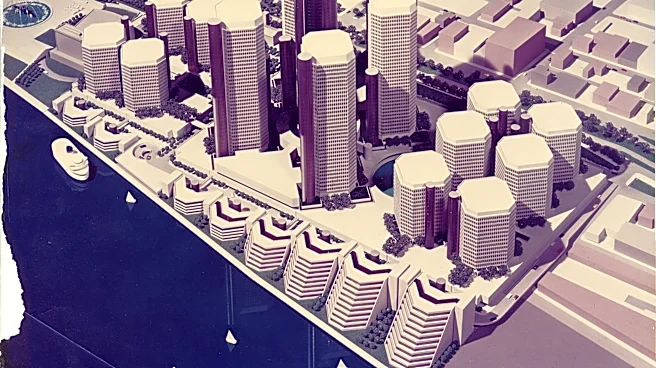
In the Renaissance Center's early plans, the complex's architect, John Portman, envisioned a series of 10 shorter
towers that were to be built on both sides of the five core towers.
While most of those additional towers would have been office space, at least one was to be a hotel. That hotel would have presumably complemented the much bigger 1,300-plus room hotel that actually was built into the RenCen's 73-story central tower.

Also in Portman's plan was a unique multistory housing development that was to sit on the riverfront in front of the entire complex.
Using contemporary marketing language, one could have described Portman's grand vision for the RenCen as live, work, stay, shop and play.
The complex broke ground in 1973 and had its grand opening in April 1977. The multistory podium that connects the towers had as much floor space as a shopping mall, and once contained over 100 stores and restaurants, known as the World of Shops. There also was a movie theater.
“You have many activities as a human being," Portman said in an interview for a WDIV-TV 1973 report, titled "Renaissance Center: A Look At Tomorrow."

"Whether you’re working in an office, living in an apartment, dining in a restaurant, strolling through a landscape mall, sitting in an outdoor space, going to an entertainment complex — all of the activities that one might desire on an around-the-clock basis — this is what we’re trying to do with Renaissance Center in Detroit."
The 1973 TV news report also quoted a manager for the 51-member corporate partnership, led by Ford Motor Co., that built the Renaissance Center. He said their plan for the housing was to have the residences built and ready to market by the time the overall Renaissance Center was completed.
When the RenCen did open four years later, the housing wasn't yet built. But it was still believed to be coming soon.
An early brochure for the Renaissance Center included renderings showing the future housing, which it described as "a unique residential community (that) will restore to Detroit the year-round delight of city life on the river, and do it with quality, excitement and style."

In the end, only two of 10 shorter office towers in Portman's conceptual vision were ever built.
That pair of 21-story towers opened to the east of the original complex in 1981 and are known as Phase II of the Renaissance Center. (It was developed by a partnership of Ford Land and Rockefeller Center Inc. of New York.)
There was still talk in the early 1980s of building luxury housing as the RenCen's Phase III, although news reports described the concept as hold amid the era's extraordinarily high interest rates.
Yet the prospect for any additional phase was dimming rapidly by 1983, when the Renaissance Center's debt and ownership needed to be restructured after the complex had lost some $140 million since opening.
Portman's conceptual plans for Renaissance Center housing and additional office towers were highlighted in a 1991 Free Press special report, "Unbuilt Detroit," about the myriad developments that had been proposed over the years in the city but which never got off the drawing board.

The report concluded that lack of money and lack of market demand were why Portman's housing wasn't built. And it pointed to how the Renaissance Center flooded the downtown Detroit market with office space when it opened, leaving little unmet demand more Phase II office towers.
Michael Boettcher, an urban planner and historic Detroit tour guide, said he has always been perplexed as to why developers thought there wasn't enough of a market for the Renaissance Center's proposed housing.
He noted how the early and mid-1980s saw the construction and opening of some large downtown housing developments, including the initial two Riverfront Towers and the 338-unit Millender Center apartments. Those buildings are still housing people today.
"Why on the riverfront they felt they couldn’t finance it or didn’t have a market, that kind of surprises me still," he said.
The "Unbuilt Detroit" report also highlighted a late 1970s concept by Rossetti Associates to construct 2,000 housing units to the immediate east of the Renaissance Center. Although that project also wasn't built, it was credited with helping to spark interest in downtown living on the riverfront.
Today's plan

The overall Bedrock and GM plan would demolish the two original 39-story RenCen towers that are nearest the riverfront.
Tower 100 would be converted from office space to 384 units of housing with construction expected to start in 2033. Tower 200 would remain office, but undergo renovations starting in 2034.
The interior of the 73-story central tower, currently a Marriott, would be split into a 858-room hotel and conference center with 200 housing units on its upper floors — plus a public observation deck at the very top. That work could begin as soon as next year.

The two all-new residential buildings would be constructed to the east of the RenCen and just off the riverfront, next to the existing River East Parking deck. Their construction is expected to begin in 2032.
The $2.2 billion redevelopment plan is presently undergoing Detroit's Community Benefits process. If it can gain Detroit City Council aproval, construction could get underway by next summer.
As for the shorter pair of Phase II Renaissance Centers office towers — Tower 500 and Tower 600 — they are separately owned and are not part of Bedrock/GM redevelopment plan.

Tower 600 is owned by a local retiree who unveiled plans this spring to eventually covert the building into a mix of office space, 200 hotel rooms and 92 apartments and condos.
Tower 500 is currently occupied by Blue Cross Blue Shield of Michigan, although the insurer recently announced plans to relocate its 1,400-plus employees there to the insurer's other downtown Detroit properties by the end of the year.
Contact JC Reindl: 313-378-5460 or jcreindl@freepress.com. Follow him on X @jcreindl
This article originally appeared on Detroit Free Press: Why the original concept for RenCen housing may finally get built