






Standing in front of a three-story, 53,000-square-foot building in Dearborn, the leader of the largest Arab American nonprofit in Michigan gestured toward the new facility, proclaiming that help was on the way for those suffering from substance abuse and mental health problems.
Turning 'heartbreak into action'
"We were losing too many community members, young and old, to opioid addiction," Maha Freij, president and CEO of Dearborn-based ACCESS, formerly known as the Arab Community Center for Economic and Social Services, said to rows of supporters on a windy Wednesday afternoon on Sept. 23. "We turned this heartbreak into action. Education, prevention and outreach were needed, in addition to a residential center that could change the lives of those on their recovery journey.
Not a temporary solution, but an integrated model of care. ... Today, that vision is standing behind us, right there."

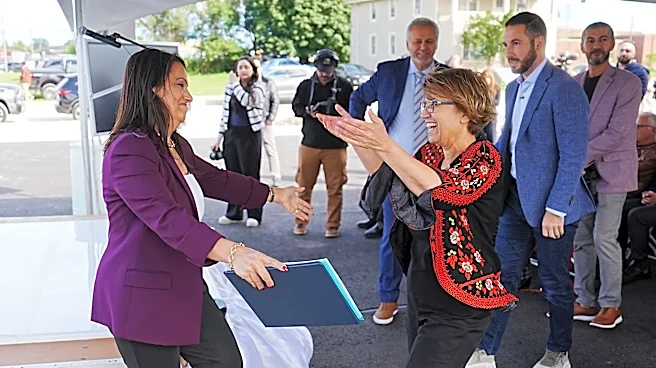
Moments later, Freij sliced through a red ribbon surrounded by other ACCESS officials and politicians to symbolize the opening of the ACCESS Recovery Center, a $25-million project that will help those with substance abuse problems and mental health challenges. Since the COVID pandemic started in 2020, there has been a "50- or 60-percent increase in mental health services demand," Freij said to reporters after the ribbon cutting. "All the wars" abroad in the Middle East also affected many Arab Americans, and "the economic hardship" some are facing contributed to increased demand for mental health treatments, she said.
Freij, a Palestinian immigrant, is stepping down as CEO in a few days after working at ACCESS for more than 35 years. Part of her legacy is the new center that sits on Michigan Avenue near Wyoming Avenue in the eastern part of Dearborn near the Interstate 94 highway and the border with Detroit. It's expected to open in January, said Sarab Al-Jijakli, the chief marketing officer for ACCESS.
A place to check in to get help
ACCESS started in 1971 in a small storefront on Dearborn's south end to serve the city's growing Arab American population, who were often marginalized by mainstream groups and faced language barriers. Today, it's a sprawling operation with 120 programs at 11 locations in Michigan with $55 million in annual revenue last year. The new recovery center, which will include some residential units for clients, came after the largest capital campaign in the group's history.
About $19 million of the $25 million for the new center came from government sources. The state of Michigan gave $12 million in two line items through legislative earmarks programs; $4 million came from the federal government through Senate appropriations with the help of former U.S. Sen. Debbie Stabenow; $2.5 million came last year from Wayne County; and an additional $500,000 came from a state grant, Freij said. Out of the $2.5 million from Wayne County, $1.6 million came from the county's opioid settlement funds, and $895,000 came from American Rescue Plan Act (ARPA) funds from the U.S. government's COVID relief package, said Wayne County spokesman Matt Allen.
The city of Dearborn also contributed. The city gave $230,000 for the ACCESS recovery center through its opioid settlement funding, city spokeswoman Paula Rivera said. Dearborn also gave in-kind donations through land donations and street paving that are the equivalent of about $2 million worth, Freij said. The $2 million in-kind donations from Dearborn are not counted as part of the $25 million for the center.
The city of Dearborn "paved the city-owned road surrounding the facility, which had been one of the most deteriorated roads in the city, and donated several nearby parcels of land to help make the project possible," Rivera said.
The city of Dearborn "gave us five lots that they owned around the building, so we can grow the parking lot and do the gardens," Freij said. "They paved the streets, and they did the massive work for piping the pipes, both for gas and water and sewer."
The partnership between ACCESS and government officials was seen at the ribbon-cutting ceremony, which featured talks by several elected officials, including U.S. Reps. Rashida Tlaib, D-Detroit, whose district includes Dearborn, and Debbie Dingell, D-Ann Arbor, who used to live in Dearborn; Dearborn Mayor Abdullah Hammoud; and Wayne County Commissioner Sam Baydoun, D-Dearborn. Also attending were two prominent faith leaders in Dearborn: Sheikh Ahmad Hammoud of the Islamic Center of America in Dearborn, an uncle of Mayor Hammoud, and Sheikh Baqir Berry, of the Islamic Institute of Knowledge in Dearborn. Hammoud and Berry sat next to each other in the front row during the ceremonies, showing their support.

Support from faith community
ACCESS has done outreach to the faith community to help encourage people in Muslim communities to seek professional health care for drug, alcohol or mental health challenges. ACCESS has posted videos on social media of Sheikh Hammoud encouraging people to get help for problems that faith leaders themselves may not be able to solve. Freij said they work with faith-based groups, schools and police to help those in need. ACCESS currently has a case manager embedded in the Dearborn police department for people with challenges.
"We have a lot of stigma in the community about this disease, and we've been working very hard on education and prevention, and reaching out and advocating for through our policymakers and through our schools," Freij said. "We don't work by ourselves. We work with the schools, we work with the court system, the criminal justice system, work with the police departments of Dearborn and Dearborn Heights. So when there is a phone call, it's not criminalized. Like we have ... embedded case managers from ACCESS in the police departments as we speak. And our faith-based organizations are essential, our teachers are essential, our principals are essential because it takes a community to ensure that the community as a whole deals with this very, very awful disease that affects the whole family."
The ceremony Wednesday was the second opening in recent weeks celebrating an Arab American nonprofit in Dearborn opening a new center. Last month, in August, Leaders Helping and Advancing Communities (LAHC), formerly the Lebanese American Heritage Club, opened with a ribbon-cutting a $3 million center in Dearborn to help people with behavioral health, workforce training and English-language classes, WXYZ-TV reported.
At the ACCESS ribbon-cutting, Lina Hourani-Harajli, the chief operating officer of ACCESS who will replace Freij as CEO and president starting next month, announced there will be a community garden named after Freij, an avid gardener, at the recovery center.

The garden will be "a place for gathering peace, reflection, and renewal, and a place that will always grow, like Maha taught us," Hourani-Harajli said. "Just like the seeds you have planted across our community for decades, we promise that we will carry that forward always and come to the garden to think of you often."
Freij thanked everyone who donated, saying they have exceeded their $25 million campaign by "a little bit" thanks to support from many, "whether the contribution was $1 or $1 million, every dollar helped make this a reality."
"It truly took a village," she said.
Contact Niraj Warikoo: nwarikoo@freepress.com
This article originally appeared on Detroit Free Press: Arab American group opening $25M substance abuse center in Dearborn