





President Donald Trump's administration finalized a new set of rules regarding mile-per-gallon standards for passenger vehicles and light-duty trucks, reducing standards set by the Joe Biden administration two years ago by nearly a third.
While the Trump administration ballyhooed the Sept. 28 announcement as the end of an electric vehicle "mandate" it says former President Biden enacted and environmentalists decried it as foolhardy and illegal, the practical effect is likely to be little in the short term other than spurring litigation.
It does, however, continue the Trump administration's efforts — which Trump campaigned on — to revive production of vehicles that use internal combustion engines at the expense of new investment in, and government
subsidies for, electric vehicle production.
On Sept. 26, Trump signaled the rule had been finalized, saying on his Truth Social site: "These new Standards will take the waste out of building cars in America. That means LOWER PRICES, saving families thousands on a new, beautiful, and safe car — Far better than the Environmental Monsters that we were building heretofore."
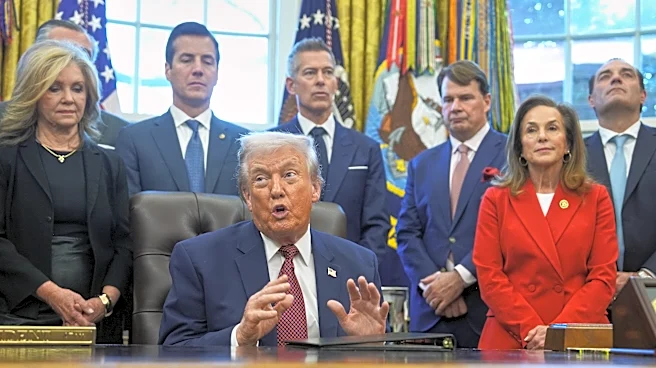
Congress, under Trump, had already taken steps to gut fuel standards requirements by removing penalties for noncompliance and the Environmental Protection Agency had reversed the policy justifying its regulation of greenhouse gases. In December 2025, Trump appeared with auto executives in the White House to announce this change in the Biden fuel standards — which were intended to spur the sale of electric vehicles, or EVs — was imminent.
“We have finally ended the illegal mandate that forced automakers to produce more expensive electric vehicles that American families didn’t want," U.S. Transportation Secretary Sean Duffy said as the new rules were released. “With our commonsense standards in place, we are making the American dream affordable again, putting safer cars on the road, and investing in the American autoworker.”
In June 2024, five months before Trump's reelection to a nonconsecutive second term, Biden's Transportation Department finalized a rule that bolstered the administration's EV push, which included greenhouse gas standards set by the EPA that, if followed through to completion, would have virtually required two-thirds of new cars and light-duty trucks sold by 2032 to be EVs.
This new rule, however, winds back those mile-per-gallon standards, which the Trump administration has said repeatedly violated statutes that disallow the consideration of alternative fuel sources in setting them, significantly.
Where the Biden-era rules estimated a national fleet-wide mpg average for all new cars and light-duty trucks of 35.8 mpg in 2027 to ramp up to 50.4 mpg in 2031, Trump's new rules would require the average to be 32.3 mpg in 2027 model year vehicles sold in the U.S. and increase that to just 34.9 mpg fleet-wide by 2031.
Duffy said this new rule will give automakers the flexibility to make "the cars the public wants to buy" and reduce the average price of a new vehicle by $1,300. But it also comes at a time when EVs appear to be getting a push by a significant increase in gas prices caused by Trump's war in Iran and its impact on fuel shipments through the Strait of Hormuz.
The new rule, meanwhile, does nothing to temper an abrupt back-and-forth change in mpg standards with every new presidential administration that goes back to President George W. Bush. The corporate average fuel economy, or CAFE, program under the Transportation Department has been in place for nearly five decades, but it was only during Bush's second term that the EPA was told to begin regulating greenhouse gases in transportation sources, which also impacted mpg standards, under the Clean Air Act following a U.S. Supreme Court decision.
The new rule appears destined to be tested in court as well, with environmentalists latching on to the fact that the statute requiring the National Highway Traffic Safety Administration, or NHTSA, which is part of the Transportation Department, to set its standards requires it do so at the "maximum feasible" level. Millions of more fuel-efficient vehicles already on the road proves this new set of standards doesn't hit that target, they say.
“Trump is tanking sensible mileage standards at the worst possible time for consumers, who’re getting hit with sky-high prices at the pump,” said Dan Becker, director of the Center for Biological Diversity’s Safe Climate Transport Campaign. “Consumers will pay the price for these reckless rollbacks ... This standard was the biggest single step any nation has taken to save gas, money at the pump, and auto pollution.”
Becker also argued that without tough standards, American automakers have no incentive to make more fuel-efficient vehicles while other countries, especially China, are moving ahead quickly with more efficient and technologically advanced EVs.
The Alliance for Automotive Innovation, a lobbying group representing the full auto industry, including General Motors, Ford, Stellantis, Toyota and others, said it was reviewing the rules, but that NHTSA made the right call, noting this rule will better align fuel economy standards with the law and current market conditions.
“The standards finalized under the previous administration effectively required a switchover to electric vehicles that was out of step with market realities and customer demand,” Bozzella said. “What the industry needs is long-term regulatory stability that includes balanced, durable and achievable fuel economy standards that continue to reduce emissions and improve fuel economy.”
Ford Motor spokeswoman Robyn Jackson said the company also appreciated Duffy and the administration's work "to align regulations with market realities."
Ford Motor leaders have been talking about bringing more affordable cars to market, including more affordable EVs.
“If you look globally, EVs are doing incredibly well and we’re participating in that and we have more EVs coming and we have a very affordable EV coming here, which I think was a big problem with EVs. They simply were not affordable," Executive Chair Bill Ford told a group of reporters on the sidelines of the Detroit Auto Show on Jan. 13. "We’re attacking that problem.”
Editor's note: This will be updated.
Contact Todd Spangler: tspangler@freepress.com. Follow him on Twitter @tsspangler.
This article originally appeared on Detroit Free Press: Trump ratchets down Biden-era mpg fuel standards in new cars, trucks