





Every K-12 school in Michigan is required to have a team in place by Oct. 1 to assess and manage students who may pose a threat of violence.
The team includes a school administrator, mental health professional and law enforcement official tasked with probing reports of alarming behavior in a school community and identifying credible threats.
This team is one of several new school safety policies recommended by a bipartisan task force that formed in the wake of the 2021 Oxford High School shooting, and is part of a series of bills signed into law by Michigan Gov. Gretchen Whitmer in early 2025.
Michigan's new behavioral threat assessment and management (BTAM) requirement calls for teams that can identify concerning behavior, determine whether a student
poses a threat and intervene to reduce that risk.

The law, however, does not require schools to report whether they have established a team, Kimberly Root, a spokesperson for the Michigan State Police Office of School Safety, said in an email. The legislation provided no funding for training or support materials, she said.
Between 2022 and 2025, the state's Office of School Safety hosted 51 BTAM training sessions attended by about 4,000 school employees, mental health professionals and law enforcement representatives, Root said. Those training sessions were funded through a federal grant.
How MSU's Prevent 2 Protect approaches training
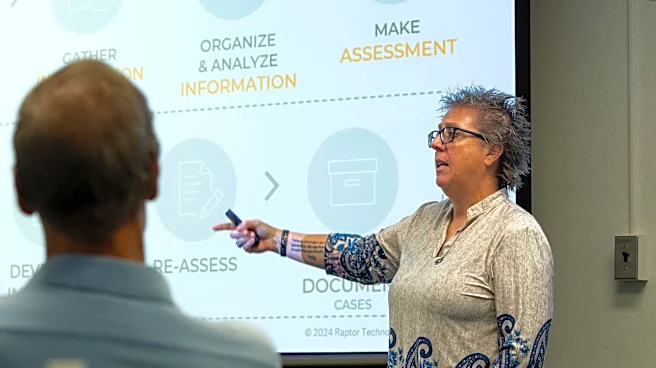
In partnership with the Michigan State Police Office of School Safety, Prevent 2 Protect, or P2P, offers free BTAM basic training for K-12 educators, administrators, mental health professionals and law enforcement.
P2P, a project housed in Michigan State University’s Department of Psychiatry, is directed by Alyse Ley, a child and adolescent psychiatrist and associate professor in MSU’s colleges of Osteopathic Medicine and Human Medicine. It trains professionals in behavioral threat assessment and community members and stakeholders in the identification of early warning signs and the complex management of high-risk adolescents. High risk is defined as posing a threat to oneself or others.
After the 2017 mass shooting in Las Vegas, Ley and her mentor, a forensic psychologist, said to each other that these mass shootings had to stop.
What she saw in mass shootings was that "everybody had a piece of the puzzle, but nobody had the entire puzzle. These groups weren't communicating with each other. You have experts in education, experts in mental health and experts in law enforcement. Everybody knows something, but nobody knows the whole picture."

They put together a model based on this question: "If there's time to intervene, how do we intervene?" she said.
In kids, she said, there are a ton of warning signs. If someone intervenes, there is a possibility (because a kid's brain is developing) that they could change the trajectory of that kid's life.
"If they're going down a path where they have a grievance, and they want to kill or hurt people in their school, you could actually take them and put them on a new path," Ley said. "If they practice this new path enough, then there is the possibility that you could change them from going down the wrong path to going down a pro-social path, where they become citizens who want to contribute."
P2P provides intensive support to five Michigan regions. The team includes a case manager, who is a systems navigator who helps individuals access care in the community, and a mentor, who makes a connection with the kid, Ley said.
How these situations can be challenging
A case involving a Monroe Middle School student last year illustrates how challenging these situations can be.
Last September, a student brought pepper spray attached to a keychain to school. Her mother, Allie Dawson, said her daughter carried it for protection and denied threatening anyone with it. Dawson said her daughter was immediately removed from school after she pulled out the pepper spray in class.
Monroe Public Schools said the student brought the pepper spray into the building and brandished it during class, resulting in disciplinary action. The incident also triggered the district's threat-assessment process. The assessment involved the principal, a licensed school social worker and school resource officer, and a BTAM screener was completed using the student's incident report and statement, according to district records. Ultimately, the screener found the level of concern was low and found no intent to harm. The district determined a full BTAM was unnecessary.
Dawson said she didn't know at the time that the school was conducting the screener and was upset that she and her daughter weren't more involved in the process.
She later filed formal complaints with the district about how the incident and assessment were handled, and said her daughter experienced negative mental and physical effects from the trauma of being removed from school.
Dawson's advice to other parents navigating the BTAM system: "Advocate for your child."
Monroe Public Schools Superintendent Andrew Shaw said in an emailed statement that it would be inappropriate for him to comment on this specific situation but said that the schools in the district have been following BTAM best practices for more than three years.
"Our intermediate school district [a regional public education agency that supports services for local school districts] has taken the lead in the training of staff, development of documents for all schools to use and guidance through the process," Shaw said. "By doing this work together as a county over the last three years made it so when the new law came out, we did not have to make any changes to our practices."
What happens after a threat is identified
Assessing whether a threat is credible is only the beginning, Ley said. The more difficult task can be managing a student over time – making sure the student receives services, monitoring changes in behavior and coordinating among schools, families and outside providers.
"It's a big task to ask schools to do behavioral threat assessment and management," Ley said. "It's a heavy lift."
Andrew Stewart, a district behavior specialist for Lincoln Park Public Schools, worked with one student referred to P2P.

Stewart said program staff got to know the student and family, assigned them a mentor and worked with school employees on ways to help the student succeed. The relationship continued into another school year.
"They stick with the child as long as they can to make sure that they are going to be OK and they're going to be successful," Stewart said. "It's an invaluable resource."
Lincoln Park already has mental health professionals and other student supports, Stewart said. P2P adds resources the district might not otherwise have.
"It's almost like a breath of fresh air," Stewart said. "We're really wrapping this kid with both arms and giving them all that they need."
Not every school district has this level of support
Ley said intensive services like those offered by P2P are not required by the new law. The program's current state funding runs through September of 2027, and expanding it statewide would require additional funding.
The Michigan Education Association, a labor union which represents about 120,000 educators and other school personnel, said that teachers and education support professionals "need appropriate training, dedicated time, clear expectations and the resources necessary to do the work effectively."
"School safety cannot simply become another responsibility added to educators' jam-packed workloads," Thomas Morgan, an MEA spokesperson, said in an emailed statement.
Contact Adrienne Roberts: amroberts@freepress.com
This article originally appeared on Detroit Free Press: Michigan K-12 schools now required to have threat assessment teams