






Not all scams start with a text or a robocall — some fraudsters hit you with a postcard or a package you never ordered.
If something pops up in your mail for a so-called “Veterans Savings Program" watch out. The Federal Trade Commission and the U.S. Department of Veterans Affairs are warning that fraudsters are mailing postcards that promise them extra money through such a “Veterans Savings Program.”
It's not a real program. But it sure sounds tempting.
The postcard falsely claims: "New in 2026, service members and their spouses can now qualify for up to $185 added to their check each month through a Veterans Savings Program."
No, they cannot.
It also tries to sound convincing by using familiar terms. "Spouses of service members may also qualify
if they have CHAMPVA or TRICARE For Life," according to the postcard.
Again, not true.
Another enticing but fake promise: "Along with this monthly amount, you could receive Dental coverage at no cost to you regardless of your VA disability rating."
What's most troubling is that the scammers claim to be affiliated with U.S. Department of Veterans Affairs.
"They might instill a sense of urgency, pressuring you to contact them as soon as possible, or within five days," according to an alert from the U.S. Department of Veterans Affairs.
You risk losing big if you worry about losing out
Of course, the postcard tries to get you to act super quickly just before you question what's going on with this deal. Scammers don't want you to take time to talk to friends or do a little research. They want you to call now.
"Once you do, they will often use flattery and praise regarding your military service to gain trust," according to an alert from the department.
The crooks want to obtain personal identifying information like your Social Security number, bank account details or other sensitive information.
Best bet if you get one of these postcards: Do not respond. The "Veterans Savings Program" is not real.
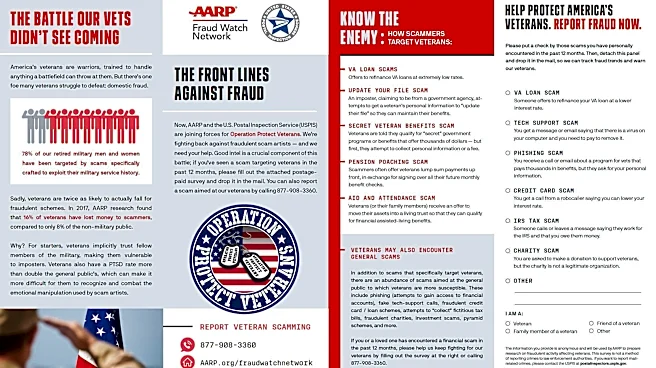
Military consumers reported losing $250 million in 2025 to imposter scams, the largest single fraud category that would include con artists who reach out and pretend to represent the Veterans Affairs Department and other government agencies, according to the FTC Consumer Sentinel Network's data.
In all, military consumers reported losing $684 million last year to a variety of scams, imposter scams, phony job opportunities, tech support pop-ups and other internet service scams, online shopping scams and more.
The real dollar amount lost to scams by service members, veterans, and their families is likely far higher than the dollars reported, given that many people do not report losing money out of embarrassment or sometimes people do not even know they ended up being ripped off.

If you spot this or another VA benefits scam, experts say report it to the FTC at ReportFraud.ftc.gov and to the VA at VSAFE.gov or call the Veteran, Service Member and Family Fraud Evasion hotline at 833-388-7233.
It's also possible to contact the Veterans Affairs hotline at 800-827-1000 to check about potential benefits. Never call a phone number on a postcard. Use a number that you know is real.
See MilitaryConsumer.gov for some warnings on scams. The site also offers a way to sign up for email updates on scams. The site has some smart warnings about scams whether you've served in the military or not.
Odd packages are showing up on porches
Veterans — as well as all consumers — need to be aware of odd boxes and packages that suddenly show up on the doorstep, as well as quirky postcards.
One of the latest alerts involves the "brushing scam" where you get a package that you did not order. Maybe the box appears to be from Amazon. Maybe it appears to be from a business or person you've never heard of before the box arrived.
In many cases, what's inside the package is basically worthless — toothpaste, baby wipes or even seeds. Sometimes, you might get a small item of jewelry or even electronics.
The weird gift makes you wonder who sent this? Why?
Giving into your curiosity, though, will only lead to trouble.
The sender of that box is "usually aninternational, third-party seller who has found the recipient’s address online," according to an alert by the U.S. Postal Inspection Service.
"While it may appear to be a victimless crime — you did after all get some free stuff — the reality is that your personal information may be compromised," the postal inspection service warns.
"Often scammers obtain personal information through nefarious means and with ill-intentions and use it for a number of scams and other illicit activities in the future."
Not surprisingly, the package does not often have a return address. But it may arrive out of the blue containing a QR code and instructions for a way to scan the code to find out who sent the package or how to start a return.
But scanning that code can lead to a phishing website or it will download malware onto your device, according to an earlier alert from the Better Business Bureau. I wrote about these types of brushing scams in November 2025, as consumers shopped for the holidays.
The scams didn't go away.
Some 'brushing scams' involve tricky strategies for crooks
In early August, the Kentwood Police Department in western Michigan published a detailed graphic warning residents about ongoing brushing scams and explained how they actually work.
Sometimes, the crooks want to use your name and information to make it seem like you're a verified purchaser and then the crooks leave fake, positive reviews on a business website as they aim to boost sales.
Sometimes, scammers will include a link or a QR code as way for them to gain access to your information, which can later be used in schemes involving ID theft. Experts say scanning the code could take you to a phishing website designed to steal information like your credit card numbers, usernames or passwords.
There's even a word for this QR code variation. It's called Quishing, short for QR code phishing.
Once you use the QR code supplied in a fake package, you could end up at a website that looks legitimate, maybe appearing to be official sites of banks, government organizations or other institutions, according to the Postal Inspection Service.
"But they are actually scams or fake sites used by criminals to get your personal identifiable information," the service noted in its earlier alert.
In other instances, according to the service, the bad actors will use a person’s address and account information to receive merchandise then steal it from the home before the resident is able to intercept it.
If you confirm that you received a package by clicking a link or scanning a QR code, you're confirming that you still live at that address. Then, according to the alert from MilitaryConsumer.gov, scammers will use your real name to place fake reviews online about their business to “brush up” their sales.
If you got a package you didn’t order, consumer watchdogs say you'll want to take a few more steps to protect your information. Consider doing the following:
- Change passwords on all your online shopping accounts in case they are compromised. If the package comes from Amazon or another online marketplace, message the platform so they can investigate removing the seller.
- Don't try to engage with the fraudsters.
- Check your credit weekly for free at AnnualCreditReport.com. Monitor the information in your credit report and look for signs of identity theft.
- Know that the law says you don’t need to return things you didn’t order. And you don’t have to pay for them, either. "But be cautious about using the product. After all, you don’t know who sent it," according to the alert from MilitaryConsumer.gov.
Contact personal finance columnist Susan Tompor: stompor@freepress.com. Follow her on X @tompor.
This article originally appeared on Detroit Free Press: Veterans warned of phony postcards promising big savings and odd boxes