







The Detroit Three automakers are expected to report third-quarter U.S. new car sales that show they sold fewer cars than they did in the year-ago period when the three companies report their results later next week.
General Motors will likely retain its crown as U.S. sales leader, but Toyota is expected to narrow the gap between the two. Meanwhile, GM, Ford Motor and Stellantis are forecasted to all report sales for the months of July, August and September that were lower than compared with sales in the same year-ago period, Cox Automotive said in a forecast it released on Sept. 24.
And, while the U.S. auto market sputtered through the third-quarter, it had enough gas to show signs that car sales will continue an upward trajectory through year-end,
prompting Cox Automotive to raise its full-year 2026 new-vehicle sales forecast to 16.1 million units, up from 15.8 million first projected in March.
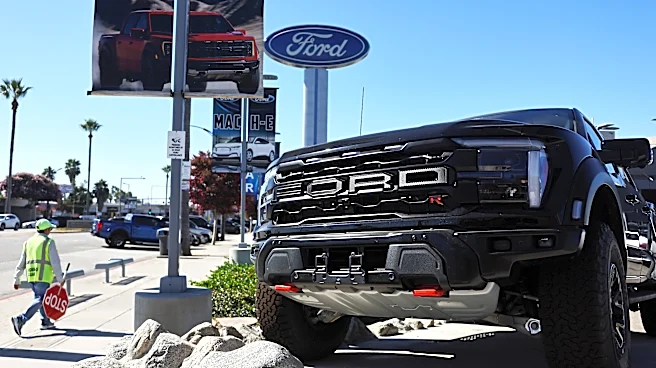
The market growth is largely driven by non-Detroit carmakers, however. As one metro-Detroit Ford dealer told the Detroit Free Press, July sales were good, but August and September slowed, giving him concerns about the fourth-quarter as Ford is in a product lull before it introduces several new vehicles next year.

“The broader market story continues to be ... growing, and mostly on the strength of Asian automakers,” Charlie Chesbrough, senior economist at Cox Automotive, said in a statement. “Asian brands are expected to account for more than half of U.S. new-vehicle sales for a second consecutive quarter, approaching record-high market share levels."
Meanwhile, Detroit Three brands are forecast to fall to just over 36% market share, the lowest level on record, Chesbrough said. He explains that car buyers are migrating toward hybrid vehicles and passenger cars, segments where Asian manufacturers hold advantages, and that "shift in market share is expected to continue through the remainder of the year.”
Cox Automotive noted the car market's remarkable resilence this year in the face of higher fuel prices, elevated interest rates and ongoing economic uncertainty. Fleet customers and wealthy buyers have kept new car sales aloft. Cox Automotive also cited strong summer sales, improving credit and continued consumer demand as reasons for its upward revision to full-year new car sales forecast.
The forecasted numbers
GM and Stellantis — which makes Chrysler, Dodge, Jeep, Ram and Fiat — will each report their third-quarter U.S. sales results on Oct. 1. Ford Motor Co. will report its results on Oct. 2.
GM is expected to remain the top-selling automaker in both the quarter and for the first eight months of the year, Cox Automotive predicts, but it said both GM's sales and market share have softened compared with a year ago largely due to broader challenges across its lineup.
Meanwhile, Toyota is forecast to post year-over-year growth in the quarter, inching in on GM's sales tally. Toyota has seen gains in market share despite ongoing supply constraints for key models, Cox Automotive said.
Cox Automotive also forecasts that Hyundai Motor Group will deliver another strong quarter, with sales rising from both a year ago and the prior quarter and ahead of Ford.
Here are Cox Automotive's forecasted third-quarter results for the biggest automakers:
- GM: 671,706 vehicles sold, down 5.2% compared with the year-ago period.
- Toyota: 642,707 vehicles sold, up 2.2% compared with the year-ago period.
- Hyundai: 511,421 vehicles sold, up 6.5% compared with the year-ago period.
- Ford: 504,172 vehicles sold, down 7.1% compared with the year-ago period.
- Honda: 402,580 vehicles sold, up 12.2% compared with the year-ago period.
- Stellantis: 317,330 vehicles sold, down 1.3% compared with the year-ago period.
- Nissan/Mitsubishi: 245,973 vehicles sold, up 1.2% compared with the year-ago period.
Chesbrough said September new-vehicle sales will likely keep the market on the path it's been on since March, "which is a low-mid 16 million pace" in sales for the full year.
"Strong fleet sales, wealthier vehicle buyers, and more access to credit are all keeping this market relatively strong in the face of many headwinds," Chesbrough said. "High inflation and historically low consumer confidence have not discouraged buyers as much as might be expected. New-vehicle buyers today are more affluent, so they may not be as impacted by inflationary pressures as other consumers.”
Ford dealer waiting for the future
But locally, at Village Ford in Dearborn, owner Jim Seavitt told the Detroit Free Press on Sept. 22 that the third-quarter for him was "mediocre," describing July as good, August as slow and September as being even slower. He expects his new car sales will be down 6% to 10% this quarter compared to a year earlier.
“I am worried about the fourth quarter. I hate to say the word bad. But we’ll see what happens," Seavitt said. "I got 35 cars in on (Monday) and 10 were sold and I have a number of cars on order. So cars coming in and so stock units are coming to build up my inventory.”

But on Tuesday, he'd only sold three new cars by 4 p.m. Typically, he sells at least 10 new cars on a Tuesday. Fortunately, used cars are selling well, Seavitt said, and his service and parts business is booming.
"Right now, people are keeping their cars and fixing them and people are buying out their leases rather than leasing a new car," Seavitt said, adding that buyers are keeping their payments "steady."
What has hurt him as a Ford dealer is the loss of some vehicles from Ford's lineup. Ford discontinued the Escape compact SUV, which had been built at Ford's Louisville Assembly Plant in Kentucky. Ford is retooling that plant to build a new line of electric vehicles there instead, starting with the all-new Fathom midsize pickup due out next year. It also discontinued the F-150 Lightning EV pickup to instead switch that to an extended range powertrain, expected next year.

Ford has struggled with some of its truck and SUV inventory this year after two fires at its main aluminum supplier Novelis in New York disrupted Ford's vehicle production.
"Inventories are lower of the F-Series, Explorer and Bronco Sport," Seavitt said. "A year ago, I sold 40 Escapes and I sold 29 Mach-E's and 18 Lightnings, so that’s 100 vehicles I can’t replace. They are hardly making any Mach-E’s and they stopped making the Lightning and the Escape.”
Still, Seavitt is optimistic about the future because Ford recently showed its dealers some future vehicles at a Las Vegas meeting that it hopes to bring to market by 2030.
"I see future product coming and I know we’re going through a product cycle and we have the Fathom coming and I hope there is a good lease on that because people will buy electric if there’s a good payment on it," Seavitt said. "I’m very optimistic about the future, we just got to get there.”
Jamie L. LaReau is the senior autos writer for USA TODAY Co. who covers Ford Motor Co. for the Detroit Free Press. Contact Jamie at jlareau@freepress.com. Follow her on Twitter @jlareauan. To sign up for our autos newsletter. Become a subscriber.
This article originally appeared on Detroit Free Press: Analysts expect Q3 U.S. sales growth for some carmakers. Not Detroit 3