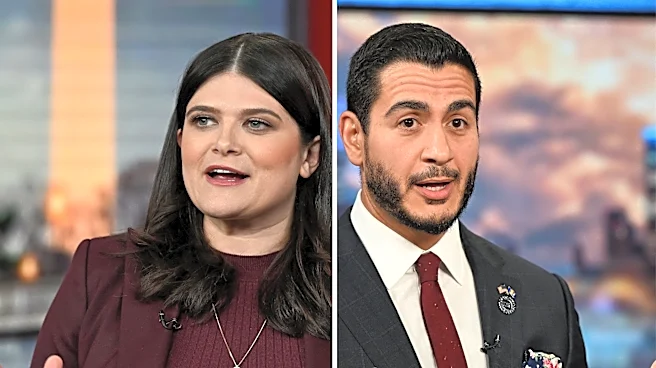

With days to go until the Aug. 4 primary, the RealClearPolitics.com polling average shows Abdul El-Sayed with a clear lead over U.S. Rep. Haley Stevens in the race for the Democratic nomination for Michigan's
open U.S. Senate seat.
As of Thursday, July 30, the average of recent polls by the website shows El-Sayed leading Stevens 50.2%to 40.8%.
If that is an accurate representation of the result of the voting, as it is intended to be, El-Sayed is on the cusp of scoring one of the biggest victories ever for the American progressive movement, setting up a race between him and Republican former U.S. Rep. Mike Rogers in the fall.
No Republican candidate has won a U.S. Senate seat in Michigan since Spencer Abraham in 1994 in what was a political wave for Republican candidates across the country. No such wave is expected this year, with most factors appearing to favor the Democrats. But Stevens and a host of mainstream, centrist Democrats have been arguing for months that if El-Sayed wins the nomination, he could cost the state the seat currently occupied by Sen. Gary Peters, who is retiring.
The RealClearPolling.com average comes after a string of polls, including at least one linked to a Super PAC supporting El-Sayed, show him in the lead. But the two most recent are from firms considered reliable, independent pollsters, including one released July 29 by Emerson College/WLNS/WOOD-TV that showed El-Sayed leading Stevens by 15 percentage points, 54%-39%.
The remainder in that poll, which surveyed 700 likely Democratic primary voters July 26-27, are undecided or still supporting state Sen. Mallory McMorrow, who dropped out of the race July 5 but remains on the ballot. The Emerson/WLNS/WOOD-TV poll has a margin of error of plus or minus 3.7 percentage points.
Another poll, by Tavern Research in Chicago, also on July 26-27, showed El-Sayed ahead 46%-36%, That same poll showed Stevens ahead of El-Sayed 41%-38% just a few weeks before. In both of those polls the remainder is also undecided; the RealClearPolitics.com average does not include a breakdown of any remainder.
El-Sayed's campaign put out a release noting the Emerson/WLNS/WOOD-TV result, saying it comes even though a flood of outside money has helped Stevens. "Despite this, it's clear (from the poll) that Abdul has both the enthusiasm of Democrat voters and the ability to expand the Democratic base in order to win in November," the campaign said.
Stevens largely dismissed the polls.
"I really don't pay too much attention to polls, I've had (it) like this before," Stevens said to reporters during an event in west Michigan on July 30, addressing the Emerson/WLNS/WOOD-TV poll. "There's a lot of different polls saying a lot of different things right now."
While the polling is unquestionably favoring El-Sayed, there remains questions. The Emerson College sample still appeared to include less primary voters over the age of 70 and more under the age of 40 than any recent Michigan primary years, a distinction that clearly favored El-Sayed. Two weeks ago, a Detroit News/WDIV-TV poll done by the Glengariff Group of Lansing showed Stevens leading 48%-41%.
El-Sayed, who lives in Ann Arbor and is the former health director for Wayne County and Detroit, has never won elected office before, having run unsuccessfully for the Democratic nomination for governor in 2018, when Gretchen Whitmer won. He has attracted hordes of national attention as his campaign has gained momentum, backed by progressive stalwarts including U.S. Sen. Bernie Sanders of Vermont, U.S. Rep. Alexandria Ocasio-Cortez of New York and U.S. Rep. Rashida Tlaib of Detroit, as well as the UAW.
On the campaign trail, he has pushed an agenda of getting corporate money out of politics, providing universal government-run health care to all, reducing medical debt and cutting foreign military aid, especially to Israel.
Stevens, of Birmingham, meanwhile, who flipped a previously Republican U.S. House district in 2018 has leaned heavily on her record as a supporter of Michigan manufacturing and a member, before she joined Congress, of the task force that helped rescue what was then Chrysler and General Motors in 2009-10. Her campaign has focused more on her argument that she is more electable as a centrist and that El-Sayed represents too great a risk, and she has attracted significant support from establishment Democrats, including Whitmer, Peters, former Gov. Jennifer Granholm and former U.S. Sen. Debbie Stabenow.
But she also had to run against the perception that she is too willing to back U.S. aid to Israel without substantial conditions, a position that has come increasingly under fire from parts of the Democratic Party following Israel's counteroffensive in Gaza. She has also seen a raft of independent outside funding − more than $50 million as of July 30 −flood Michigan on her behalf, much of it from a Super PAC, United Democracy Project, linked to the American-Israel Public Affairs Committee, which backs candidates supportive of U.S. aid to Israel.
Staff writer Arpan Lobo contributed to this story. Contact Todd Spangler: tspangler@freepress.com. Follow him on X @tsspangler.
This article originally appeared on Detroit Free Press: El-Sayed takes big lead over Stevens in polls ahead of primary