



With a goal of wrapping up negotiations in under two weeks, the Canadian labor union Unifor said it aims to restore its laid off General Motors workforce and rightsize what it believes is an unfair ratio of cars the Detroit automaker produces in Canada compared with those it sells.
However, compared with the successful negotiations theUnifor wrapped up with Ford Motor Co. in June
, GM presents unique challenges.At the launch of negotiations, one-third of GM’s Canadian workforce is on layoff, most due to the idling of one of GM's largest plants in the country after smaller-than-anticipated demand for the electric commercial van that it built there.
GM also faces penalties from the Canadian government for those layoffs. But the automaker is weighing
those costs against the capital needed to retool the plant to return it to retail production.
According to Unifor National President Lana Payne, GM sold twice as many cars in Canada last year than it produced, a ratio that threatens the long-term viability of the auto sector in the country.
“At every single one of our GM manufacturing facilities, there are Unifor members on indefinite layoffs. Company production volumes have declined in Canada, yet GM continues to be the top selling automaker in our country. This has us concerned,” Payne said Aug. 10 at a media conference. “If a company expects to sell here in Canada, they must also build here in Canada. Canada cannot, and must not, become a market only for vehicles that are made somewhere else.”
Canada’s comparatively weaker dollar and publicly funded health care system offers demonstrative labor savings for automakers over those in the United States, according to Jim Stanford, director of the Centre for Future Work. Stanford previously served as an economist for Unifor.
The Canadian dollar is worth roughly 70 cents U.S. and health care alone can save the automaker between $8 and $10 per hour U.S. compared with what it would pay an American worker. Even the Canada pension plan, the country’s equivalent to social security, costs employers of Canadians less than in the United States.
But the extreme cost of automotive tariffs that U.S. President Donald Trump’s administration has levied on Canada has largely wiped out any cost savings GM gets manufacturing vehicles across the border, Stanford said.
“The 25% tariff overwhelms that. The autoworkers could work for free and it would barely start to offset that,” he said. “There’s nothing Canadians could do. We don’t know how long it’s going to last.”
What GM builds versus what GM sells
Canada’s $100 billion auto market is “lucrative” for automakers, Payne said, as Canadians purchase about 2 million vehicles per year.
GM Canada vehicle sales of 299,813 comprised 15.5% of the country’s total vehicle market in 2025. The company built around 130,000 vehicles in Canada, most of which were sold in the United States.
Why even build in Canada?
The history of why GM builds vehicles in Canada dates to before the automobile itself existed ― to carriage production. The longstanding tradition of imposing tariffs on vehicle imports from the United States ended in 1965 with the enactment of the Canada-United States Automotive Products Agreement, a precursor to the North American Free Trade Agreement that removed tariffs between the two countries. The agreement was abolished in 2001, but by then NAFTA had more or less superseded it.
Without tariffs, Ford, General Motors and Chrysler were able to “rationalize” their production in North America, including their Canadian facilities, to streamline and focus on the continent rather than building cars for one market at a time. Rather than having to build small batches of every vehicle sold in Canada, Canadian plants switched to building large quantities of a few vehicle types shared across countries, Stanford said.
“The grenade that has gone off in the middle of that longstanding arrangement has been Donald Trump’s tariffs,” Stanford said. “Canada is not going to allow GM to supply the entire market from the United States without maintaining a significant footprint in Canada.”
Meanwhile, while Ford sells nearly as much as GM, it currently does not build any vehicles in Canada, though what it builds now and plans to build in future is enough to satisfy the union and the Canadian government.
What GM’s layoffs cost the company
Even without full vehicle production today, Ford is not paying the same costs that GM and Stellantis do when importing vehicles north across the border.
In April 2025, Canada imposed its own 25% tariff on imported vehicles as a countermeasure to auto tariffs imposed by the United States but quickly offered a remission program to carmakers that met certain criteria. One of those exemptions, which applies in the case of Ford, is for an importer that has reduced or paused manufacturing of motor vehicles in Canada because of factory retooling but plans to restart manufacturing in Canada among other requirements.
The Oakville Assembly Complex in Ontario previously built the Ford Edge and the Lincoln Nautilus before closing at the end of 2024. By the end of 2025, Ford of Canada sold 294,418 vehicles. Of that, 162,841 were pickups across the F-Series, Ford Ranger and Ford Maverick.
Ford scrapped plans to retool the site for a three-row electric utility vehicle in 2024, opting to reopen Super Duty trucks instead. That production, which adds capacity for up to 100,000 F-Series Super Duty trucks at the plant in addition to the trucks built at Kentucky Truck and Ohio Assembly, is expected to begin later this quarter.
While truck production in Canada cranks up, Ford’s two engine plants across the bridge produce all of the company’s V-8 engines, amounting to more than 400,000 engines and machined components at both Windsor and Essex facilities. Ford also operates three tech centers in Canada, based in Ottawa, Waterloo and Oakville. Ford employs nearly 7,000 workers across its hourly and salaried workforce.
When Canada first imposed reactive auto tariffs, all five manufacturers that build in Canada ― Honda, Toyota, Ford, Stellantis and GM ― met Canada’s remission obligations. That is, until GM laid off its workforce at CAMI Assembly Plant in Ingersoll and Stellantis canceled plans for its Brampton assembly plant.
About 1,200 employees at CAMI Assembly in Ingersoll, Ontario — roughly 140 miles from Detroit — were laid off when GM cut production of the electric Chevrolet BrightDrop van in October 2025 due to low demand for the van. Around the same time, Stellantis announced production of the Jeep Compass would move to Belvidere, Illinois, and not in Brampton, Ontario, reversing what it promised Unifor in a 2023 collective bargaining agreement.
On Aug. 14, Unifor said Stellantis is considering selling the Brampton plant altogether while the automaker delayed plans to start production at Belvidere Assembly Plant for the third time.
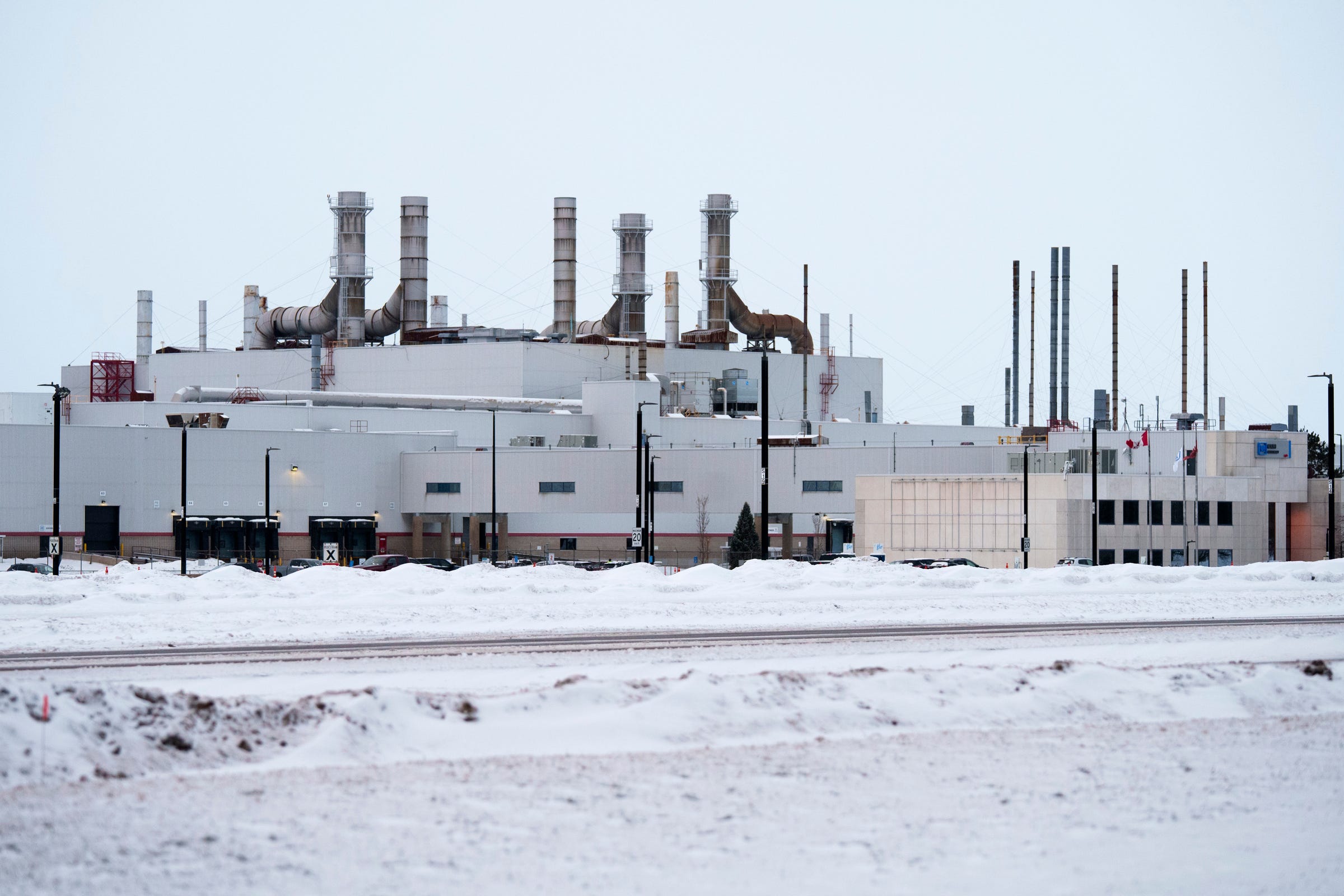
The Canadian department of finance noted on Oct. 23 of 2025 that those changes go “against their commitments to Canada and Canadian workers” and decided to amend the quantity of vehicles those companies produce that remain eligible for tariff remission.
Canada responded by reducing GM’ annual remission quota 24.2%, and Stellantis’ 50%.
The actual calculations for remissions framework are not public, but with one-fourth of the vehicles GM imports unshielded from the 25% tariff could get costly.
If GM imports about 200,000 vehicles from the United States to Canada per year with an average value of $50,000 per vehicle at a 25% tariff it would be $2.5 billion, Stanford estimated. If nearly a fourth of that no longer qualifies for the exemption, he said, “GM could save in excess of $500 million per year by making investment commitments to Canadian production sufficient to requalify for the full Canadian tariff remission.”
According to a Department of Finance Canada official, the Department does not disclose the quantity of duty-free imports allocated to automakers or any other import-specific data in order to protect commercially sensitive and confidential information that could have potential competitiveness implications.
What Payne plans to bargain for
Unifor is negotiating two separate contracts with GM, both of which are slated to expire on Sept. 20.
One contract covers the 1,029 hourly workers on layoff at CAMI, while the second Unifor contract is more general, covering the remaining 3,585 workers at Oshawa Assembly, St. Catherines Propulsion and the Parts Distribution Centers GM owns and operates in Ontario.
“The most powerful leader in the world, the president of the United States, has said repeatedly that he is coming for our auto sector and our jobs. For that reason, some commentators in this country have written us off. Some fail to understand the significance of the auto industry to workers, to communities, and to the advanced manufacturing industrial economy of our country,” Payne said. “I want to be clear: We are not going anywhere. We expect a pattern agreement to build on the foundation and momentum we established with Ford Motor Co.”
Still, GM has made significant investments in Canada even through the Trump administration.
GM’s Oshawa Assembly Plant, to which the automaker has committed $280 million to prepare for next-generation full-size pickup production, employs 2,750 Unifor-represented workers. GM plans an investment in St. Catherine’s propulsion systems for next-generation truck production of $691 million Canadian dollars.
The plant reverted to two shifts down from three earlier this year, which Payne described as operating substantially beneath capacity.
Unifor’s timeline to convince GM to agree to a similar deal with Ford is two weeks, ending on Aug. 21.
“What we negotiated with Ford was a very strong agreement, so obviously we expect the same thing,” Payne said. “With respect to what makes this round different compared to Ford Motor Co., is we have one-third of our membership on layoff at General Motors, we have underutilized facilities right now, and that’s going to inform the bulk of what we talk about in the next two weeks.”
Staff reporters Jamie L. LaReau and Liam Rappleye contributed to this report.
Jackie Charniga covers General Motors for the Free Press. Reach her at jcharniga@freepress.com.
This article originally appeared on Detroit Free Press: What makes GM-Unifor contract talks more contentious than Ford’s