




I used to love Gretchen Whitmer.
She was a political icon ‒ a fierce champion of reproductive freedom, a powerful woman and, for many of us, the embodiment of a new kind of leadership. I was proud that she was our governor, honored to know her and thrilled whenever I was invited to an event with her.
That is what makes writing this so difficult. I know it will ruffle feathers in many of the circles I run in, but it is long past time that we hold our elected leaders accountable ‒ even when they are Democrats, even when we once supported them and even when doing so is incredibly uncomfortable. Accountability matters most when a leader’s actions no longer reflect the people she was elected to serve.
So, let’s talk about what happened to Gretchen Whitmer.
Whitmer has turned her back on the communities that supported her
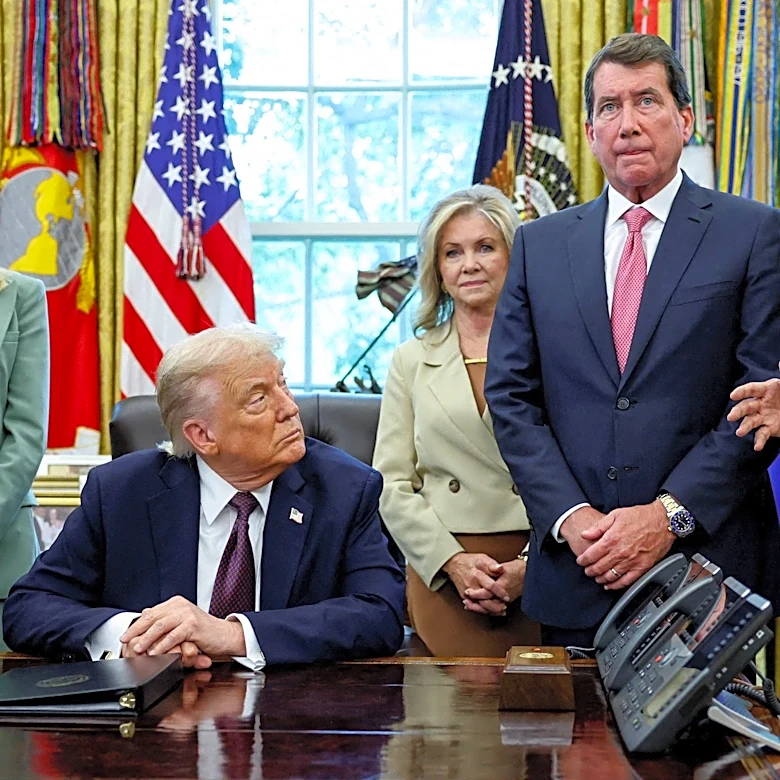
In April 2025, Americans watched Whitmer stand alongside President Donald Trump in the Oval Office. When reporters unexpectedly entered the room, she covered her face with a folder.
Whitmer said she was there to fight for Michigan, but the image was difficult to reconcile with the leader we had elected ‒ the bold, unapologetic “woman from Michigan” who stood up to Trump during the pandemic and championed reproductive freedom after his Supreme Court appointments helped overturn Roe v. Wade. Suddenly, that leader seemed to disappear behind a blue folder.
It felt as though we were watching the image she had spent years building melt away in real time.
That was the first moment I began to wonder where this version of Gretchen Whitmer was headed.
Over the past few months, the answer has become increasingly clear: Whitmer has repeatedly turned her back on the very communities that put her in the position of power she now holds.
Data center debacle, the inexplicable veto and Line 5
In June, she stood alongside some of the most powerful men in technology as they broke ground on a controversial $16 billion artificial intelligence data center in Saline Township. Photos documented the celebration, yet the event was notably absent from Whitmer’s social media ‒ a curious omission for a project she publicly touted as an economic victory.

The project has faced intense opposition from residents concerned about the loss of agricultural land and its enormous energy and water demands. The Saline Township Board rejected the necessary rezoning after residents spoke out against the development. But when the developer and landowners responded by suing the township, what power did residents really have to keep fighting? The township ultimately settled, and the project moved forward anyway.
The scale of the proposed facility is difficult to comprehend. It is expected to require 1.4 gigawatts of electricity, roughly equivalent to the electricity used by 1 million homes. Michigan has approximately 4.6 million households. In other words, this single data center could demand an amount of electricity comparable to what is used by more than one-fifth of the households in our state.
Then, just a few weeks later, Whitmer managed to alienate another major constituency that helped put her in office: organized labor.
Before Democrats lost control of the state House, they passed nine bills designed to protect working families and public employees. But when Republican Matt Hall became speaker, he refused to deliver those bills to Whitmer’s desk.
So unions and Democratic lawmakers did what they were supposed to do: They fought back to ensure the will of the people was honored. For more than a year, they battled through multiple court rulings and took the fight all the way to the Michigan Supreme Court, which finally ordered the House to send the bills to the governor.
These bills would have protected working families from aggressive debt-collection practices, strengthened retirement security for corrections officers and helped prevent teachers, nurses, first responders and other public employees from being crushed by health care costs.
After all that work, all that organizing and an 18-month legal battle, Whitmer vetoed every single one.
She blamed the delay, arguing that the bills contained implementation dates that had already passed and would create administrative and financial problems. But Democratic lawmakers said those technical issues could have been fixed. Whitmer could have signed the bills and worked with the Legislature to correct them. Instead, she killed them.
And then came Line 5. Line 5 is an aging oil pipeline owned by Enbridge, a Canadian energy company. It runs through Michigan and beneath the Straits of Mackinac, where a spill could threaten the Great Lakes.
Whitmer campaigned on shutting it down. Whitmer said Enbridge had imposed an “unacceptable risk” on Michigan. In 2020, she revoked its easement beneath the Straits of Mackinac and ordered Line 5 to shut down.
But in a complete 180, agencies within Whitmer’s administration recently issued two key permits advancing Enbridge’s proposed tunnel beneath the Straits. Tribal nations and environmental advocates warn that the project threatens wetlands, Tribal sovereignty and the Great Lakes ‒ the source of drinking water for millions of people.
Maybe each of these decisions could be explained away on its own. Taken together, however, they’re damning.
I miss the old Gretchen Whitmer
This is not the Gretchen Whitmer I was once so proud to support. I miss the bold woman with a backbone who made so many of us believe powerful women could lead differently. I want that Whitmer back.
I do not regret supporting her. But my past support does not require my present silence. We should be able to celebrate what our elected leaders got right while holding them accountable for what they are getting wrong. That is not betrayal. It is our responsibility to hold them to the standards they promised us.
What matters now is where we go from here: the lessons we carry forward and the leaders we choose next. We need leaders who will not turn their backs on the people who put them in office the moment powerful corporations come calling. Leaders who listen, lead with integrity and remain accountable to their constituents long after the election is over.
Because elected officials do not work for their donors, corporate executives or the people writing the biggest checks. They work for us.
We gave them their power. We have every right ‒ and every responsibility ‒ to demand that they use it on our behalf.
Nikki Sapiro Vinckier, PA-C, is a Michigan-based physician assistant, reproductive health advocate and author of “We Deserve More.” She is the founder of Take Back Trust, a nonprofit dedicated to reproductive healthcare literacy, and a longtime advocate for reproductive freedom. Follow her @nikkivinck. Submit a letter to the editor at freep.com/letters, and we may publish it in print or online.
This article originally appeared on Detroit Free Press: Gretchen Whitmer used to have a bold backbone. What happened? | Opinion