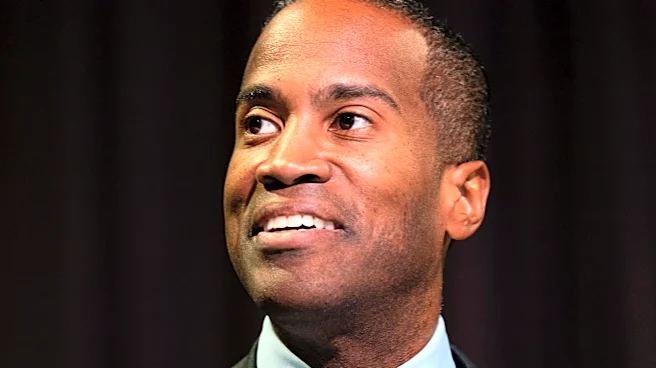







Republican former Michigan Gov. George Romney saw a state income tax as one of his signature policy achievements. Decades later, GOP gubernatorial nominee U.S. Rep. John James has made eliminating it a centerpiece of his campaign.
"We are eliminating the state income tax. Not someday. Not maybe. We are doing it," states the Shelby Township Republican's "Freedom Agenda" outlining his platform. Many Michigan Republicans share James' aim to eliminate the state income tax, including all of the primary opponents he bested.
The income tax helps fund schools, Medicaid, prisons, state police and more. Eliminating it would entail a massive overhaul of public services and benefit the wealthiest Michiganders, according to fiscal and tax policy experts.
Since
its creation in 1967, the income tax rate has fluctuated and led to pitched political battles. In the 1980s, a pair of Democratic lawmakers' support for a tax hike prompted the first successful recall elections of state officials. During the Great Recession, then-Democratic Gov. Jennifer Granholm temporarily raised the income tax rate. Republican Gov. Rick Snyder later approved a tax rollback when state revenue growth outpaces inflation. Court rulings found that a 2023 tax cut triggered by that law was temporary and not permanent, as Republicans argued.
The tax serves as the state's largest source of revenue. Estimates project it will generate about $14 billion for the current fiscal year. James has proposed starting with an initial cut to Michigan's 4.25% income tax, paid for by slashing state spending by $3-3.5 billion.
His proposal relies on outdated budget numbers. For instance, he promises to eliminate more than $1 billion in "pork," but the budget doesn't include nearly that much in earmarks. He also calls for axing corporate subsidy money now used to balance the budget and unemployment fraud penalties that cannot legally be used to cut the state income tax. James' campaign promises a new plan soon.
Cut would usher in drastic changes
No state has eliminated its income tax through the kind of phaseout James proposes, according to James Hohman, director of fiscal policy at the Mackinac Center for Public Policy. But a cut could improve the state's tax competitiveness, he said. "If you're just talking about taking 0.5% less of someone's income it matters – it would be an improvement – but it wouldn't be a night and day and change for the state's economic prospects," Hohman said.
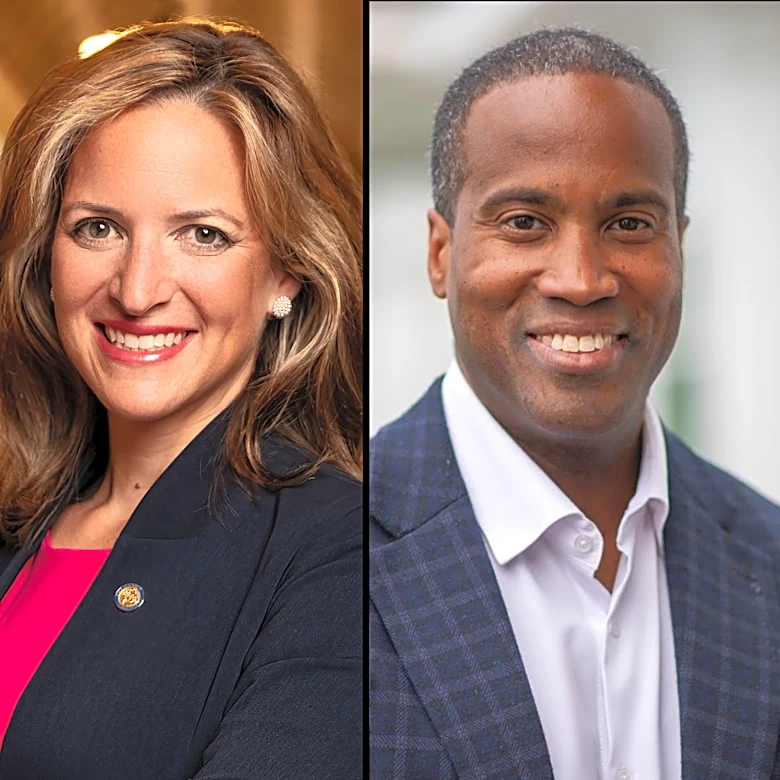
For her part, Michigan Secretary of State Jocelyn Benson, the Democratic nominee for governor, has called for a review of how the state generates revenue and hasn't, so far, called for a change to the income tax. When asked about Republican proposals to eliminate the tax, Benson, in a short July interview, said lowering costs won't come through "one-off gimmicks that sound good on the campaign trail."
Some opponents of Michigan's flat income tax, such as the Michigan League of Public Policy (MLPP), advocate for a graduated income tax that would impose a higher tax rate on those with higher incomes, arguing the wealthy should pay more. James' proposal to eliminate the tax altogether would have unequal benefits, according to an analysis.
For middle-income households, which make between $48,100 to $81,400 a year, fully eliminating the tax would represent, on average, a $1,489 annual savings, according to an analysis from the Institute on Taxation and Economic Policy (ITEP). But most of the benefit would accrue to higher-income households, according to the analysis, which assumes state income tax credits would disappear along with the income tax. Sixty-six percent of a $14 billion tax cut would go to households in the top 20% of the income distribution, the analysis finds.
"So by and large, the wealthiest stand to gain the most from this," said Miles Trinidad, a state analyst at ITEP.
Bob Schneider, a senior research associate for state affairs at the Citizens Research Council of Michigan, found that eliminating the income tax without replacing the lost revenue would entail a 23% cut to the school aid fund, which primarily supports K-12 education, and a 65% cut to the state fund that supports general government operations.
"You can pass a budget that does that, but that’s the trade-off," he said. Eliminating the income tax means "reimagining what state government should be in a very fundamental way," he said, providing examples such as closing prisons or privatizing universities.
Rachel Richards, fiscal policy director at MLLP, raised serious concerns about eliminating the income tax, pointing to tax cuts implemented in Kansas over a decade ago as an example of what can happen.
How cuts play out in other states
The "Great Kansas Tax Cut Experiment" saw the state's then-Gov. Sam Brownback, a Republican, approve tax cuts that required slashing state spending and preceded a downgrading of the state's bond rating. The fallout and voter backlash prompted the GOP-controlled Legislature to reverse the tax changes, overriding the veto of the Republican governor who championed them.
Hohman said states have learned from what happened: they need a "feasible plan" for reducing state spending or cutting taxes based on revenue growth.
Several states have no income tax, and James says these states have done a better job growing their populations and attracting business.
Most states without an income tax haven't historically levied broad-based income taxes, according to ITEP research director Carl Davis. Alaska is the only state in recent history to have repealed its tax and did so almost 50 years ago (South Dakota repealed a Depression-era income tax several decades earlier).
Tennessee eliminated its tax on interest and dividends in 2021, marking a historic first in eliminating a major tax without replacing the revenue, according to Hohman. It's possible – if politically difficult – to reduce income tax rates, he said. "But actual income tax elimination – a lot of people have talked about it, few have accomplished it," he said.
Contact Clara Hendrickson at chendrickson@freepress.com or 313-296-5743.
This article originally appeared on Detroit Free Press: James wants to ax income tax. Experts see boon for wealthy, big cuts