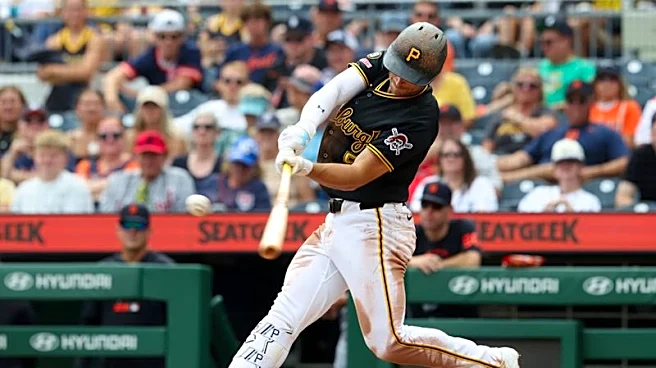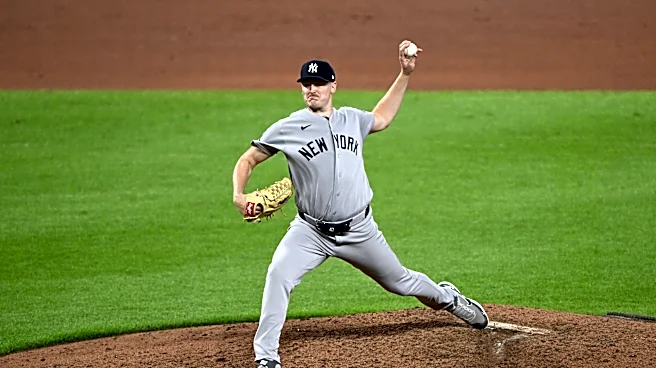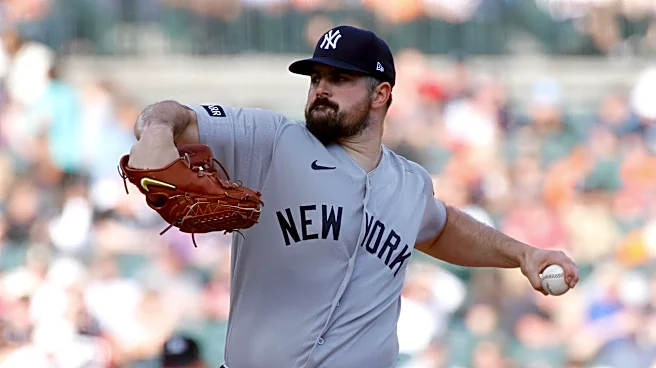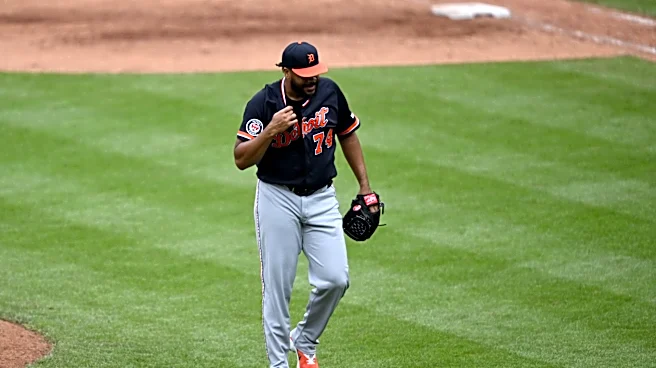




It seems like everyone is talking about the Detroit Tigers' bullpen these days.
On Tuesday, Aug. 18, popular baseball YouTuber Foolish Bailey released a video named "The 2026 Tigers: A Failure in Bullpen Management," in which he blamed the shortcomings of Detroit's season on Tigers manager A.J. Hinch's bullpen strategy. The analysis, which reached over 40,000 views over its first two days online, mostly concerns a few games during a nightmare 6-22 stretch in May where Tigers relievers blew games late. But though narrow in scope, the video re-sparked discussion online about whether the Tigers' bullpen has been the biggest reason for a disappointing season.
Less than 24 hours later, Detroit's bullpen blew another game, with closer Kenley Jansen
allowing two solo home runs in the bottom of the ninth inning in a walk-off 4-3 win for the Pittsburgh Pirates. It only ignited hotter discussions of Tigers relievers.
And with the Tigers having recorded an American League-leading 28 blown saves as of Thursday, it's easy to blame the bullpen for Detroit's shortcomings. But the numbers paint a more nuanced picture of the Tigers' bullpen situation, one that may show the Tigers as a product of bad luck more than bad pitching – depending on your interpretation, of course.
So, has Detroit's bullpen been that bad this season? The answer is complicated, which pretty much defines the Tigers' season.
Tigers lead league in blown saves

There's no getting around the blown saves – 28 of them, the highest mark in the AL and second-worst in MLB, behind the Washington Nationals' 32 (another team with a positive run differential and many games out of a playoff spot). It's seven more than the Tigers had in all of 2025, with the Tigers having 35 more regular-season games to add to the total this season.
Much of that falls on closer Kenley Jansen, who is having arguably the worst season of his career. His 16 saves to five blown saves is his worst-ever SV/BS ratio, while the 38-year-old righty is sporting a career-worst 4.19 ERA over 34⅓ innings pitched. He was the most significant addition to the Tigers' bullpen this past offseason, and with minus-0.2 FanGraphs WAR (his first season with negative value), he has not lived up to the expectations of a high-leverage reliever.
But he hasn't been Detroit's least-valuable reliever this season. Not even close.
That title goes to righty Kyle Finnegan (minus-0.7 fWAR), whose eight blown saves not only lead the Tigers, but all of MLB. Finnegan has pitched 52⅓ relief innings, which is third on the team behind swingman Drew Anderson (56⅓ relief IP) and go-to lefty Tyler Holton (55 relief IP). Finnegan's 3.27 ERA is actually better than his career average, but his 5.22 expected ERA (calculated using Statcast measurements) is by far the worst of any Tigers reliever with at least 20 IP this season. He has nearly doubled his walk rate this season (from 2.84 per nine innings in 2025 to 5.33 in 2026) and has a career-low strikeout rate (from 8.68 per nine innings in 2025 to 6.88 in 2026).
Finnegan has been especially ineffective as of late, giving up 10 earned runs in 13 innings pitched since the beginning of July. And for a pitcher who put up a 1.50 ERA over 18 regular-season innings for the Tigers in 2025, Finnegan's fall has been a massive blow for Detroit's late-inning strategy.
But believe it or not, the rest of Detroit's bullpen hasn't been that bad. In fact, this group outside of Jansen and Finnegan has actually been pretty solid this season.
The rest of Detroit's bullpen

Here's a stat that might surprise you – as of Thursday, the Tigers' bullpen has the ninth-best ERA in all of baseball (3.78). Combined with the second-best ERA among starters (3.43), that gives the Tigers a top-five pitching staff, easily the strength of a team with the third-best run differential in the American League (plus-82).
Of the 10 Tigers relievers with at least 20 relief innings pitched, seven have an ERA-minus (a park adjusted pitching metric) under 100, an above-average mark. The only three who have below-average rates are Jansen, Anderson and Will Vest, who is out for the season with a stress fracture in his elbow.
Among those 10, seven have produced positive fWAR, with righty Ty Madden and lefty Drew Sommers leading the way with 0.5 fWAR each. By comparison, only three Tigers relievers with at least 20 innings pitched produced positive fWAR in 2025: Vest (1.8), righty Brenan Hanifee (0.6) and lefty Brant Hurter (0.5), who is currently on the shelf with a back injury.
But despite the Tigers featuring several good relievers, Detroit doesn't have a great one in the bullpen. Holton has taken a step back, as did Vest before his injury. Both Sommers and Enmanuel De Jesus have been valuable in low-to-medium leverage situations, but without standout performances from Jansen, Finnegan and Vest, the Tigers don't have a reliable high-leverage pitcher to turn to. And much like the Tigers as a whole, the team's relief corps has marked 2026 with good numbers, but bad results.
Bad luck a factor?
A key stat in Detroit's decline from 2025 to 2026 is the Tigers' 12-22 record in one-run games this season. That marks the lowest winning percentage (.353) among MLB teams in 2026, with the Tigers having the fewest wins and a tie for the most losses in such games.
On the surface, it seems the bullpen should be blamed for Detroit's struggles in close games this season, but that may not necessarily be the case. By ERA (3.78), the Tigers' bullpen has been better than it was in 2025 (4.05), but the Tigers were 21-12 in one-run games in 2025. That was the best winning percentage in such games in the majors, even with a bullpen that finished 24th in fWAR.
How is that possible? A typical analytical conclusion about one-run games is that they are more a product of luck than skill. Put simply, a team with a bad record in one-run games is probably just unlucky, which is admittedly not very useful in trying to figure out Detroit's putrid one-run record.
One-run games are not solely controlled by pitching performances, however. The Tigers have lost an MLB-high 19 games after leading in the seventh inning, much of that coming down to relief pitching, but the Tigers' offense isn't doing its bullpen any favors as it ranks 20th in runs scored (166) between the seventh and ninth inning of games (it ranks eighth in innings 1-3 with 204). That's not exactly terrible, especially with the Tigers' offense putting up so many runs early, but it's a contributing factor to Detroit withering in late-game situations.
It's impossible to say for sure whether the Tigers are getting the wrong end of a coin flip more often than any other team, but if luck is a factor, the Tigers can hope that luck will veer in their direction as the last month of the regular season approaches. But with only 35 regular-season games left, there isn't much time for the Tigers to fix what is ailing them, whether that be bullpen troubles or getting on the better side of fate.
Need to catch up on the news during your lunch break? Sign up for our Sports Briefing newsletter to get daily summaries of Detroit sports!
You can reach Christian at cromo@freepress.com.
This article originally appeared on Detroit Free Press: Why the Detroit Tigers' bullpen has been better than you think