







As Michiganders weigh their seasonal vaccine options, COVID-19 cases are surging close to home and across much of the U.S.
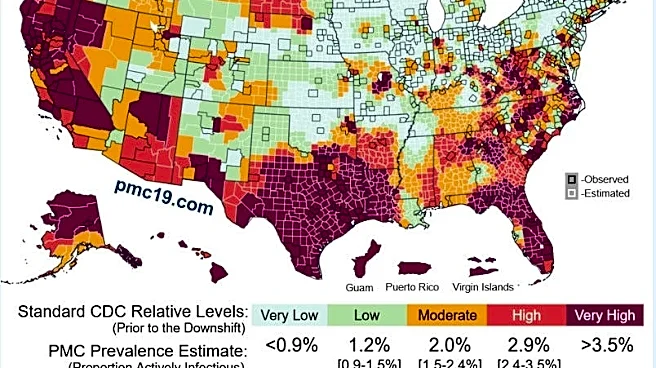
The Mitten is among at least 37 states and three territories are experiencing coronavirus outbreaks, according to the Pandemic Mitigation Collaborative's latest map, which was built using county-by-county data from wastewater samples. It notes: There likely are outbreaks in other states, too, where monitoring is poor, such as Maryland, Idaho, Louisiana and Tennessee.
Here in Michigan, testing of wastewater samples from six Michigan communities show more people in the state had COVID-19 infections in the last week than at any time since March, according to WastewaterSCAN.

Coronavirus activity was considered "high" as of Sept.
16 at collection sites in Ann Arbor, the city of Warren and Mount Pleasant. It was considered "moderate" in Jackson, Jenison and Traverse City, though the data suggests an upward trend.
This meansnow is the timeto get a COVID-19 vaccine, if you haven't already been boosted this season, said Michael Hoerger, who leads the collaborative at Tulane University, where he also is an associate professor of psychology, psychiatry and oncology.
What type of COVID-19 vaccine should I get?
The U.S. Food and Drug Administration authorized the following COVID-19 vaccines, which have been updated for the 2026-27 respiratory virus:
- Nuvaxovid: A protein-based vaccine made by Novavax and Sanofi, which can be used in people ages 65 and older as well as those between the ages of 12 and 64 with an underlying condition, such as asthma, cancer, diabetes or obesity, that puts them at higher risk for severe outcomes from COVID-19.
- Spikevax, an mRNA vaccine made by Moderna, which can be given to people ages 65 or older and to those who are between 6 months and 64 years old with at least one underlying condition that puts them at high risk for severe outcomes from COVID-19.
- Comirnaty, an mRNA COVID-19 vaccine made by Pfizer and BioNTech. It can be used in people ages 65 and older as well as anyone ranging from 5 years to 64 years old with at least one underlying condition that puts them at high risk for severe outcomes from COVID-19.
- mNexSpike, a lower-dose mRNA COVID-19 vaccine made by Moderna that can be used in people ages 65 and older as well as those between the ages of 12 and 64 who have an underlying condition that puts them at risk for severe disease with COVID-19 infection.

CDC shifts how it reports COVID-19 spread
Tracking COVID-19 spread six years after the pandemic began isn't as easy as it used to be, as reporting requirements have changed along with the way the U.S. Centers for Disease Control and Prevention maps the virus on its website.
The federal agency has shifted its analysis of wastewater data in a way that minimizes the risk of infection, said Hoerger.
"The CDC is blue washing to make COVID levels look artificially low," Hoerger said in a video posted on the collaborative's website. "They changed their color-coding scheme to make COVID levels look lower across the U.S. and there are further data anomalies that raise red flags. All of this leaves you less prepared.
"The CDC monitors COVID transmission through wastewater and they take these numeric values and convert them to a color scheme in categories. About a year ago, they made a major update to the system that mostly pushed higher levels into lower categories. This [August], they did the exact same thing, but to a much greater degree."
So, he explained, a level of COVID detection in wastewater that would have been considered very high in the past is now classified as just "high" on the CDC's surveillance map. Similarly, "moderate" spread is now considered "low," which is represented on the CDC's map as the color blue.
"The CDC website is just less reliable for the casual user," Hoerger said. "We warned you that if any funny business like this ever happened, we would catch it right away. Here, we did."
Hoerger and his team developed a heat map that shows county-by-county COVID-19 transmission using raw data collected from wastewater samples that can reveal a clearer picture of how much of the virus is spreading in communities, he said. It allows people to see the data the way it used to be classified, and to toggle to the system the CDC now is using to compare the differences.
Changing federal vaccine recommendations, too
It isn't only the data about COVID-19 spread that's changed at a federal level.
President Donald Trump and Robert F. Kennedy Jr., the U.S. secretary of health and human services, have made dramatic changes to how the U.S. government reviews and recommends vaccines and issues guidelines for their use.
Those efforts have sparked outrage among many in the scientific community, which led the major medical societies and associations to band together in collaboration with the Center for Infectious Disease Research and Policy at the University of Minnesota to launch the Vaccine Integrity Project, which provides evidence-based data on the safety and efficacy of vaccines.
“Vaccines are one of medicine’s greatest success stories,'' said Sarah C. Nosal, president of the American Academy of Family Physicians (AAFP) during an August news conference. "They prevent serious illness, reduce hospitalizations and long-term complications and save lives."
Although they differ from the federal government's guidelines on COVID-19 vaccines, the AAFP's recommendations are closely aligned withthose set by other medical societies, including the American Academy of Pediatrics and the American College of Obstetricians and Gynecologists, the Infectious Diseases Society of America and the American Medical Association, "to ensure continuity for both patients and physicians," Nosal said.
Dr. Ronald Nahass, president of the Infectious Diseases Society of America, said at the news conference that all of the organizations are "speaking with one voice relative to the vaccinations and all acknowledging the challenges of the lack of trust and the lack of clarity.
"The medical community ... is uniform in our effort to bring clarity and to restore that trust."
They suggest:
- All adults 19 years of age and older should get an annual COVID-19 vaccine. It is especially important to get a COVID-19 vaccine if you are:
- 65 years and older;
- At an increased risk for severe COVID-19 infection; and
- Have never received a COVID-19 vaccine.
- All adults ages 65 years and older should get two doses of the updated COVID-19 vaccine. The first should be administered this fall. The second shot should follow six months later to maintain protection against the virus because immunity wanes over time.
- Infants and toddlers between the ages 6 months and 23 months should be vaccinated against COVID-19.
- Kids ages 2 years to 18 years old who are at risk for severe illness from COVID-19 infection should be vaccinated. The same is true for any children whose families choose to vaccinate against COVID-19.
- Anyone who is pregnant should get a COVID-19 vaccine during any trimester. Vaccination also is safe for women who are breast-feeding.
Contact Kristen Shamus: kshamus@freepress.com. Subscribe to the Detroit Free Press.
This article originally appeared on Detroit Free Press: Michigan, much of the U.S. in COVID-19 surge