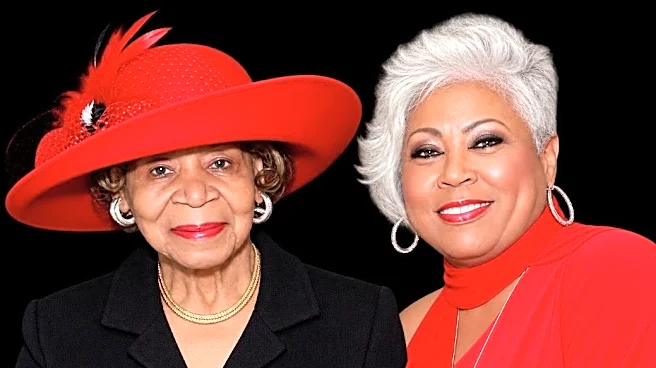










When she visited Maxine Powell’s gravesite earlier this summer, Beverly Bantom arrived with an important message.
Setting her just-published book against the headstone, Bantom addressed her old friend: “We did it. I got it done.”
“Maxine Powell: Motown’s Maven of Class, Style and Refinement” is a 218-page, richly illustrated book that serves as part biography, part celebration of a woman who made her mark in Black Detroit’s high society before becoming a key figure behind the scenes at Motown Records.
There, Powell trained some of the company's biggest young stars in the art of public decorum.

For Bantom, who was entrusted to oversee Powell’s estate following her 2013 death at age 98, the book was a labor of love — and the fruit of a vow she made
long ago.
“I promised her I’d get her book done,” says Bantom, a Farmington Hills resident. “She even gave me a lot of instruction on how things should be worded.”
Before her Motown stint, Powell was an established independent force in Detroit, having carved her path in the 1950s with a finishing school and modeling agency that broke racial barriers with companies such as Chrysler.
Her employment with Berry Gordy's Motown Records ran for just a handful of years in the mid-1960s, but her short time there was crucial: The firm but graceful Powell was a tutor for acts such as the Supremes, training the young Diana Ross, Mary Wilson and Flo Ballard on their presentation at public engagements, red carpets and meetings with royalty.
“What Berry Gordy got out of Maxine Powell were three beautiful, charming Diahann Carrolls, a group that was totally different from others,” Bantom says.
It was that attention to polished style that separated Motown from its label competitors across the country, the author contends. Powell was part of Gordy’s artist-development pipeline, a process that endures today via the Motown Museum’s Hitsville Next youth programs.

“In being an image builder — she wasn’t fond of being called an etiquette teacher — she wanted people to understand it wasn’t about etiquette,” Bantom says. “She felt it was the personal image you portrayed that was important, to be that glamorous person.”
The new book includes forewords by Martha Reeves and Claudette Robinson, along with contributions from fellow Motown alums such as Paul Riser, Pat Cosby and the just-deceased Janie Bradford.
"She was more than an entrepreneur; she was a visionary who redefined possibilities for Black women, setting a new standard of excellence and style," Robinson writes in her entry. "Those she mentored still carry a piece of her with them today."
The opening chapter comes from the subject herself. Before her death, Powell had begun work on the book with New York scholar Michael Dinwiddie, tracing her life story from Texas to Chicago and ultimately Detroit, where she arrived in 1945 and promptly made a splash.
Hired by the Gotham Hotel, a hub for Black social events and visiting celebrities, Powell founder herself rubbing elbows with movers and shakers. By 1951, she’d opened her finishing and modeling school before establishing the Ferry Center, a lavish site available for banquets and parties — including the 1959 wedding reception of then-little-known Smokey and Claudette Robinson.
It was during that time that Powell came to know the Gordy family, including the musically inclined young son Berry, who would later welcome her into the Motown fold as his artists’ popularity blossomed across the globe.
“Her life was so big before Motown,” says Bantom, who describes her late friend as a forward thinker whose real contribution came as “a community builder and connector of people around Detroit.”

During her early decades in Detroit, Powell was little known beyond the city. But over time, she became a familiar figure in the telling of the Motown story, frequently appearing in documentaries, books and articles about the groundbreaking record company.
While Bantom knows that the Motown link is an attention-grabber — it’s in the title, after all — the broader scope of Powell’s life is what she’s eager to illuminate. The author came to realize that even within the Motown orbit, many folks were unfamiliar with the full story.
The book benefits from an array of documents, artifacts and writings left behind by Powell in three storage units, one of which contained about 1,000 pairs of shoes, which Bantom eventually donated for charity.
Befitting Powell's style, the full-color book is elegantly designed, and many pages feature reproductions of Powell’s event programs, business pitches and personal notes. QR codes sprinkled throughout will take readers to Powell’s own voice through interviews archived online.
As Powell prepped Bantom to carry her legacy forward, she was precise. The author recalls one such direction: “Whenever you write or say anything about me after I die, never move ‘class, style and refinement’ out of that order. Don’t switch it.”

That was the backdrop as Bantom set about to do justice to her late friend’s memory, ultimately fulfilling what she describes as a shared mission.
“This is her personal book,” says Bantom. “I was just the vessel that was able to get her legacy out there, so people could understand how important she was not just to Motown, but to culture.”
Contact Detroit Free Press music writer Brian McCollum: 313-223-4450 or bmccollum@freepress.com.
'Maxine Powell: Motown's Maven of Class, Style and Refinement'
By Beverly Bantom
Self-published, 2026
$45, available at maxine-powell.com
This article originally appeared on Detroit Free Press: Maxine Powell quietly shaped Motown style, and a new book tells it all