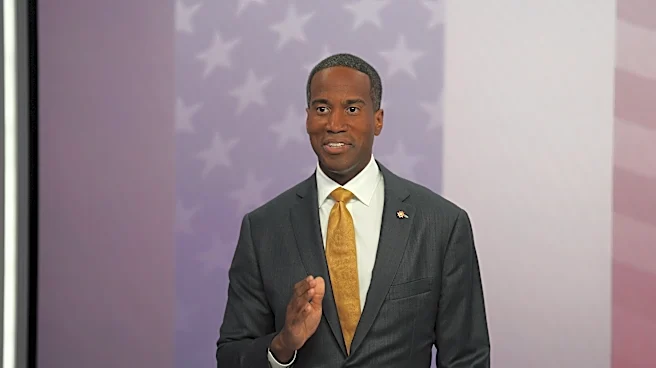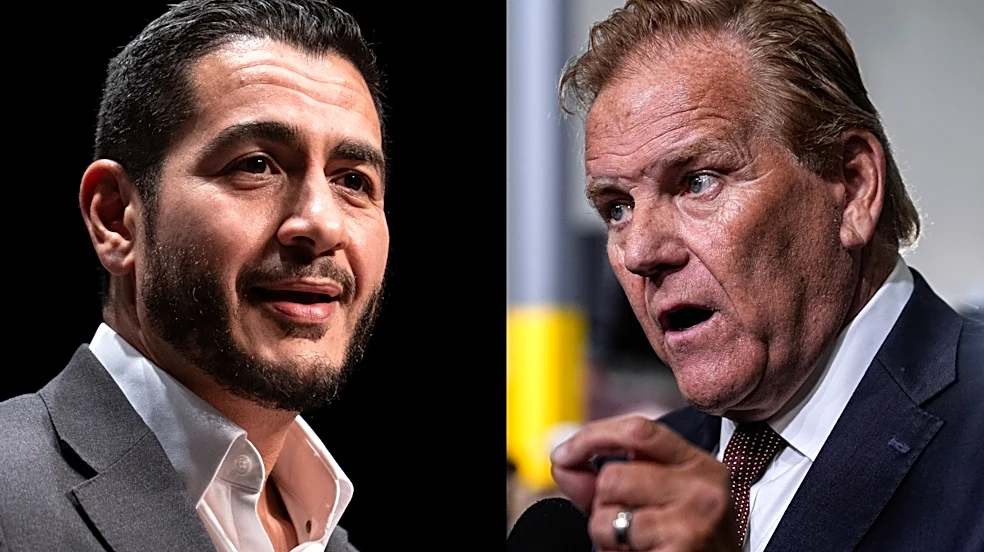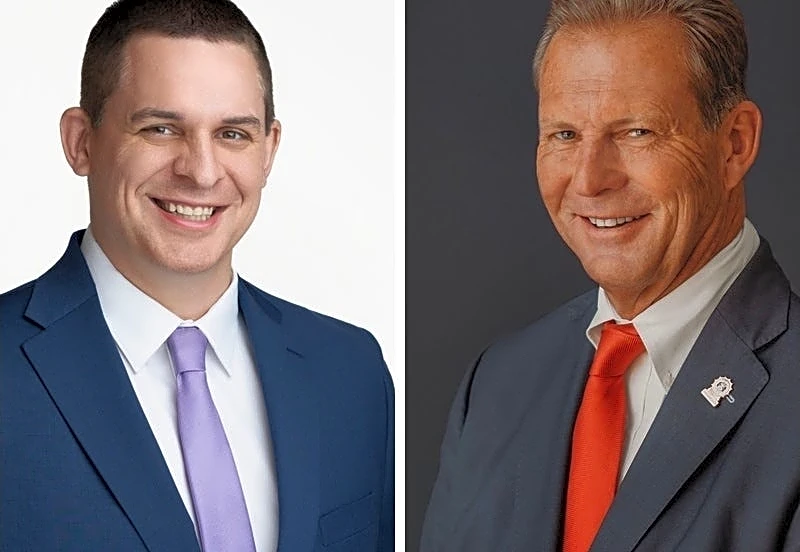




LANSING — With two county prosecutors running against each other for Michigan attorney general for the first time, the Detroit Free Press set out to compare the work and staffing of their two offices.

No simple comparisons are possible.
Washtenaw County, where Democratic AG candidate Eli Savit is prosecuting attorney, has a population more than three times bigger than Eaton County, where Republican AG candidate Doug Lloyd is in charge of the prosecutor's office.
Although both Washtenaw and Eaton counties are designated as "partially rural" by the state of Michigan — largely because part of Lansing and its suburbs spill into Eaton County from neighboring Ingham County — there are fewer people in all of Eaton County than in Washtenaw's largest city,
Ann Arbor.
Eaton County has about 44% more farmland than Washtenaw does, according to the U.S. Farm Service Agency, with 38% of its population living in rural areas, compared to 17% of Washtenaw's population, record show. Studies show violent and property crime rates in urban areas can be two to three times higher, respectively, than in rural areas. At the same time, Ann Arbor has been ranked among the safest cities, both within Michigan and nationally, with an overall crime rate more than 60% lower than Detroit's.
Considering all those factors, some limited takeaways about prosecutions in Washtenaw and Eaton counties are possible, based on selected 2025 criminal case data for the two counties that the Free Press obtained from the State Court Administrative Office.
The Free Press asked the SCAO to pull 2025 data for Washtenaw and Eaton counties for about 25 state offenses, identified by their PACC (Prosecuting Attorneys Coordinating Council) codes. The crimes were randomly selected to represent a cross-section of the criminal code, while including certain offenses relevant to campaign rhetoric.
Who is tough on crime?
One of Lloyd's campaign narratives — him as a tough-on-crime prosecutor facing a soft-on-crime opponent — is not borne out by the statistics, which at best are inconclusive in terms of charges brought to court.
Washtenaw brought 2,288 felony cases in 2025, compared to 461 in Eaton County. That's a rate of 618 felony cases per 100,000 people in Washtenaw compared to 421 per 100,000 people in Eaton. The statewide average in 2025 was 631 cases per 100,000 people.
Washtenaw's assistant prosecutors were busier in 2025 felony-wise, with an average of 69 felony cases each, than were Eaton's, with an average of 46 felony cases each.
Felony drunk driving cases in 2025 totaled 87 in Washtenaw and 35 in Eaton, which is roughly proportional to their populations. But charges of armed robbery were 43 in Washtenaw compared to four in Eaton, records show.
Keith Schipper, a spokesman for the Lloyd campaign, said in an Oct. 5 email that broad conclusions can't be drawn based on data for a limited number of criminal charges. For example, he said the Free Press sample included only two of seven possible child sexually abusive material charges and showed Eaton County bringing three such charges, compared to 17 in Washtenaw. But if all seven possible charges had been included, it would have showed Eaton County with eight cases, he said.
"Obviously the most glaring issue for the comparison is the presence, or lack thereof, of law enforcement resources in the county," Schipper said after reviewing all the 2025 case data the Free Press obtained from the SCAO.
Schipper noted that 2025 was marked by further cutbacks in sheriff's road patrol hours in parts of Eaton County as a cost-cutting measure, after county voters twice rejected tax hikes to support public safety expenditures.
Marijuana/prostitution
Lloyd has criticized Savit for saying he won't prosecute certain crimes, such as possession or small-scale distribution of marijuana, or for prostitution-related crimes he considers consensual work.
The 2025 case data obtained by the Free Press shows that while Savit didn't charge such crimes in any significant numbers, neither did Lloyd.
Washtenaw brought three 2025 cases for delivery or manufacture of marijuana or a synthetic equivalent; Eaton brought zero, records show. Neither Washtenaw nor Eaton charged anyone with possessing or using marijuana.
Schipper said the case data for 2025 doesn't tell the full story, since some marijuana possession cases that year were handled by Eaton County through other measures, such as a diversion program or a civil infraction. He said Eaton County brought charges related to an illegal grow operation in November 2024 and that case was not covered by the data request.
Neither Washtenaw nor Eaton charged anyone with being a "common prostitute" under Michigan law in 2025, though Washtenaw did bring one charge of "disorderly person — illegal occupation," while Eaton brought no such charges, records show. Eaton County brought one charge of "engaging the services of a prostitute," record show. Washtenaw brought none.
Domestic abuse
The most glaring contrasts between the case numbers in Washtenaw and Eaton counties relates to domestic abuse cases: Washtenaw charged 542 domestic violence cases in 2025; Eaton charged 114, records show. Washtenaw charged 55 cases of aggravated domestic assault; Eaton charged three.
There was also a large disparity in stalking cases: Washtenaw charged 18 cases of stalking related to a domestic relationship; Eaton charged zero, records show. Washtenaw charged 68 cases of aggravated stalking; Eaton charged five.
Savit, after reviewing all of the comparative data the Free Press obtained, said he though most of the data was reflective of the population differences between the two counties, as well as the fact that Washtenaw is more urban than Eaton County.
But, he said, the domestic violence numbers were noteworthy.
"Unlike some other offenses, domestic violence is a crime which occurs frequently in rural, urban, and suburban areas, as well as across socioeconomic demographics," Savit said. Washtenaw has "filed domestic violence charges at a far higher frequency than Eaton County, even adjusted for population," he said.
Savit credited the fact his office has specialized domestic violence prosecutors, plus a special fast-track queue to make sure domestic violence cases don't languish.
Lloyd's spokesman did not specifically comment on the disparity in the domestic violence numbers, beyond his broad observation that Eaton County suffers from a lack of law enforcement resources.
Lloyd, during a July 24 interview with the Free Press, singled out domestic violence cases as an example of how prosecutors must put many more hours into each potential criminal case than many people realize.
"Take a simple domestic assault case," Lloyd said.
The call is made and a police officer shows up, or maybe two or three, and each is at the scene one to two hours, he said.
"They then bring that case in," he said. "It's expected of the prosecutor's office that they are going to review the police report. They're going to review any documentation as far as pictures, photographs." Then, with each officer wearing a body camera, there could be six hours worth of body camera footage that a prosecutor would hope to review, he said.
"Well, there's eight hours in a business day," Lloyd said. "I always point out that my assistant prosecutors work a lot more than eight hours."
Contact Paul Egan: 517-372-8660 or pegan@freepress.com.
This article originally appeared on Detroit Free Press: Prosecutions data for Lloyd and Savit cut through AG campaign rhetoric