






City leaders came together this week to promote the latest round of bus shelter and bench installations and announce plans to add more.
The city will install about 100 new shelters and 120 benches through 2027. The additions are part of an ongoing plan to upgrade roughly 400 bus stops. So far, more than 100 new shelters and nearly 80 new benches have been installed.
"We really hope that this turns into a model that we can use to expand for even more bus stops in the future," said Robert Cramer, executive director of transit, during a news conference on Monday, Sept. 28. The new shelters have a solar light and USB charging ports — all part of the overall customer experience, he said.
Ananalysis last year by a transit advocate, using city data, identified
seating at about 5% of stops. At the time, the Detroit Department of Transportation (DDOT) said the figure was misleading because more than a quarter of bus boardings happen at sheltered stops. Still, the city acknowledged thelow percentage of stops with shelters or seating.
Recent data shows the average sheltered bus stop gets 44 boardings a day, compared to stops without a shelter, which see 7 boardings per day, Cramer said in a statement to the Free Press.
Federal, state and city general fund dollars are paying for the shelters and benches, according to a news release. The cost for a new shelter averages about $50,000 and $15,000 for a new bench, Cramer said. As part of theDDOT Reimagined plan to improve thecity's public transit system, and as funding allows, DDOT aims to get 75% of passenger boardings to take place at shelter stops.
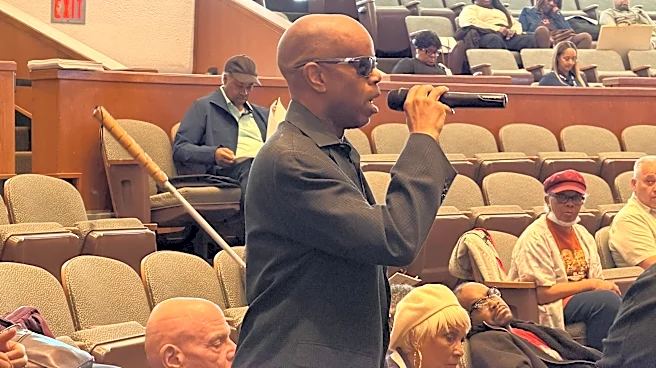
Transit advocateMichael Cunningham, who said he has invisible disabilities and experiences sharp pains, recalled the broken benches and shelters from more than a decade ago and how he had to sit on the ground and lean on poles and buildings.
"It was a bad situation over a decade ago," said Cunningham, a DDOT ambassador who gives out hand warmers, ice water and bus tickets at stops. He applauded the announcement of more seating and shelters, though he said there's room for improvement.
Joel Batterman, campaigns manager for Transportation Riders United, a public transit advocacy nonprofit, also celebrated the progress.
"It's really about dignity for bus riders," he said. "Folks should have a place to sit, a place to take cover from the elements, when they're waiting for the bus. Ideally, they don't have to wait very long, 15 minutes or less is ideal, but when they do need to wait, it's important to have that dignity that's afforded by benches and shelters, as well as accessible paths so folks with disabilities are able to safely get on and off the bus."
Bus frequencies vary by route and time of day from less than 10 minutes to more than an hour, Cramer told the Free Press.
"Wait times and frequency are part of the bus stop scoring we use to identify which stops are suitable for a shelter or bench," he said.
Where are the shelters and benches located?
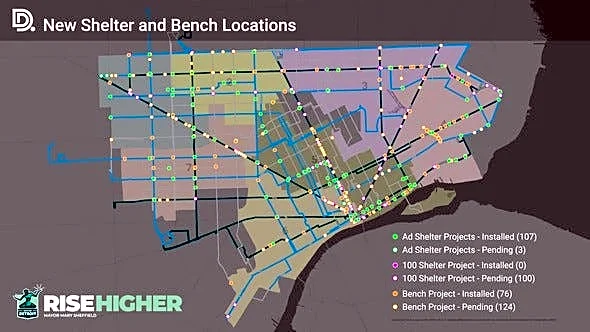
The shelters and benches have been, or will be installed across Detroit, according to a map provided by the city. Several new shelters were added along E. Jefferson as part of a pilot project to ramp up rider experience, timeliness and safety at high volume stops.

Reach reporter Nushrat Rahman at nrahman@freepress.com.
This article originally appeared on Detroit Free Press: Detroit to install more than 200 bus shelters, benches through 2027