







Coleman Young has been gone for almost three decades, and he's still getting blamed for things he didn't do and overlooked for things he did.
“I had a conversation with a neighbor just Sunday night,” Marvin Beatty said a few days ago, and it was the same old grumbling that Detroit’s only five-term mayor tried to run all the white people out of town.
Beatty knew Young, and he knows better. And, as board chair of the Coleman A. Young Foundation, he knows this:
Come Tuesday, Oct. 20, he and his old friends are going to have a very big night, the liftoff for a campaign that will ultimately place a statue of Young at the U.S. Capitol.
A gathering of notables at the Charles H. Wright Museum of African American History will hear details of a fundraising
campaign, meet the sculptor, see a 26-inch-tall version of what will ultimately be close to nine feet of bronze, and learn what a staggering honor it is to be upright in the National Statuary Hall.
"It's been four years in the making," Beatty said, establishing a base after the Michigan Legislature voted unanimously in 2022 to send Young to join President Gerald Ford as the state's two allotted representatives.
Now, as a reward for hard work, comes more of it. The Coleman A. Young Statue Initiative hopes to not only place a sculpture in Washington, D.C., but erect a replica in Detroit − and the first part alone is a tall order.
The people involved don't have an exact number and hesitate to even offer a broad estimate, but $1.5 million or more wouldn't be a surprise.
Pay the sculptor, 31-year-old Detroit native Austen Brantley. Pay for the design and construction of a pedestal. Pay to transport the statue and stand to Washington, D.C. Pay to remove the statue of 19th-century politician Lewis Cass that Young is replacing, to hoist the new artwork into place, to ship Cass home and replant him.
Pay respects to Young, who'll become the first Black man standing amid the 100 historical giants positioned on the Capitol grounds.
'Bring him back to life'
Young was a Tuskegee Airman, serving as a bombardier and navigator in World War II. An auto worker. A block of granite when the powerful House Un-American Activities Committee tried to steamroll union leaders in Detroit: "You have me mixed up with a stool pigeon, sir."
He was Michigan's second Black state senator, Detroit's first Black mayor, an encyclopedia entry long before the internet made everybody one, and Georgella Muirhead's boss for his last seven years in office.
“I’m jumping up and down here,” said Muirhead, 76, his former communications director and now co-chair of the initiative's steering committee.
The mayor, she said, “would not have been surprised” to see his cantankerous, fearless, funny self immortalized, though “he might have had some colorful comments about it.”
She can hear him growling that it was about damned time − but she recognizes that for more than a generation of Detroiters, he's mostly a name on a downtown office building and an eastside airport they don't go to.
“We’re trying to bring him back to life,” she said, “so people can understand why he deserves this kind of recognition.”
The accomplishments are easy to look up. The misconceptions can be hard to deflect.
No, he didn't create white flight, and neither did the 1967 riot, though that was certainly an accelerator. Detroit had been losing population to the suburbs since the 1950s.
No, he didn't spend Detroit into insolvency. A Free Press study published in September 2013, two months after the city declared bankruptcy, found that "Young was the most austere Detroit mayor since World War II, reducing the workforce, department budgets and debt during a particularly nasty national recession in early 1980s."
No, he didn't dismiss white-led businesses, the people who led them, or federal help, even if he called President Ronald Reagan "Pruneface." Whatever their flaws, projects completed during his 1974-94 tenure included the Renaissance Center, Joe Louis Arena and the Detroit People Mover.
"You could be in a room," Muirhead said, "and he'd say, 'Let me ask Henry about that.' Next thing you know, there's Henry Ford II on the phone."
That's too much to fit on the base of a statue, but it matters.
Unanimous votes for Young
Young died of emphysema in 1997. He was 79.
Adam Hollier was 12, a 7th-grader at P.J.M. Hally School in Detroit, and Young's funeral and procession were on the social studies teacher's television all day.
He thinks her name was Mrs. McWilliams. He's certain she was crying.
Hollier, 41, grew up to be a Michigan State Senator, serving from 2018-22. There, said Beatty, "he was the architect of this endeavor," winning unanimous votes in both chambers for the resolution that will send Young to Washington.
Step one, Hollier said, was to get Democrats on board. It took more persuasion to align what was then a Republican majority; it helped that Republicans had already elevated Ford, who replaced abolitionist Detroit mayor, Secretary of the Interior and U.S. Senator Zachariah Chandler.
Young, Hollier would say, embodied the boldness and determination that typify Michigan.
Colleagues offered alternatives – Sen. Carl Levin? Reps. John Dingell or John Conyers? Maybe Berry Gordy or Rosa Parks? – “but there was never a list for me,” he said.
There was only a larger-than-life mayor of Detroit with a statewide footprint. Hollier kept chiseling away, and ultimately earned the complete support he wanted as a platform for Young’s sculpture.
“When you look in the statuary hall,” he said, “you don’t want that person to be there representing Democrats only, or Black people or white people.”
And by 2022, you didn’t want to see Lewis Cass.
From Cass to Young
Cass' accomplishments were noteworthy: senator, ambassador, cabinet secretary twice, 1848 Democratic candidate for president.
But: He was a slaveholder. A leading voice for the doctrine of popular sovereignty, which held that each state should be able to permit owning people as it wished. The architect of the Indian removal campaign that became known as the Trail of Tears.
His marble statue has been in place since 1889, and even if it still gleams, it's badly tarnished.
"There's been a lot of people born into politics since that statue was installed," said Jeremy Dimick, director of curatorial and collections for the Detroit Historical Society. "I was surprised when Ford went in that Cass wasn't replaced at that point."
Congress passed a law in 2000 that allowed states to swap out their statues. Seventeen new figures have been installed since, including Amelia Earhart for Kansas and Johnny Cash for Arkansas. Virginia spirited away Robert E. Lee in favor of early civil rights activist Barbara Rose Johns.
Cass' new home has not been determined, Beatty said, though it will be in mid-Michigan.
"It becomes this really interesting shorthand," Dimick said, "for who's important in your state's history."
Then comes turning the decision into art.
Getting the mayor right
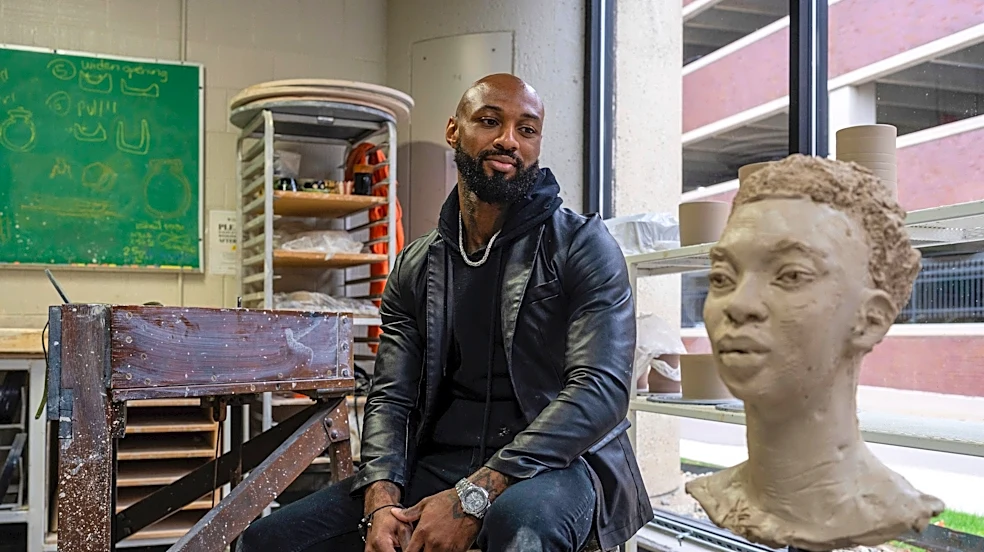
A ceramics class at Berkley High School launched Brantley on a highly public career with a deliberately muted last 18 months.
His public installations include a statue of civil rights martyr Viola Liuzzo at the park named for her in Detroit, a pair of students outside his alma mater, and the boxer dressed for golf along the Joe Louis Greenway.

The Coleman Young commission has been so deeply under wraps that he was only allowed to tell his parents, Myrna and Drake, a year into his work on the scale model known as a maquette. There's money to be raised yet, and the more secrecy, the bigger the splash.
The maquette will be unveiled Tuesday at the Wright, then return with him to his studio.
It’s been a challenge to get comfortable with Young’s pose.
“I like the aspect of his ambition,” Brantley said. “I wanted to create him as a type of builder. Someone who sees where things can transform, where they can grow.”
At first, Young had his hands on his hips. That changed, and while he can’t say to what – the surprise is part of the attraction – “I feel like I’m close at this point.”
'Hit the road!'
The Detroit Free Press will also play a role Tuesday.
Young's life was closely chronicled in print for a quarter-century, and if the attention was sometimes useful, he made it clear that the relationship was love-hate, and tilted toward the latter.
The Detroit Press Club, long defunct, used to hold an annual comedy revue called the Steakout. Mayors traditionally attended, but one year, the event fell when Young was vacationing in Hawaii.
Dialing in, he was patched through to the ballroom public address system, and he greeted the packed house with a cheery island welcome:
"Aloha, (bleeper-bleepers)!"
The Coleman A. Young Foundation, which administers the scholarships Young endowed with a $1 million gift, asked the Free Press and a few other newspapers to provide front pages to display in what it's calling a Historic Newspaper Headlines Gallery.
Our contribution includes the account of Young's first inaugural address in January 1974, the one in which he did not tell white people to clear out.
“I issue an open warning now, to all dope pushers, to all rip-off artists, to all muggers. It’s time to leave Detroit. Hit Eight Mile Road!” he said, and then he was interrupted by a standing ovation.
“And I don’t give a damn if they’re Black or white," he continued, "if they wear Superfly suits or blue uniforms with silver badges. Hit the road!”
Beatty said his neighbor, the one clinging to a imaginary sound bite from the past, will be at the Wright.
Best case, Beatty, 76, a former deputy fire commissioner, can steer him to the story.
Otherwise, he can repeat what he told the gentleman already about Young supposedly directing Caucasians to the border:
"I told him, 'You still live in the city, so obviously, it didn't work.'"
Reach Neal Rubin at NARubin@freepress.com.
This article originally appeared on Detroit Free Press: Coleman Young is headed to the U.S. Capitol. We all should remember why