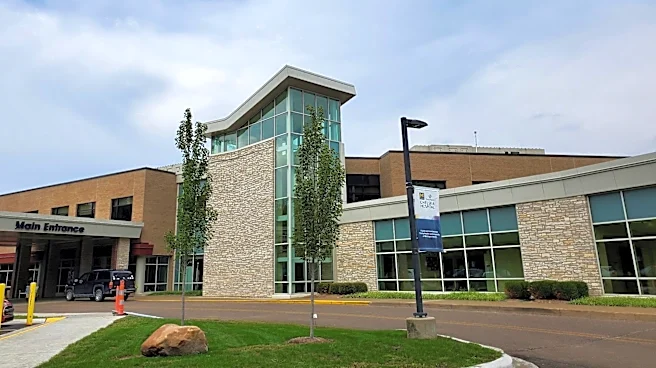









Michigan's health care labor movement got a boost in September, when nurses at Trinity Health Chelsea Hospital won certification from the National Labor Relations Board to unionize — becoming the first and only labor union at the Washtenaw County hospital.
"It's huge," said registered nurse Kindra Weid, 48, of Manchester, who is among the roughly 330 registered nurses who organized with the Michigan Nurses Association (MNA) and can now begin collective bargaining to negotiate their first contract.

The hope, she said, is to begin negotiations before the end of the year.
Among the key issues, she said, are wages and nurse-to-patient ratios at the hospital, which has 103 staffed beds and is jointly owned and operated by Trinity Health Michigan and the University
of Michigan Health.
The Chelsea hospital nurses join thousands of other nurses, respiratory therapists, medical technicians and others across Michigan to organize labor unions in recent years — part of a swell of labor activity in the state's health care sector.
In August, about 10,000 Corewell Health registered nurses who organized as International Brotherhood of Teamsters Local 2024 ratified their first contract with the state's largest health system. Bargaining stretched for more than a year, but the union negotiated a 15% pay raise over the course of a new, three-year contract.

And in the Thumb, as many as 900 health care workers in three different bargaining units at McLaren Port Huron Hospital are now organizing with two unions — the American Federation of State, County and Municipal Employees (AFSCME) Michigan and the Teamsters, the Port Huron Times Herald reported.
Aaron McCormick, president of the Michigan Nurses Association, said its ranks have swelled to more than 14,000 statewide.
"Health care professionals, and especially nurses, across the state are joining together with their comrades and they're fighting for their rights," McCormick said. "They're fighting to have a voice. They're fighting to have a say in their working conditions.
"I think it's happening now because they're tired. They're exhausted by the conditions they have had to endure throughout the years, and they are ready to speak up and fight back."
Bucking the trend
Although the U.S. Bureau of Labor Statistics reports that union membership across the Michigan workforce fell by about 15,000 people between 2024 and 2025 statewide — declining from 13.4% in 2024 to 13.0% in 2025 — the trend appears to be swinging in the opposite direction when it comes to the state's health care workers.
About 80% of employees at Michigan Medicine, the Ann Arbor-based academic medical center of the University of Michigan, now belong to a labor union, according to the Service Employees International Union (SEIU) Healthcare Michigan.
Roughly 4,000 of those workers are represented by SEIU Healthcare Michigan. Its University of Michigan Health bargaining unit ratified its first contract in November 2024. Additional classifications of workers were added to the union in October 2025.
Another 4,600 Michigan Medicine workers secured their first contract in 2025, organizing as the United Michigan Medicine Allied Professionals AFT Local 6739, AFL-CIO.
SEIU Healthcare Michigan says it represents more than 16,000 health care workers statewide and more than 8,000 nursing home workers. It added another 32,000 home care workersto its membership in October 2025. Those members provide at-home support like bathing, cooking, toileting, and mobility assistance to Michigan's aging population as well as to people with disabilities.
Weid said the forces that are affecting registered nurses at the Chelsea hospital are similar to what's affecting other health care workers across Michigan as hospital consolidation has sweptthrough the state. Larger health systems have gobbled up independent hospitals and smaller health systems — driving down competition.
Trinity Health Michigan and the U-M Health's joint venture at the Chelsea hospital in 2018 gave 51% ownership to Trinity and 49% to U-M.
Pandemic-era pressures persist
The COVID-19 pandemic intensified the pressure on hospitals and health care workers, Weid said, making retention of staff harder, and in the five years since, conditions haven't gotten much better.
"I grew up in Chelsea and I grew up in the halls of this hospital," said Weid, who has worked at Trinity Health Chelsea Hospital for more than a decade. "My mom was a nurse there and she started in the late '70s. Chelsea has truly been a community hospital ... and was a very coveted place to work. When I hired in back in late 2015, I was working with nurses that had worked alongside my mom when she was pregnant with me.
"It was a place where people stayed, and where turnover had been pretty rare."

Now, she said, the hospital's nurses are leaving for higher-paying jobs at nearby health systems, such as U-M's Ann Arbor hospitals and Henry Ford Jackson Hospital.
"We are bleeding staff," Weid said. "If you don't have staff to fill positions, then you have a higher ratio of patients to nurses, which creates unsafe staffing environments for patients. ... It really affects the quality of care that you can provide, and it affects how you feel at the end of a shift. ... It's like being on constant high alert for 12½ hours.
"We're seeing a higher demand on nurses at Chelsea hospital. We've seen some corporate pressures on census and on staffing. .... The nurse-to-patient ratio we can retain is dependent on how many staff we can keep at the hospital. And in the last five years, we have not kept up with competitive wages and we are losing ground."
That hurts, she said, when she thinks about who she's treating.
"I can't tell you how many times I've taken care of my neighbors or the parents of the people I went to high school with," Weid said. "We are taking care of our own community."
In a statement emailed to the Detroit Free Press, a spokesperson for Trinity Health Michigan said: “Chelsea Hospital has received certification from the National Labor Relations Board (NLRB) confirming that nurses at the hospital have voted in favor of union representation through a secret ballot election.
"While we value a direct partnership with our nursing colleagues and work hard to foster a safe, supportive, and inclusive work environment, we respect the decision made by those who participated in the vote. Our focus remains on providing high‑quality, compassionate care to our patients and supporting the dedicated nurses who deliver that care every day.”
Contact Kristen Shamus: kshamus@freepress.com.Subscribe to the Free Press.
This article originally appeared on Detroit Free Press: Trinity Health Chelsea Hospital nurses join growing unionization push