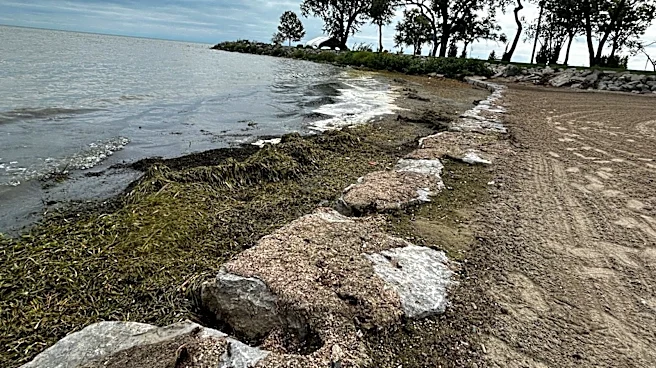










Tony Wheaton said it can take 10-15 minutes, going about 5 mph, to wade through the muck along the shoreline of Campau Bay in Harrison Township into the more open waters of Lake St. Clairbefore he can pick up speed in his 44-foot cabin cruiser.
For the last 12 years, he said, he's lived around the corner from the nearly 70-year-old Huron Pointe Yacht Club, where he is commodore, which is on South River Road near the bay. Wheaton keeps his boat near his house, in a canal that enters into the bay.
"We can't swim in our canal," Wheaton said. "You sink to the bottom, your knees in muck."
In the bay, he said, it's worse − around 3 feet of muck called Microseira wollei (M. wollei), a type of blue-green algae also known as cyanobacteria. Homes in that
corner of the bay, he said, are supposed to be lakefront property, but residents can't go out in the water because theMicroseira wollei (M. wollei), which everyone just calls muck, piles up. Right now, he would say, residents have lakeview, not lakefront, properties.
That could change for this pocket of the lake and two others: the marina at Hidden Cove Condominiums in Harrison Township, south of the Clinton River spillway, and Veterans Memorial Park in St. Clair Shores.

Macomb County is launching a three-year project to remove the muck in those areas and learn how to manage it long-term. The field trial is to look at removal techniques; study how long it takes wind and waves to redeposit it to the shore, and to remove it from the lakebed to examine its potential regrowth or migration.
A separate section of the lakebed in the bay is also to be cleared of Microseira wollei (M. wollei) to determine growth and migration patterns, county, local and state officials announced in July.
The areas were selected because they have less wave action, the water is more stagnant, and the muck is more densely matted. The field trial is funded by an $800,000 state earmark awarded to the county's public works office.
Work was anticipated to start in September, but it hasn't begun yet. County Public Works Commissioner Candice Miller said the contractors are working through the permitting process.
"I don't have jurisdiction over Lake St. Clair or the permitting or staff or resources," she said. "But we're very focused on everything we can do to protect the lake ... We're not sure how this will go, but (we'll) get rid of the muck as best as we can."

Some permits approved, others in the pipeline
Lake St. Clair is not only used for recreation, it also provides drinking water to some and is known for world-class fishing and, Miller said, is generally "very healthy." County Executive Mark Hackel said in August that the freshwater lake is a $2.2 billion economic engine for the county and southeast Michigan.
Miller said the water at the public beach at Veterans Memorial Park hasn't been usable for a number of years, though she won't guarantee this work will reopen it. She said the boat wells at the Hidden Cove location also haven't been usable for a number of years and the muck is packed in, now 5-6 feet deep. And the bay's water is stagnant.redging permits for two sites were approved earlier this week, Andy Hartz, district supervisor of the water resources division for the Michigan Department of Environment, Great Lakes, and Energy office in Warren, said Thursday, Sept. 24. He said the permits are awaiting final processing by administrative staff.
He said one permit is for the site at Hidden Cove, the other at Veterans Memorial Park; and they are good for five years. Hartz did not believe a permit request had come in yet for the work at the bay. He said there is plenty of time to get the work done this fall if that's when the parties choose to do it.
Miller's office said Dean Marine & Excavating in Mount Clemens and Sediment Lakes Aquatic Management (SLAM) in Harrison Township were chosen for the job, with work starting pending their permit applications and review by the state as well as the U.S. Army Corps of Engineers.
Brandon Hubbard, public affairs specialist for the U.S. Army Corps of Engineers Detroit District, said the contractor will need permits from the agency for vegetation removal without disturbing the lake bottom as well as a water quality certification from the state. Once approved, the permits will be valid for five years.
The Detroit District received one application for Harrison Township and one for Veterans Memorial Park within the last 30 days, Hubbard said in an email. Both are pending.
"We typically decide within 30-60 days, depending on the number of incoming applications," he said.
Hubbard said he didn't have access to permit specifics, but it is standard to submit the requests jointly with the state, so it is likely that the location in Harrison Township is the same as the state permit, which is for the Hidden Cove spot.

Cost to clean up 10 sites estimated at $3.3M
The public works office said the muck grows on the lakebed, possibly as far as 1.5 miles offshore; becomes dislodged through wind and wave agitation; floats to the surface, and deposits along parts of the shoreline. The mats usually are dark green or black and can have an unpleasant smell, according to the state. It sometimes looks like pellets along the shoreline.
Miller's office said this phase in tackling the issue was by the U.S. Army Corps of Engineers after wildlife biologists at its Engineer Research and Development Center in Alabama in 2024 completed a two-year field research and sampling analysis of it in the lake. That work was funded by a $400,000 study that was paid for by theU.S. Army Corps of Engineersand the county.
A Request for Proposals (RFP) for this field trial was published to receive methods and pricing from a variety of contractors with experience working in the lake and included information on multiple sites, even though available funding could not cover the cost of cleaning all the sites, according to the letter of agreement for the field trial provided by public works.
It said that based on the results, cleaning 10 shoreline locations would cost more than $3.3 million based on figures provided by the lowest qualified bidder.

Based on funding and being guided by field trial goals, the agreement said, three shoreline locations were chosen: Campau Bay shoreline at South River Road and Lakeshore near the mouth of the Clinton River; Hidden Cove Condominium Inlet south of the river's spillway; and Veterans Memorial Park.
"These locations provide the best opportunity to study redeposit rates at three distinct areas along the Lake St. Clairshoreline. They are also a combination of private and public sites in Harrison Township and St Clair Shores. Thelakebed location in Campau Bay provides the most opportune access to document M. Wollei in the lakebed prior toremoval and afterward, given the bay’s geography and proximity to local infrastructure," according to the agreement.
It said Dean Marine & Excavating focuses on excavation removal techniques and will be awarded the Hidden Cove Condominiums and Veterans Memorial Parkprojects, while SLAM focuses on hydraulic removal techniques and will be awarded shoreline and lakebed muck removal projects in the bay.
"It is well understood that this field trial is not a complete solution and will not be able to address all areas of theshoreline that are affected," the agreement said. "It should be noted that the (county public works) has no jurisdiction, nor does the department receive any funding for maintenance of Lake St. Clair. This issue is clearly way beyond the scope of a single county department. The purpose of this field trial is to provide actionable information for larger state and federal projects to ultimately remove and potentially treat the M. Wollei algae in the affected lake areas to prevent regrowth."
Yacht club commodore: Muck also can damage boats
Miller said the muck will return after it is removed; it's a matter of when. But she hopes they can find a way to stop it from coming back.
Wheaton said the muck, which he noticed got worse in the bay about six years ago, not only can affect property values, but also can damage boats because it gets sucked up into cooling systems.
"If you blow up a motor, overheating from this, it can cost up to $20,000," he said. "That's one motor. Most bigger boats have two motors, like mine."
Wheaton said it's hard to get bigger boats in the yacht club's harbor with the muck, and dredging would cost $150,000, which the club doesn't have. He said it's leased boat slips to smaller boats. He said some people have switched to pontoon boats, which he said don't need as much water.
Wheaton said some people won't come back to the yacht club as members if they decide to keep their boat elsewhere. He said the club has 168 memberships, equating to about 300 members.
He said once boaters get past the muck, "everything is fine" on the lake. The cleanup would definitely bring up property values and be easier on boats.
"It would make everything easier," he said.
Contact Christina Hall: chall@freepress.com. Follow her on X, formerly Twitter: @challreporter.
Support local journalism. Subscribe to the Free Press.
Submit a letter to the editor at freep.com/letters.
This article originally appeared on Detroit Free Press: Lake St. Clair muck removal planned in Michigan, permits in the works