
After a Michigan camper was hospitalized from a rattlesnake bite in Oakland County, many residents may be wondering how to identify Michigan's only venomous snake: the eastern massasauga rattlesnake.
On
Tuesday, July 21, a person camping in Commerce Township in Oakland County was bitten by a rattlesnake. The individual was taken to the hospital for medical treatment as the bite contained venom.
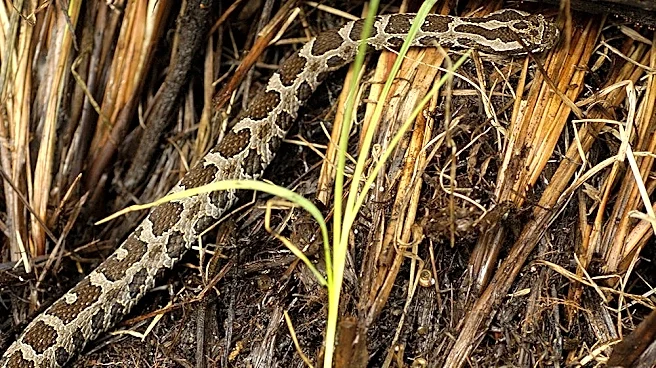
On Wednesday, July 22, the Commerce Township Fire Department posted a public safety notice on Facebook to spread awareness of the rare incident. The post included an image of an eastern massasauga rattlesnake which is the only venomous snake inhabiting Michigan among the 18 other non-venomous species.
Encounters with the eastern massasauga rattlesnake are rare because of their innate shy and non-aggressive behavior, though they can still occur, and they are active throughout the summer. They inhabit only the Lower Peninsula favoring wetlands, hence their nickname, "swamp rattlers," according to the Department of Natural Resources.
The rattlesnake was listed as a threatened species in 2016 by the U.S. Fish and Wildlife Service under the Endangered Species Act due to their declining habitat and persecution by people, making them a protected species statewide.
Here's a breakdown of the eastern massasauga rattlesnake:
Meet the only venomous snake in Michigan: eastern massasauga rattlesnake

The eastern massasauga rattlesnake is venomous, but encountering the snakes is rare because of their secretive, aloof nature.
Michigan appears to be the last stronghold for this species with more massasauga populations currently than any other state or province within the species' range, the Michigan State University Extension said.
Eastern massasaugas have been found in a variety of wetland habitats, including bogs, fens, shrub swamps, wet meadows, marshes, moist grasslands, wet prairies, and floodplain forests, the MSU Extension said.
"Historically, they could be found in a variety of wetlands and nearby upland woods throughout the Lower Peninsula," the DNR said.
The snakes have been seen in nearly every Lower Peninsula county, as well as Iowa, Missouri, Wisconsin, Indiana, Illinois, Ohio, Pennsylvania, New York, and Ontario, Canada.
Massasaugas usually are active between April and late October, the MSU Extension said. Spring emergence typically starts in late March and early April as groundwater levels rise and ground temperature approaches air temperature.
Massasaugas spend most of the time in the spring basking on elevated sites, such as sedge and grass hummocks, muskrat and beaver lodges, or dikes and other embankments.
How to identify the eastern massasauga rattlesnake
They have a wide triangular face, thick-body, and most often are gray, light brown or black with a pattern of brown or black blotches along their bodies. In adulthood, they grow to 2-3 feet in length.
Oftentimes, they are mistaken for look-a-like species such as the eastern milk snake, eastern fox snake, eastern hog-nosed snake and the Northern water snake, so look for their distinct segmented rattle tail.
The rattle noise is "best described as a buzzing sound, similar to one made by a bee stuck in a spider web," MSU Extension said.
What do eastern massasauga rattlesnakes eat?
Massasaugas eat small mammals such as voles, moles, jumping mice and shrews, but also will consume other snakes, and occasionally birds and frogs.
Animals that prey on the snakes include hawks, skunks, raccoons, and foxes. Massasaugas also are commonly killed by humans.
What do I do if I encounter an eastern massasauga rattlesnake?
Due to the their declining populations, officials urges residents to report any sighting with a photo. Do not attempt to move, or handle the snake in any form.
If you come across a snake basking in the sun, officials recommend residents leave it alone and give it space. The National Park Service suggests giving a snake 10 feet of space.
What should I do if I am bitten by a snake?
The severity of a snakebite depends on what species of snake it was from, though all bites should be treated and seen as an emergency.
A non-venomous snakebite is called a dry bite, and a venomous snakebite is called a venomous bite.
If an eastern massasauga rattlesnake bites, their short fangs can inject only a small volume of venom, MSU said, so fatalities are rare, though small children and people with preexisting health conditions are at greater risk.
The U.S. Forest Service and Commerce Township Fire Department recommend steps to follow after a venomous snakebite:
- Call or radio 911 immediately.
- Keep calm and as still as possible.
- Wash the area with soap gently and immobilize area.
- Remove rings, watches or any restrictive clothing before the bite swells.
- Keep bite below heart if possible.
- Go to the nearest medical facility.
What is the difference between venomous and poisonous?
Mixing up "poisonous" or "venomous" in a sentence is understandable, as they both describe a type of toxin that could inflict bodily harm. However, there is an important difference.
"Poison and venom are two kinds of toxins. That means they’re substances that cause damage to living things," the Cleveland Clinic said.
Here's the difference according to the National Park Service:
- Poisonous refers to a toxin that gets into the body by inhaling, swallowing, or absorption through the skin. Examples include poison ivy, bleach or pesticides.
- Venomous refers to a toxin that gets into the body by being injected, usually by a bite or a sting. Examples include certain snakes, box jellyfish and the brown recluse spider.
Contact Sarah Moore @ smoore@lsj.com
This article originally appeared on Detroit Free Press: How to identify Michigan's venomous eastern massasauga rattlesnake