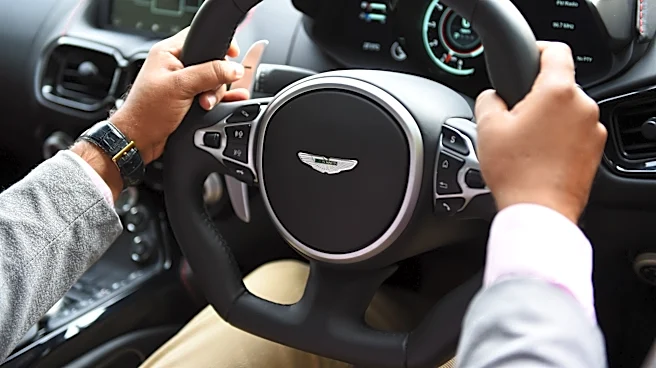









The first thing a lot of us learned in driver’s ed – where to put your hands on the steering wheel – no longer applies.
Whether you were taught your hands belonged at 10-2 on an imaginary clock face, 9-3 or even 8-4, the first rule of driving school has been replaced by a range of choices. (Digital natives are excused to Google “Analog clock face.”)
“Recommendations relative to hand position on the steering wheel have become more flexible,” due to new shapes for steering wheels and technical advances ranging from steering to air bags, according to the National Highway Traffic Safety Administration publication “Using Efficient Steering Techniques.”

When you consider how much time we spend with our hands on the steering wheel, it’s remarkable how little
data exists on the right versus wrong way to do it.
“Very little research is done to prove one is better than the other,” Becky Mueller, Insurance Institute for Highway Safety senior research engineer, told me. “The most recent research is from 1997-’98. That’s really old data based on first-generation air bags.”
9-3 position gets AAA stamp of approval
But the longtime instruction of hands at 10 and 2 o’clock on the steering wheel is even more outdated, said Rachel Wilson, director of driver education programs for AAA – The Auto Club Group.
“The 10 & 2 hand position is no longer recommended. (It) was commonly recommended when vehicles did not have power steering because it made turning the wheel easier,” Wilson told me. “In modern vehicles with power steering, this higher position is no longer necessary.”
Wilson cited 10-2 disadvantages:
- The higher grip can cause the arms to straighten more, reducing comfort and control.
- Drivers using the 10 and 2 position may be more likely to oversteer in an emergency because pulling down on the wheel is a stronger, more natural movement than lifting up.
- A lower hand position helps drivers make more precise steering inputs and avoid excessive steering corrections.
AAA now recommends hands at 9-3 or even 8-4.

Control in emergency maneuvers
The driver’s hands being 180 degrees apart at 9-3 “provides the greatest steering control and leverage,” Wilson said. “It allows for quicker, more precise steering and better control during emergency maneuvers.”
It also allows driver to turn the wheel farther before repositioning their hands, she said.
“Most turns can be completed with fixed-hand steering, without moving hands on the wheel.”
AAA recommends drivers try 8-4, too. Some drivers find it less fatiguing, though it provides slightly less control, particularly in emergency maneuvers and drivers can’t turn as far before relocating their hands.
Air bags can be a concern
Support for 9-3 rose as steering wheel-mounted air bags became common, then universal.
There was concern about air bag deployment – no matter how well controlled, it’s still an explosion – burning drivers’ arms or throwing the arms back into the driver’s face.
In the past, IIHS downgraded some vehicles’ safety rating because the air bag burned the “skin” on a crash test dummy’s arm.
Air bag engineering has come a long way since then. Modern air bags benefit from advances that make them less likely to cause injury or burns.
In addition, “Air bag-related facial injury risk generally decreases as the hand moves lower on the steering wheel,” Wilson said:
- 8-4: Lowest risk
- 9-3 Moderate risk
- 10-2 or higher: Highest risk
Support for hands at 8-4 is recent, IIHS’s Mueller said.
“The risk of injury from air bags is probably much lower with modern air bags,” she said, adding the steering wheel should be at least 10-12 inches from the driver’s chest.
“If you have a hard time picturing that, put a sheet of 8 by 10 paper between yourself and the steering wheel.”
More research needed
It’s hard to get real-world data on hand-position benefits and drawbacks, Mueller said.
Drivers may not remember or accurately report where their hands were in an accident, and crash data omits the overwhelming majority of the time when nothing goes wrong.
On top of that, crash test dummies aren’t updated often, and air bag injuries haven’t been a major concern.
“We may get better data as more vehicles are equipped with cameras and driver-monitoring systems,” Mueller said.
AAA tips on driving and mirror position
- Sit in a comfortable, upright position at least 10 inches from the steering wheel.
- You should be able to operate the brake pedal and accelerator without lifting your right foot from the floor.
- Adjust the rearview mirror to show the entire rear window.
- Viewing the mirror should only require eye movement, not head movement.
Driver-side mirror:
- Lean your head against the driver’s window.
- Adjust mirror so you can barely see the side of the car.
Passenger-side mirror:
- Lean toward center of car.
- Adjust mirror so you can barely see the side of the car.
Source: AAA The Auto Club
Contact Mark Phelan: mmphelan@freepress.com. Follow him on Twitter @mark_phelan. Read more on autos and sign up for our autos newsletter. Become a subscriber.
This article originally appeared on Detroit Free Press: The first thing you learned in driver’s ed is wrong. What to know.