






Dan Gilbert is opening his personal wallet to help with the $2.2 billion proposal from General Motors and his own real estate firm for redeveloping downtown Detroit's Renaissance Center and the nearby riverfront.
But is he opening the wallet wide enough?
That question is increasingly at the center of public debate over the development project as it heads toward a crucial round of city votes that start the week of Oct. 26.
The project calls for a unique and complex arrangement of tax abatements and incentives that has never before been tried in Michigan, with tens of millions in voluntary payments coming from the development to fund city services.
In projects with more ordinary incentive structures, local tax revenues typically get siphoned away
to the developers. These incentives, by comparison, would mostly draw from future state-level taxes generated at the completed development.
GM and Gilbert's real estate firm, Bedrock, say they designed their arrangement to maximize future funding for Detroit while still giving the $2.2 billion RenCen project the boost it needs to get built. Even with the incentives, worth an estimated $548 million, the development is only expected to have a 1% cash-on-cash return on investment.
Ordinarily, projects with such slim returns don't make business sense and do not get built.
The new RenCen also is to be developed, owned and operated by a nonprofit organization. Gilbert is putting $1 billion toward the nonprofit as Bedrock's equity contribution for the project, with GM putting down $250 million.
GM and Bedrock have been emphasizing the philanthropic aspects of the development as they race to get all of its city-level approvals in hand before Detroit City Council goes on break in December.
Even so, the project has come under significant criticism during a series of public hearings that began in August, with some residents and community activists calling on the developers to go further by giving direct public ownership of the development, plus revenue-sharing with the city. The Renaissance Center is currently owned by GM.
There also was a tense exchange Oct. 22 between the Bedrock CEO and a city councilman on whether Bedrock and GM truly need all the incentives they are seeking.
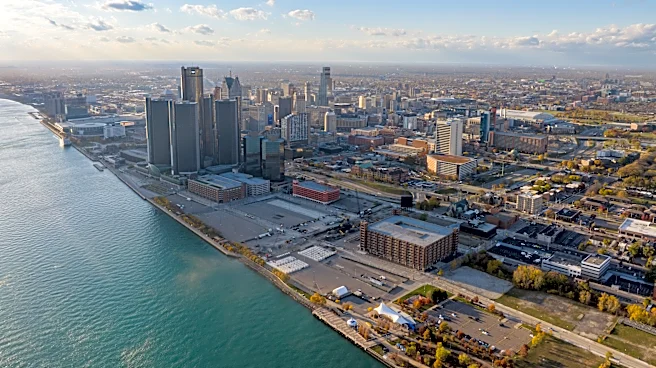
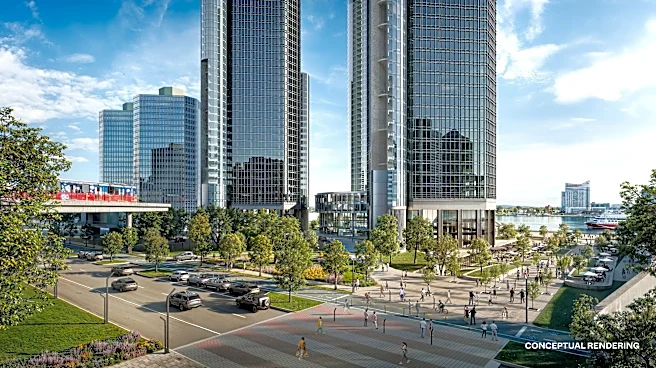
The redevelopment calls for demolishing two of the original 1970s RenCen towers and the complex's multistory podium, repurposing the remaining two towers and then turning the nearby east riverfront into public space and an amenity-filled attraction comparable to Navy Pier in Chicago. Final approval for the project needs to come from the Detroit City Council and the Michigan Strategic Fund in Lansing.
A final version of the project's much-awaited Community Benefits package from the development partners, filled with millions of dollars' worth of commitments, concessions and gifts such as small business grants and free parking, was expected to be unveiled and voted on Tuesday evening, Oct. 27, by a neighborhood committee — a step before an eventual city council vote on the package.
And on Thursday, Oct. 29, a city council committee is expected to consider key portions of the development's $548 million request for tax abatements and other incentives.
A tense exchange
The head of Gilbert's Bedrock real estate firm, Jared Fleisher, faced pointed questions and skepticism the week of Oct. 19 from a few council members during that committee's first review of the request.
Not everyone seemed to be buying the Bedrock and GM argument that their project was essentially a gift to Detroit.

"The residents are saying, ‘What’s in it for me?' " Latisha Johnson, chair of council's planning and economic development committee, said during an Oct. 22 meeting.
The tense exchange happened during the meeting between Fleisher and Councilman Denzel McCampbell, after McCampbell questioned whether the development needs the tax abatements and incentives, considering how Gilbert has the ability to write $1 billion donation checks and GM is preparing to spend $20 billion on stock buybacks.
A few days before the meeting, Bedrock and GM had made a big announcement: a new nonprofit — a 501(c)4, which the IRS classifies as a social welfare organization — was being created to develop, operate and own in perpetuity the new Renaissance Center and the project's to-be-developed 35 acres of nearby riverfront.
The nonprofit's board is to largely be recruited by the Rev. Wendell Anthony, president of the Detroit Branch NAACP, and any revenue it has left over after operating expenses, debt payments and reserves is to "go to support Detroiters and the community."
The announcement also put a brighter spotlight on Bedrock's and GM's respective $1 billion and $250 million equity commitments toward the project, describing them as philanthropic gestures. And it emphasized that the $1 billion commitment on behalf of Bedrock would be personally coming from Gilbert.
“He is contributing $1 billion and he can never get a penny of it back," Fleisher said at the Oct. 22 council committee meeting. "GM is along for this ride and they’ve said from the beginning, ‘no profit.’ “
Yet even with Gilbert's contribution, Fleisher told the council members that the $2.2 billion development still needs the $548 million package of incentives, including what is known as a Transformational Brownfield tax capture.
That's because the project is calculated to have a mere 1% cash-on-cash return on investment once it is built and occupied. (The quasi-public Detroit Economic Growth Corp., known as the DEGC, says it has confirmed the developers’ calculations.)
"There is a 1% return, and that’s based on the brownfield, that’s based on the package that is before you," Fleisher told the council members on Oct. 22. "If you remove that package, it is a negative return that cannot pay its bills — it cannot happen.”

Fleisher also emphasized that the project's incentives package was designed to maximize future funding for city services by drawing on state tax revenue streams, rather than revenue for Detroit.
But Councilman McCampbell, who represents District 7, didn't seem fully convinced.
He told Fleisher that he still questions the developers' need for all of the incentives, considering how Bedrock and GM seem to have plenty of "liquid funds." And even if the city’s future revenue streams are protected, McCampbell said, "we also pay state taxes as well as Detroiters.”
McCampbell also posed questions about the possibility of adding public revenue-sharing and direct public ownership. His exchange with Fleisher has been circulating on social media.
"I’m still lost on the need for us to approve these items that are before us today," McCampbell said.
He later added, "What I continue to hear from the constituents in District 7 is that that is all fine and nice, but this is a property that is not under city hands currently and won’t be under city hands in the future as well. So it’s still not there for them as to the actual benefit to Detroiters in doing this.”
The Bedrock CEO grew visibly frustrated.
“You can imagine my perspective," Fleisher said, "when you go back to Dan, who has given a $1 billion gift, who is in the middle of intensive physical therapy, who can’t walk, can’t use his left arm, lost his son, and he said, ‘How did it go? How is my billion-dollar gift received?’ And the answer is, ‘Well Dan, it’s not enough.’
“That’s my perspective on the matter," Fleisher said. "I find your position to be indecent — I find it to be indecent, to be honest with you.”
McCampbell responded that he was just doing his job.
"My constituents put me in this role to ask questions, to get answers on what is before us," he said. “If they are looking at this plan that we have to approve, it is my duty to ask these questions. So I think it is indecent to have this type of response to me when I’m asking questions.”
Fleisher went on to apologize for his "animation" and laid out reasons why he believes any revenue-sharing arrangement or direct city ownership of the project would be less beneficial for Detroit than Bedrock's and GM's current proposal.

Never-before-tried arrangement
Key to understanding the project's incentives arrangement is the Renaissance Center’s location within the boundaries of the quasi-public Downtown Development Authority or DDA.
Detroit created the DDA in the mid-1970s amid concerns about a deteriorating downtown and the need for more investment there. Since then, concerns have shifted away from the downtown, which now appears thriving, and to neighborhoods in Detroit that are still awaiting revitalization.
Currently, 75 cents of every $1 in property taxes collected at the RenCen site goes toward the DDA — not the city's general fund.

Fleisher explained at the Oct. 22 meeting that the unique arrangement of incentives unlocks the legal ability for tax revenues that get collected within the DDA's boundaries and would ordinarily go to the DDA, to instead reach the city's general fund.
“It gets technical," he said, "but they (the incentives) have to work together to stop the money from going to the DDA, so we can voluntarily pay it to the neighborhoods.”
More fine details
The developers will also be voluntarily paying $135 million in city income taxes that otherwise would be abated under the tax breaks.
And Bedrock and GM have planned to do a "Payment In lieu of Taxes" arrangement. Under the so-called PILOT arrangement, the redevelopment project is expected to pay $94.8 million directly to the city and $31.2 million directly to Wayne County between 2027 and 2056.
Those PILOT payments are meant to make the city and county whole for the property tax payments that wouldn't be happening, due to the DDA and various requested tax breaks.
What's more, the project's Transformational Brownfield incentive would only be capturing state-level taxes, not local property taxes. Such a restriction against siphoning local taxes is unprecedented in the program.
All told, Bedrock and GMare seeking $548 million worth of abatements and subsidies over 30 years, including a "Renaissance Zone" designation and $75 million in previously approved DDA grant funds. (The DDA money is to go to demolish the Renaissance Center's podium and build out the riverfront civic space.)
'GM is really proud'
Overall, the Detroit Economic Growth Corp. calculates a $300 million net positive impact on the city's tax collections over 30 years if the development project is built. By comparison, if the RenCen simply stays in its current form and continues to empty out, the property would only generate $21 million in city tax revenue over that time.
GM executive Dave Massaron, who previously worked as city’s chief financial officer, touted the clever arrangement as he sat near Fleisher at the Oct. 22 committee meeting.
"What is so great about this structure is that it takes money that would otherwise go to the DDA or otherwise stay in the pockets of the individuals who are in this development, and allows it to go to the general fund and allows this honorable body to spend the money across the city," Massaron said. “GM is really proud that these funds will be able to go throughout the city.”
501(c)4 vs. 501(c)3
Still, residents at public meetings have voiced skepticism about the developers' philanthropic intentions.

Some have pointed out that 501(c)4 organizations have become associated with "dark money" political spending since the U.S. Supreme Court's 2010 decision in the "Citizens United" case as they have minimal requirements for disclosing donors' identities.
During one recent Community Benefits meeting, a member of the activist group Detroit People's Platform asked why the development will be owned and run by a 501(c)4 instead of a more common 501(c)3 organization.
“Choosing a (c)4 is a step away from public accountability and towards secrecy, and secrecy is where corruption goes," resident Eden Bloom said. "Will this be the People’s waterfront, or will it be a dark money front?”
Councilman Coleman Young II posed a similar question to Bedrock and GM at the Oct. 22 committee meeting.
Fleisher responded that there is no "nefarious intent" behind their choice of a 501(c)4. He also noted how donations in general to 501(c)3s are tax deductible, while those for (c)4s are not.
"The reason that it’s a 501(c)4 is because to be 501(c)3, you either got to be a hospital, which we’re not, you got to be a church … or you have to have a broad base of donors, that’s what the Internal Revenue Code says," Fleisher said. "We’re not any of that. What are we? We are an organization that is dedicated 100% to social welfare and civic betterment."
A decade-long timeline
The Renaissance Center redevelopment would take place over a decade and transform the three towers that wouldn't be demolished into 584 units of mixed-income housing, 858 hotel rooms and modern office space.
The project also would develop the 35-acre riverfront area to the east of the RenCen as public space and an amenity-filled attraction, featuring a marina, a possible water park and more.
Under the proposed timeline, demolition of the RenCen's podium and Towers 300 and 400 would begin next summer, followed by conversion of the 73-story central tower (currently a Marriott) into a mix of hotel rooms, 200 for-rent apartments and a public observation deck on the top floor. This first phase of the project is to finish in 2031.
Construction of the marina and initial riverfront public amenities would begin in 2028 and finish in 2031.
Next would be the adaptive reuse of Tower 100 from office to residential, set to happen from 2033 to 2036. Then the modernization of Tower 200's office space from 2034 to 2036.
Construction of two all-new residential buildings near the riverfront with 350 units of additional housing is to happen between 2032 and 2036.
Contact JC Reindl: 313-378-5460 or jcreindl@freepress.com. Follow him on X @jcreindl
This article originally appeared on Detroit Free Press: Some question if Dan Gilbert, GM are giving enough for RenCen plan