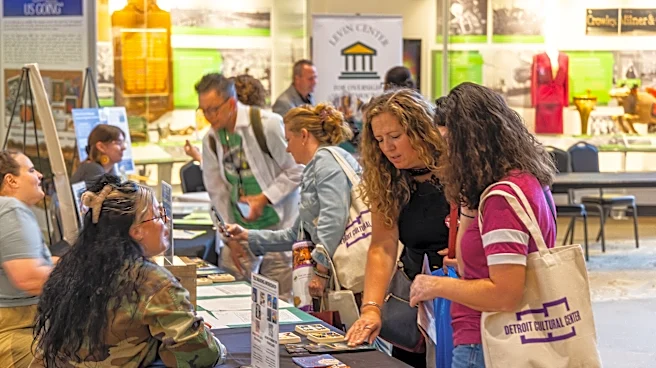








Teachers, school administrators and homeschooling parents from across southeast Michigan will have an opportunity to explore the Detroit Cultural Center as an extension of their classrooms during the Detroit Cultural Center Association's fourth annual Educators Night on Sept. 15.
The free event, scheduled from 4-7 p.m., will bring together five Cultural Center institutions and about 80 arts, cultural, STEM, and education organizations to showcase programs, field trips, professional development opportunities, and classroom resources available throughout the school year.

Organized by the Detroit Cultural Center Association, the event is designed to help educators discover how the district's museums, libraries, universities and nonprofit organizations
can support student learning both inside and outside the classroom.
"Detroit's Cultural Center is a classroom without walls, and Educators Night gives teachers an opportunity to experience the district as one connected learning community," said Annmarie Borucki, interim executive director of the Detroit Cultural Center Association.
"In a single evening, an educator can participate in professional development, discover a new field trip, experience hands-on learning, find resources to use in the classroom and meet organizations that can support their students throughout the year. We want educators to leave with practical ideas they can use right away, new relationships they can build upon and a much bigger sense of what is possible for their students."
Participants can begin their evening at one of five host institutions, including the Detroit Institute of Arts, Detroit Public Library, Michigan Science Center, Charles H. Wright Museum of African American History and Detroit Historical Museum. Once checked in, attendees can visit as many participating locations as they choose.
This year's event goes beyond informational exhibits, with institutions offering professional development workshops, live performances, demonstrations, hands-on activities, exhibitions and other interactive experiences.
A featured professional development session will be the College for Creative Studies' "Puppetry and Storytelling for K-12 Teachers" workshop at the Detroit Institute of Arts. The 90-minute session, scheduled from 5-6:30 p.m., offers State Continuing Education Clock Hours, or SCECH credit, and will introduce educators to puppetry and storytelling as classroom teaching tools. Participation is limited to 20 educators, and advance registration is requested.
The DIA
At the Detroit Institute of Arts, educators will learn about resources from creative organizations including the College for Creative Studies, Cranbrook Art Museum, Museum of Contemporary Art Detroit, Pewabic Pottery, and Signal Return. The museum's Artmaking Studio will host drop-in activities throughout the evening, and select galleries will remain open for exploration.
Detroit Public Library
The Detroit Public Library will focus on literacy, early childhood education and teacher resources. Educators can connect with organizations such as Detroit PBS, Wayne RESA and Wayne State University's College of Education while learning about library services, field trip opportunities and classroom support programs.
Wayne State
Wayne State University's College of Education will also present four short sessions covering artificial intelligence literacy, cultural storytelling, community-based writing and classroom engagement strategies.
Michigan Science Center
STEM education will take center stage at the Michigan Science Center, where educators can explore exhibit galleries, watch live science demonstrations and learn about programs offered by organizations including Ann Arbor Hands-On Museum, Cranbrook Institute of Science and the University of Michigan Engineering Zone.
The Science Center will also host live stage shows throughout the evening and offer presentations in its recently renovated Penske Planetarium. Educators can experience a flight simulator and visit the museum's "A-Mazing Detroit" exhibition, featuring what organizers describe as the world's largest cardboard maze.
Wright Museum
Performing arts and cultural education organizations will be featured at the Charles H. Wright Museum of African American History. Participating groups include Detroit Opera, Mosaic Youth Theater, Detroit Public Theater, the Sphinx Organization and Michigan State University's Community Music School.
In addition to performances and demonstrations, educators will be able to explore museum exhibitions including "Who Votes?," "The Art of Elizabeth Catlett," "Stories in Stained Glass," "Black, White & Red: Black Women in Silent Film," and "Bill Smith the Jeweler."
Detroit Historical Museum
At the Detroit Historical Museum, programming will focus on history and sustainability. Educators can connect with organizations including the Arab American National Museum, Detroit Riverfront Conservancy, The Henry Ford and the Historical Society of Michigan while exploring ways to incorporate Detroit history into classroom learning.
Additional event benefits include free admission to all participating institutions, complimentary parking in the Detroit Institute of Arts' John R parking lot beginning at 4 p.m., educator resources and giveaways, light refreshments and access to a food truck rally outside the Michigan Science Center.
Pre-registered attendees will receive a complimentary Detroit Cultural Center tote bag while supplies last. Educators who visit at least three participating institutions can earn a special Cultural Center-themed gift and receive a signed art print created by Detroit artist Stacey Malasky.
Organizers say the event is intended to introduce educators to a broad network of organizations committed to supporting student learning throughout the year.
Registration is free and available through Eventbrite. Educators should register individually and select the institution where they plan to begin the evening. Additional information and registration can be found at https://bit.ly/EducatorsNight2026.
This article originally appeared on Detroit Free Press: How Detroit's cultural institutions are making it into classroom