
Democrat Will Lawrence has one clear advantage over first-term Republican U.S. Rep. Tom Barrett as he challenges him to represent Michigan's most-evenly split congressional district on Nov. 3.
Height.
At
6-foot-6, the 36-year-old community activist from Lansing would be the prohibitive favorite in a jump ball competition over the 6-foot, 45-year-old Barrett, a former U.S. Army helicopter pilot and state legislator from Charlotte.
This not being basketball, however, the outcome of this toss-up race in mid-Michigan's 7th Congressional District is far harder to handicap.
"A lot of this is going to come down to two things," said Adrian Hemond, CEO of Grassroots Midwest, a political consulting, communications and public relations firm in Lansing, and who worked for Democrats in the state Legislature. "No. 1 is how saleable Will Lawrence is to actual moderate voters. No. 2 is whether Republicans are going to show up without Donald Trump on the ballot."
With four weeks to go until Election Day and Barrett and Lawrence set to debate at WKAR-TV PBS 23 at 11 a.m.on Tuesday, Oct. 6, Barrett's got a lot to overcome.
If any district in Michigan were to flip in a Democratic wave nationally, it should be this one and political observers are bullish on that party's chances of retaking one or both chambers of Congress considering soaring gas and diesel prices, high inflation and lousy approval ratings for President Donald Trump and his war with Iran. The fact that that party in power regularly loses seats in midterm elections makes matters even more tenuous for the Republicans.
But this region and this district — anchored in Lansing but spreading out through suburban enclaves, industrial parks and rural stretches chiefly in Clinton, Eaton, Ingham, Livingston and Shiawassee counties — is historically centrist; its deep blue Democratic vote in the state capital and around Michigan State University being moderated by ruby red parts of Livingston outside of Howell and elsewhere, and a not insignificant number of independents throughout.
Barrett won it two years ago with a solidly conservative record as a state legislator; then-U.S. Rep. (now Sen.) Elissa Slotkin won it before that as a centrist Democrat with a military and intelligence background.

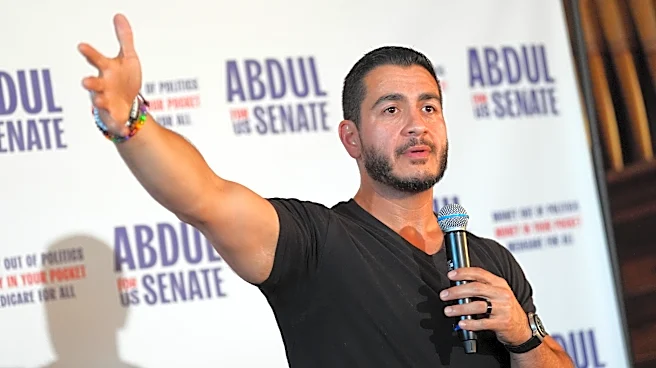
Lawrence, though, is an unabashed liberal, a progressive in the style of U.S. Sen. Bernie Sanders of Vermont and Democratic U.S. Rep. Alexandria Ocasio-Cortez of New York. He probably owes some of his electoral success this year to another progressive stalwart, Abdul El-Sayed, winning the Democratic nomination for Michigan's open U.S. Senate seat and driving liberals to the polls.
And this region hasn't elected anyone like that in decades, maybe ever.
"I am confident that I'm making the best argument to the voters of my district but I have never been one to take anything for granted," Barrett told the Free Press. "I think if we fast-forward the tape until Election Day this year, we'll come out of it ahead. But that is not for me to let up on any of the effort that we're doing.
"I think there is a very stark contrast between me and my opponent and one that the voters of this district deserve to have all the information about available to them."
For his part, Lawrence says he's happy to have that contrast.
"It's not about left versus right, it's about the elites versus the people," he said. "We've seen too many politicians from both sides of the aisle, especially Tom Barrett, represent D.C. insiders, billionaire donors, and in his case, President Donald Trump … People can see that I care about them and I'm here to listen and fight on the issues that matter to them."
So far, Lawrence has run a race hitting hard on hot-button issues like the threat potentially posed by data centers and the Iran war. Barrett has been working equally hard to suggest he and Lawrence are effectively in agreement on the dangers posed by both, if not all, of the solutions.
Both accuse the other of dissembling their true intentions and agenda.

"We're going to work hard every damn day between now and Nov. 3rd to reach every single voter," Lawrence said. "I'm optimistic about our chances, but we can't take anything for granted."
What Barrett has going for and against him
Any list of Barrett's advantages need to include the money he and his allies are able to throw at this race. A new financial report from the candidates' campaigns isn't due until mid-October but as of the middle of July, when the last was filed, Barrett, who didn't have a primary challenge, had raised more than $6 million, and had nearly $3 million left.
Lawrence, who won a three-way primary that saw moderates split between former U.S. Ambassador to Ukraine Bridget Brink and former Navy SEAL Matt Maasdam, had raised a little over $1 million and had less than $400,000 left at the time. Lawrence's war chest is certain to have improved dramatically when he next files, but Barrett has many supporters nationally and Republicans have an advantage in ad reservations in the race through the election, according to CNN.
Barrett also can legitimately claim a level of independence from Trump's agenda, even if it's a selective one. He has been one of the few Republicans in the U.S. Houseto repeatedly call for — and vote in favor of — limits on the president's ability to wage war in Iran without congressional approval, having done so months ago. He also was an original cosponsor of a resolution to force the release of the Jeffrey Epstein files.
And early in his term in 2025, Barrett publicly questioned staff reductions by Trump at the Veterans Administration. He has introduced legislation that would protect local prerogatives to block data center development — which Trump has opposed — and stayed away from Trump's midterm convention in Texas in September despite having the president's endorsement.
"The work that I've done in Washington may not be in the cookie-cutter version of what a Republican in most people's mind might be doing," he said, adding that he supports the president when he thinks it's best for Michigan and has campaigned with him in the state. "And that's okay. I'm my own person and I want to carry out the things that I think are important."

"It's my job to go out and tell the voters what I've done, what I campaigned on," he continued. "And I've stuck to those priorities that I said I was going to work on. And I think a little bit of it is, you know, promises made, promises kept."
Lawrence and the Democrats argue that leaves out Barrett's solidly pro-Trump agenda voting record on tariffs, on taxes, and on military funding. And, it's true, Barrett does vote with Trump and the majority Republicans in the House most of the time. He is a supporter of the administration's crackdown on immigration across the southern border and its effect on reducing the flow of fentanyl into the country.
And while his votes for military funding haven't been specific to supporting the war in Iran, and his votes on corporate incentives in the so-called One Big Beautiful Bill weren't specifically intended to help data center development, they didn't counter them either (which is always the issue with sweeping pieces of legislation).
Barrett can take credit for cutting taxes on tips, Social Security and overtime — and he says he wants to cut taxes on health care — but measures like that almost always involve trade-offs (such as the new restrictions on food stamp benefits and Medicaid).
"This is very straightforward," Lawrence said. "He's just doing whatever he needs to do to try to distance himself from his failing president and his failed war without actually taking any votes of consequence that would have the effect of limiting it."
"People can see that he's there for Trump every single time that it matters," Lawrence continued. "And the rest of it is all political theater."
What Lawrence has going for and against him
Lawrence is a longtime civic activist who helped found the Sunrise Movement, which fights for policy to combat climate change nationally; and he created the Michigan Rent Is Too Damn High Coalition, a tenants' rights group. He also has worked to alleviate homelessness in mid-Michigan.
In and of itself that might not translate into electoral success but in Lawrence's first run, it did. Partially that's because Brink and Maasdam split what might otherwise have been a decisive centrist bloc, but it also counts that unlike those two Lawrence was born and raised in the district and has deep ties to the younger, more progressive voters that helped decide this raceand El-Sayed's Senate nomination.
Don't sleep on that coalition in the general, either.
Yes, older, more centrist voters tend to decide elections in Michigan. But without question, the energy, especially in Michigan, is with younger, more progressive Democrats in the general. The mood is bleak for Republicans nationally. And while El-Sayed's name was tossed around by multiple speakers at Trump's novel midterm convention in September, Lawrence's was never uttered, even when some speakers mentioned statements he had previously made.

In as much as Lawrence can both capitalize on that progressive energy and, at the same time, appear to be a standard-issue Democrat to other voters, that could be enough with generic ballot polling showing Democrats up significantly.
"He’s being positioned as a replacement level Democrat because that’s probably enough to beat Tom right now," said Hemond of Grassroots Midwest.
Lawrence is not a generic Democrat, however: He supports a single, government-run health plan to cover all Americans; would vote to halt arms sales to Israel and any other countries considered to be human rights violators; and would crack down on Immigration and Custom Enforcement's activities during the second Trump administration.
Like many in his party, Lawrence said he would support raising taxes on the wealthy and corporations. And he has called for a federal moratorium on data centers — with talk of one being proposed in Mason, in the heart of the district — and limits on artificial intelligence development and use.
"People are hurting with the cost of food and fuel. They're frustrated with data center developers pushing their ways into our small towns. And they feel betrayed by a president who said that he wasn't going to start any new wars and would lower costs, and in fact has started a disastrous new war and raised costs," Lawrence said.
"There is a lot of disillusionment with politics," he continued. "There's no doubt about it. But we're getting thousands of people involved in my campaign because people can see that we're doing politics differently. I'm not taking any corporate PAC money, unlike Tom Barrett, and unlike many politicians on both sides of the aisle, frankly.
"And that's why I can afford to fight hard alongside residents fighting data centers, fight hard against these wars, fight hard for good health care for all, because I'm not taking money from the corporations that are profiting off of all this. People see that and they see me fighting for them and that is why they're turning out to fight alongside me."
But Lawrence also has some baggage in the form of past comments on social media and elsewhere appearing to embrace a world without prisons, the defunding of police, winding down production of fossil fuels and accusing more moderate Democrats of timidity. He has criticized the traditional nuclear family home as an “isolating, individualistic, violent way of organizing society.”
And he's made remarks on a podcast that appeared to blast some Black leaders as being enablers of "establishment, capitalist, imperialist American power,"in reference to U.S. support for Israel during its counteroffensive against Hamas in Gaza.
Lawrence, who has let his membership in the Democratic Socialists of America lapse, had previously deleted or otherwise rescinded each of those comments, noting that most are many years old and are not in step with his thinking now.
"Like many millennials, I've spent my fair share of time thinking out loud on the Internet, and I've said some silly things that I disagree with now. Tom is using all of this as a distraction, in some cases pulling up old posts from 15 years ago when I was in college, because he wants to distract from his failed record of votes over the last two years," Lawrence said. "I mean, what's more important, something that I said 15 years ago or a vote that Tom took one year ago? Because he can't answer for his vote to take away people's health care. He can't answer for his vote to fund the war."
It still gives Barrett and Republicans an easy line of attack.
"He called the nuclear family a violent way to organize society. I mean I'm raising a nuclear family. I'm raising four kids in this district," said Barrett. "I take a little bit of offense to that. And I'm not somebody who's easily offended."
"He's now trying to reverse himself on every single one of these," Barrett continued. "It would be one thing if we were excusing one or two statements he had made a long time ago. But this is the body of work that he has stood for the last 15 years as a career activist. So, we shouldn't be surprised that these are the things that he's said and done. And only now, on the eve of an election, he's trying to reverse himself and pretend like those aren't his true positions any longer. I think it's appropriate and fair for the voters of this district to ask questions about whether or not they can trust that in fact is the case, that he doesn't support those positions. What changed for him?"
Who has the edge four weeks away from election
That's an impossible question to answer with the available information. There's been little-to-no independent polling recently. Barrett's institutional edge, the makeup of the district, the expected funding advantage and the fact that Democrats, while coalescing around Lawrence, haven't been as vocal in their support for him as they have, say, for El-Sayed, gives the incumbent a chance.
"Tom’s going to win, I'm 90% sure, because Will Lawrence is too far left for this district," said Andrea Bitely, founder and principal of Bitely Communications in Lansing who worked previously for former Detroit Mayor Mike Duggan on his independent gubernatorial run and for Republican former state Attorney General Bill Schuette.
Sure, she said, there is a strong liberal vote in Lansing and East Lansing. But "the rest of the district is moderate to conservative... He's (Lawrence) a bridge too far."
Corwin Smidt, an associate political science professor at Michigan State University in East Lansing, said the message he's being clobbered with is that "Tom Barrett is a dorky dad who wears jeans and is a regular guy" and "Will Lawrence is a socialist, communist, who wants to defund the police."
But Smidt said he believes Lawrence clearly has a chance to win, given the economy — and the fact that gas and diesel prices, as well as tariffs, are hammering families, farmers, manufacturing and tourism.
"Lawrence has hustle, I think he’s authentic," Smidt said. "It’s (also) going to be Will Lawrence against Tom Barrett and he’s going to seem like a generic Democrat by name (to many voters). Who’s going to get scared of some guy named Will Lawrence?"
Still, Lawrence may need to count on Republicans and Republican-leaning independents being so fed up with the economy, or so disinterested with Trump not on the ballot, that they stay home. Otherwise, Barrett could find a way to defy political gravity and retain possession for a second term.
"I think one of the mistakes that was made in the Democratic primary by the two other candidates that ran is they absolutely did not take William Lawrence seriously," Barrett said. "They never thought he would be viable. And obviously that wasn't true... I'm out there every single day making that case to the voters in my district."
"I'm not disregarding that we have more work to do: Gas is too expensive. Diesel fuel is too expensive. Groceries are too expensive. Healthcare and housing are too expensive. I acknowledge each and every one of those things, but the solutions to those problems aren't the solutions that my opponent is offering," Barrett continued. "I think the people of my district have a choice to make."
But don't count out the probability that the headwinds facing Barrett are real and Lawrence has a more-than-viable chance in this election too.
"It's killing people," Lawrence said of the tariffs, the war, the economy. "Farmers are especially hurting. They've lost market access for their product. And then they're also suffering severely for the cost of diesel, putting thousands of dollars into their combines each day. And they're wondering if they're going to break even when they get the harvest in. And they're wondering if they're going to make it through the fall, frankly, is what I'm hearing. And 'Tom Tariff' voted to allow Trump to continue to set the rate based on how he feels when he wakes up in the morning."
"They (the Republicans) probably don't want people to get to know me because when anyone gets to know me, they find I'm a pretty nice and reasonable guy," Lawrence added. "Trump and Tom Barrett have failed over the last two years and made the American dream farther away for people of the 7th District. And people are ready for change."
Contact Todd Spangler: tspangler@freepress.com. Follow him on Twitter @tsspangler.
This article originally appeared on Detroit Free Press: Rep. Tom Barrett hopes to defy political gravity facing Will Lawrence