



A turbocharged engine is great but what if it could go faster -- even faster?
Stellantis engineers in Detroit said Thursday, Aug. 6, that they had developed technology that can essentially eliminate "turbo lag" — the slight delay needed to spool mechanical turbochargers on gas-powered engines.
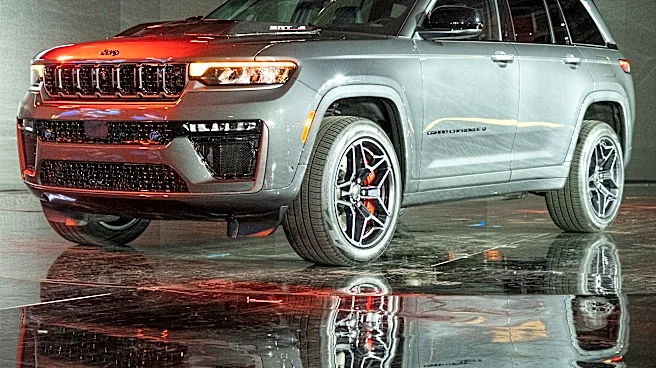
Using a technology called "eBoost Air," which has yet to reach production, Stellantis' high-performance engineers said prototype vehicles can pull 90% of a powertrain's peak torque in just 650 milliseconds. At the Conner Center on the city's east side — a private Stellantis museum that was previously the manufacturing plant where the ferocious Dodge Viper was built — engineers unveiled the technology under the hood of a Jeep Grand Cherokee, which housed
an inline six-cylinder turbocharged engine fitted with the eBoost Air tech.
All of the developments are preliminary, engineers said. Even the vehicle showing the new technology, the Grand Cherokee, is currently not available with that six-cylinder engine.
Joel Baker, Stellantis' vice president of propulsion engineering, said there are "no plans for this in the future yet," but, he added, "I can tell you, this concept, it has a lot of value in multiple engine architectures. ... I think this is a very viable concept."
Some automakers have sought to eliminate turbo lag with electric turbos. Usually, turbos are driven by exhaust that circulates through, but an electric turbo can spin the turbo blades almost instantly before the exhaust takes over. Stellantis' eBoost Air, though, is not electronically assisted in the same way: SRT engineers developed a turbo system that uses an air compressor and shutoff valve to promptly power the turbochargers and "virtually eliminate" turbo lag before the exhaust takes over.
"What we've done with this is produce a Hellcat's level of acceleration with a six-cylinder turbocharged engine," Baker said, in reference to Stellantis' popular supercharged V-8 engine.
All told, Baker said, it took just seven weeks for the engineers to bring the eBoost Air from idea to testable product.
"That's SRT speed!" another engineer shouted while Baker was flanked by the news media answering questions about the new turbo technology.
SRT, an abbreviation for Street and Racing Technology, is Stellantis' ultra-potent development arm responsible for creating the company's most ridiculous vehicles, like the various Hellcats, the Jeep Trackhawk and the Dodge Viper. In a slideshow used to unveil the new products to news media, the automaker referred to SRT as the "Department of Batshit Crazy."
Indeed, the automaker has given SRT engineers free rein to develop outrageous vehicles and powertrains, often on short timelines. Tom Sacoman, the head of SRT operations, said the eBoost Air concept was the product of that "rapid development and cross-functional engineering."
“In this case, by electromechanically pre-spooling the turbochargers before exhaust energy is available, we're able to significantly improve boost response and drivability,” Sacoman said.
Biggest, baddest Rumblebees
Stellantis also unveiled that its new "muscle truck" lineup of high-performance, factory-ready street trucks will come with a slew of aftermarket options through Stellantis' parts network, Direct Connection.
The automaker showed several trucks that had been upfitted to ridiculous specifications, including a Hennessey Performance-made Rumblebee capable of reaching more than 1,000 horsepower. Roush Performance, long known for its collaborations with Ford Motor Co., also punched up a Ram 1500 truck, and Fox Factory, another high-performance vehicle upfitter, tuned up a Ram 2500 heavy-duty truck.
Stellantis made its own tuned-up Rumblebees, too. The automaker rolled out three black versions it calls the "Darkside Twins" to show off the capabilities of the Direct Connection after-market tweaks owners could make to their trucks.
The "Darkside Twins" all sported black paint jobs with "Direct Connection" accents. All three were lowered on 24-way suspension systems, tuned with MagnaFlow exhausts and fitted with 3-liter twin-screw superchargers. Stellantis claimed the fastest Rumblebee, with the right Direct Connection parts, could reach over 900 horsepower.
Stellantis first launched the Rumblebee muscle trucks in May.
You can see those vehicles in the gallery below.
The announcements come before the kickoff of Roadkill Nights, an annual event hosted by Dodge in Pontiac, which brings in thrill-seekers and car enthusiasts from across the country to participate in an all-day-long drag racing extravaganza at M1 Concourse.
Dodge said that the new eBoost Air technology will be on display at Roadkill Nights, where the brand is also expected to debut a new muscle car.
Liam Rappleye covers Stellantis and the UAW for the Detroit Free Press. Contact him: LRappleye@freepress.com.
This article originally appeared on Detroit Free Press: Stellantis says it has eliminated turbo lag with this new technology