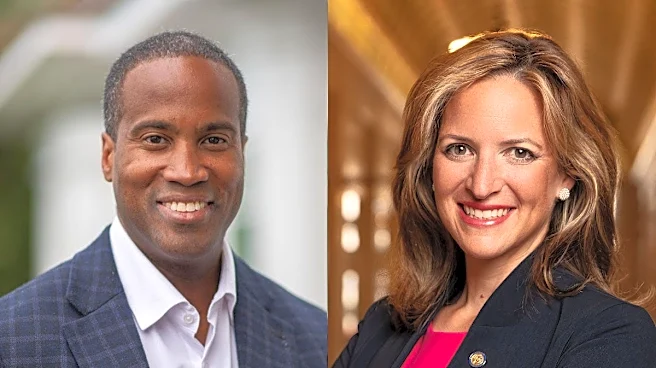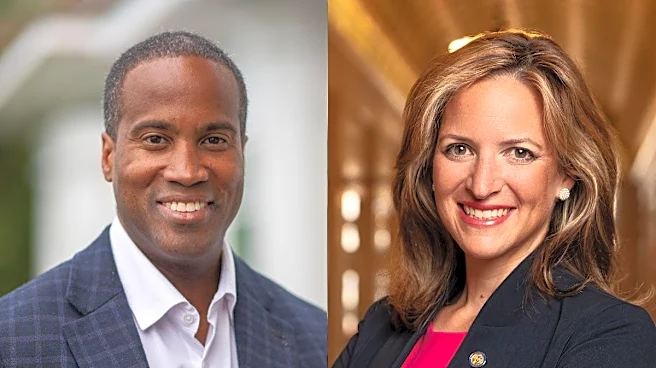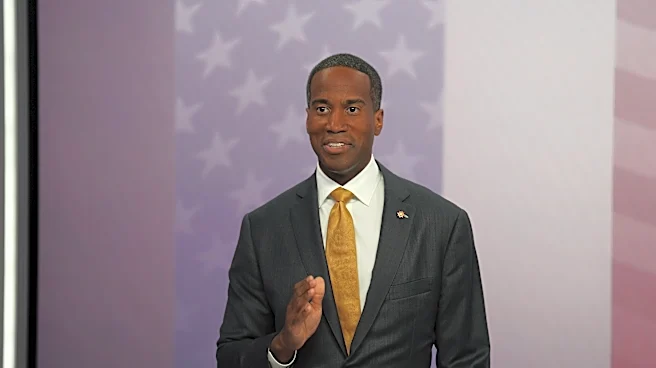


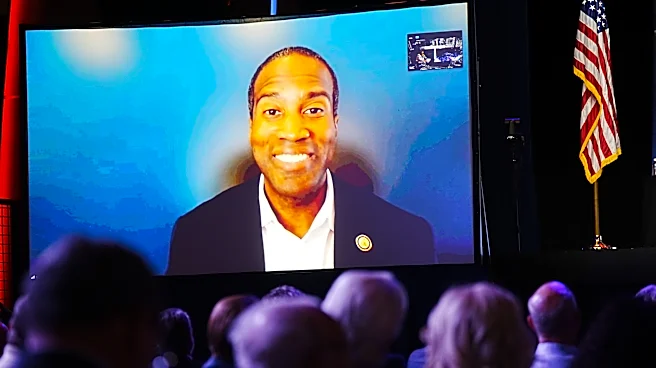

In their second and final gubernatorial debate before Election Day, Republican U.S. Rep. John James and Democratic Secretary of State Jocelyn Benson kept things close to the vest and lobbed similar attacks at each other as they did in their first salvo earlier this month.
During the Thursday, Oct. 15 debate, both candidates blamed the other's party as being responsible for the current state of Michigan and the country: Benson said President Donald Trump's tariff policies and the U.S. war in Iran have led to higher costs for Michigan families, and she accused James of being complicit in the president's policies.
James, in turn, pointed to the state's languishing literacy rates, sluggish population growth and worsening per capita income, saying
a near-decade of Democratic executives in Michigan was to blame.
Still, there was ample enough policy discussion during the WDIV-Local 4 debate for voters to parse through. Here are a few takeaways.
James says Benson isn't being accurate on tariff talk
For the most part, tariffs have been an issue where James has had to be on the defensive. Tariffs have been a favored economic policy of Trump's, and the president's endorsement of James was something he pointed to frequently during the Republican primary process.
Now, Benson has criticized James heavily for the tariff policies. During the debate, she noted James was not among the handful of House Republicans who voted in February to rein in tariffs. Economists generally agree the tariffs have increased costs for American families, with estimates ranging from a few hundred dollars to thousands annually.
Michigan is particularly affected by the tariff war with Canada because of the cross-border auto manufacturing industry. Benson, during the previous Oct. 6 debate, said if elected she would craft a subnational agreement with Canada to try to help shield Michigan from the tariffs.

James argued, however, a governor doesn't have the power to craft such an agreement under the U.S. Constitution. The Supremacy Clause of the Constitution generally states the federal government has power over state-level laws and agreements when federal policy is in the same sphere.
James, too, has recently called for an end to the trade dispute with Canada. "The fact of the matter is that Canada is our friend ... but we must negotiate a deal that also works for Michigan."
Benson disagreed with James' contention that she would be powerless, as a governor, to negotiate with Canada, pointing to the Gordie Howe International Bridge connecting Detroit and Windsor as a direct example of such a subnational agreement. The bridge, which opened earlier this year, moved forward in planning after former Gov. Rick Snyder and the Canadian government reached a deal where Canada would pay for the span's construction in exchange for the toll fees drivers have to pay to cross it, until the U.S. share is paid off.
Although the federal government had to approve a new border crossing, it doesn't appear to be the same as allowing a single state to subvert tariffs on certain goods levied by the federal government.
Whatever the outcome, it appears voters are seeking tariff relief — 64% of respondents in an Associated Press poll earlier this month said Trump has gone "too far" with his tariff policy.

New lanes of attack
Like they did in the first debate, Benson and James went after each other's stance on data centers, health care, tax policy and other policy areas. But new lanes of attack took shape during the WDIV debate, including a jab at James' business record and Benson's fundraising strategies.
James' campaign has repeatedly emphasized his business experience, saying he is a "job creator" who will make a great "CEO" of Michigan if elected governor. But Benson tried to puncture holes in the pitch, repeating an attack line against him lobbed by his GOP opponents in the primary: That his family's Detroit-based logistics company received state support to create jobs that never materialized.
The state's economic development body later revoked the tax agreement, according to the Michigan Economic Development Corporation.
"That was before I was there. When that happened. I was literally fighting in combat," James told reporters after the debate. He has previously said that the the agreement was brokered when he was still in the military, but it also overlapped with James' time as a company leader.
In turn, James attacked Benson for fundraising in California from "coastal elites."
Benson has held far more out of state fundraisers than James, according to their campaign finance filings.

But John Sellek, the CEO of the Lansing-based Harbor Strategic Public Affairs who has worked on multiple Republican campaigns, said Benson did what she had to do to compete financially in the governor's race.
"She built a national fundraising operation. Michigan is no longer a place where you can solely fund a statewide campaign, and so she is open to criticism for going to California and elsewhere a million times, but that's what it takes right now," he said in an interview ahead of the debate.
Whose fault is it anyway
Given Trump's disapproval ratings have hit record highs in recent months, Benson is not alone among Democrats running in the midterms in tying her opponent to the president.
But James has tried to pin blame for the state's languishing literacy rates, worsening per capita income and stagnant population growth on Democrats, who have controlled the governor's office in Michigan since Gov. Gretchen Whitmer's election in 2018.
After the debate, James blasted the focus on Trump in his race, calling it a “Trump obsession.”
“The president is gone in two years. The next governor of Michigan likely has eight. Are you really willing to allow Michigan to continue to burn under Democrat leadership because you hate somebody so much?” he asked.
“We’re losing our kids,” he told reporters after the debate, referring to population trends in Michigan. “And y’all are focusing on some dude in Washington, D.C. who’s going to be gone in two years? We are smarter than that. There are places in the city of Detroit that were bad before President Trump got in office, and they’re going to continue to fail our people after unless we decide to take our future, grasp it, and move forward together.”
As James made the case for a change from Democratic leadership in Lansing he describes as a failure, Benson expanded on her debate stage counterattack zeroing in on Republican legislative control.
“He also forgot to mention that we’ve actually had split government,” she told reporters after the debate. When Benson first took office, Republicans controlled both legislative chambers before Democrats won a governing trifecta in 2022. Currently, Democrats control the Michigan Senate while Republicans hold the gavel in the Michigan House of Representatives.
As she makes the case for restoring Democratic majorities in both chambers, Benson was pressed on where Democrats have erred over the past several years.
“I think, if anything, we haven’t done enough. We haven’t been big and bold in trying to ensure our public schools are among the best in the nation, and haven’t ensured our agencies are transparent and accountable and actually delivering results,” she said.
You can reach Arpan Lobo at alobo@freepress.com
Contact Clara Hendrickson at chendrickson@freepress.com or 313-296-5743.
This article originally appeared on Detroit Free Press: Benefactors, bank accounts, blame rule Benson, James second gov debate