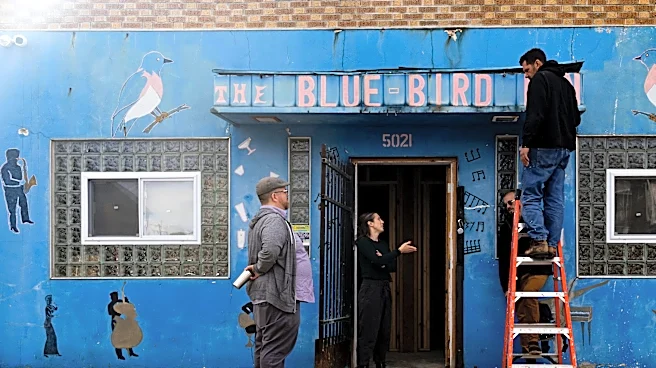





Behind the weathered blue facade of the Blue Bird Inn, construction crews are rebuilding one of Detroit's most storied jazz landmarks.
The legendary west-side club at 5021 Tireman Ave., where generations of jazz musicians once performed and where bebop helped take root in Detroit, is being transformed into a live music venue, community gathering space and archive dedicated to preserving the city's musical history.
After years of fundraising, planning and stabilization work, Detroit Sound Conservancy's multimillion-dollar restoration is taking shape inside the long-vacant building. On Sept. 25, the Detroit Free Press got a glimpse of what organizers hope will become a cultural anchor for the neighborhood and a living home for Detroit's musical
legacy.

"It's more about the music and the community coming together around the music and the love of it," said Michelle "Jahra" McKinney, director of Detroit Sound Conservancy.
The nonprofit acquired the building in 2015, helping save it from demolition. Early fundraising efforts helped stabilize the structure, while a later $1.9 million grant from the Mellon Foundation moved the project into full-scale construction.
Preserving more than a building
Although the renovated space will resemble the historic club, it will serve a broader purpose than simply recreating a bar.
"It will look and feel like the bar did," project consultant Graig Donnelly said. "But not necessarily be a bar anymore. It's more of a community space where the music can be celebrated and enjoyed and shared."
The original footprint is being restored, including the stage, which was removed and preserved after leaks from the deteriorating roof threatened to damage it. A new addition at the rear of the building will house an archive devoted to Detroit music.
The first floor will include public space where visitors can explore archival materials, attend meetings, events and performances. Upstairs will hold collections, recordings, photographs, oral histories and memorabilia documenting Detroit's musical heritage.
A living archive of Detroit music
For McKinney, the archive mission is personal. Her husband, Harold McKinney, was a prominent Detroit jazz pianist and educator whose work helped mentor generations of local musicians. After he died in 2001, a basement flood destroyed part of his collection. Some materials were salvaged, but others were lost forever.

McKinney said the experience showed her how vulnerable Detroit's musical history can be when artists and their families lack a permanent place to preserve it.
Unlike traditional archives that focus primarily on preserving historical collections, Detroit Sound Conservancy envisions the Blue Bird Inn's archive as an evolving record of the city's music. The archive will grow through contributions from working musicians, as well as materials generated by performances, educational programs and projects held at the venue.
"Don't wait till you die and your kids say, 'What are we gonna do with this stuff?'" McKinney said. "You have value and worth now.
"It's a living archive. It's not just the legacies of the '50s and the '60s and the old jazz cats. ...It's Detroit music."
That includes jazz, gospel, hip-hop, Latin music and other genres.
"It just has to have been created or happened in Detroit," she said.
A symbol of Detroit jazz history
The Blue Bird Inn began as a neighborhood bar and restaurant opened by William and Pinkie DuBois in 1937 before later coming under the ownership of Clarence and Mary Eddins, according to the Detroit Sound Conservancy. Under the Eddinses and pianist Phil Hill, who led the club's first bebop house band, the club emerged as one of Detroit's most influential jazz venues, hosting musicians such as Barry Harris, Tommy Flanagan, Miles Davis and John Coltrane.
"The Bird was an institute for musicians who would influence global modern music and a hearth of freedom for the Black community within a deeply racist and heavily segregated post-Depression and post-WWII Detroit," according to Detroit Sound Conservancy's website.
Over time, changing economic conditions and the decline of neighborhood clubs contributed to its closure. The building sat vacant for years and was at risk of demolition.
McKinney said the restoration is both a preservation effort and an investment in the neighborhood, with hopes that the Blue Bird Inn's revival will attract new activity and help reestablish the corridor as a cultural destination.
"People have been really excited about this opening," she said. "This place is a symbol that people remember. And that remembering will help us tell our story in our voices."
Reviving a neighborhood gathering place
Organizers say they envision everything from jazz performances and community panels at the Blue Bird Inn to educational programs and youth workshops.
"Our pillars are preservation of the music. … Activation, where we find the people who make the music. Then there's education so we can get that intergenerational talent going. … The last pillar is placekeeping; we have to make places for this interchange of culture to happen."
Across the street from the Blue Bird Inn, Detroit Sound Conservancy is helping transform a vacant lot into a community park that will serve as an outdoor gathering space. The park will host the nonprofit's annual barbecue from 2 p.m. to 5 p.m. Saturday, Sept. 26, bringing together residents, musicians and supporters.

McKinney said the goal is to reconnect generations through music and create a place where neighborhood children can interact with working musicians.
"Detroit's magic is the mentoring of the young," she said. "This is what happens when you have a place for those groups to be together."
The project's first phase is expected to be completed by December or January, allowing Detroit Sound Conservancy to occupy the building, Donnelly told the Free Press. A later phase will add interior finishes, furnishings, a replica of the original bar and audiovisual systems as funding becomes available.
"We were a dream," McKinney said. "Now we have to be a sustaining servant. We have to be of service."
Nour Rahal is a trending and breaking news reporter for the Detroit Free Press. Email her at nrahal@freep.com
This article originally appeared on Detroit Free Press: Historic Blue Bird Inn restoration will preserve Detroit music