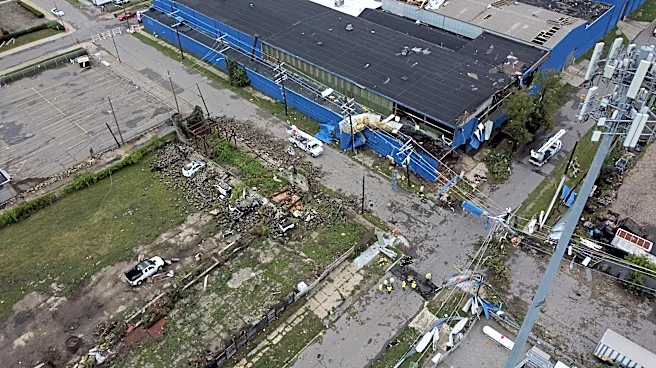




DTE Energy said it is doubling down on its commitment to improving Detroit's utility infrastructure in response to criticism from city officials and residents after last week's storm — which included an EF2 tornado touch down — left many without power, including a city council member.
Crews worked throughout the holiday weekend to clean up and restore power, but the storm, combined with Detroit's aging infrastructure is pushing some city officials to look into alternative options.
On Tuesday, Sept. 8, the City Council unanimously agreed to direct its legislative policy division to identify what other municipalities in Michigan are doing to source their energy needs. Several east and west side residents lost power after the major storm on Thursday,
Sept. 3, with Mayor Mary Sheffield confirming a tornado that touched down on Detroit's east side.
"I was one of the people that had their power out for a couple days, and so I was really concerned about whether or not my constituents were in that area. Not only was my power out, the guy that lived behind me, (his) power was out. The guy that lived behind him, (his) power was out," said Coleman Young II, City Council president pro tem, who touted city crews for cleaning up debris.
"I had a tree that was knocked over on my property that I had to pick up and move over to be able to get it off my property, onto the street, and DPW picked that up the next day."
In a statement to the Free Press, DTE said it has invested more than $1 billion in the last five years to modernize Detroit's electric grid and that while more work is on the horizon, the investments are "helping Detroit recover faster and building the resilient grid our customers deserve."
"That investment made a difference last week, when an EF2 tornado with 115 mph winds tore through Detroit's Islandview neighborhood. Tornados of that magnitude can cause damage so severe that it leaves communities without power for weeks. Instead, our crews worked around the clock and restored more than 90% of Detroit customers within 48 hours," according to the Sept. 9 statement from DTE. "The powerful storm and the restoration effort that followed are proof that when we invest, it works. Where we've rebuilt the system, it was more resilient. Where upgrades are still underway, equipment took heavier damage, and in some cases, was destroyed."
The length of Detroit's power outages improved by 91% from 2023 to 2025, according to DTE. The company trimmed more than 350 miles of trees in the city, boosted 220 miles of infrastructure and replaced 2,270 poles, according to DTE.
Yet, several council members said they were frustrated with DTE, seeking further answers on how the company plans to further upgrade the system to prevent continuous power outages.
Prior to being elected, District 4 council member Latisha Johnson said she and others on her grid experienced frequent outages. She and other elected officials said they had conversations with DTE about improvements, which were made. However, her district still is facing similar issues, Johnson said.
"We're going back to the same conditions that we experienced then, and that was probably seven years ago," Johnson said. "I think there's a lot DTE needs to address, that they need to be responsible for."
District 6 council member Gabriela Santiago-Romero said she submitted a memo to the council's legislative policy division to explore what other cities — naming Wyandotte and Ann Arbor — are doing to create their own energy sources and infrastructure.
Santiago-Romero said she voted against all of DTE's projects because "we're getting very little."
"Quite frankly, I feel like we're being robbed," Santiago-Romero said.
District 2 council member Angela Whitfield-Calloway questioned the city's reliance on DTE for gas and electricity, and whether the city could bring in another partner, citing its past use of MichCon and Detroit Edison.
"DTE is a monopoly, and when they're down, we're all down ... we need to look into our options," Whitfield-Calloway said. "There's outages when there shouldn't be. We know that there's pressure on a very old infrastructure. We know that, and now we have all these new buildings going up. I don't see any solar panels, which means that's going to be additional pressure and reliance on that old infrastructure."
After providing a storm update to the council, Mayor Sheffield's Chief of Staff David Bowser said the mayor has advocated "directly with DTE" for a change in policies and is working toward sharing all concerns with DTE. Bowser said officials also are discussing "hardening the grid" to improve Detroit's infrastructure.
Sheffield also issued an executive order, following a storm update last week, declaring a local state of emergency for Detroit's east side bounded by Sylvester Street, East Jefferson Avenue, Chene Street and McClellan Avenue, along with Belle Isle, which took a hit with downed trees, branches and shrubs. The order allows the mayor to mobilize local resources to help with recovery efforts.
David Bell, director of Detroit’s Buildings, Safety Engineering, and Environmental Department (BSEED) said approximately 55 businesses were affected, 20 of which sustained major damage.
At least 20 multi-family homes and 24 single-family homes also were affected, Bell said, and at least four buildings will require emergency demolition. Exact building locations were not provided.
Dana Afana is the Detroit city hall reporter for the Free Press. Contact: dafana@freepress.com. Follow her: @DanaAfana.
This article originally appeared on Detroit Free Press: Detroit Council seeks more options, less reliance on DTE after tornado