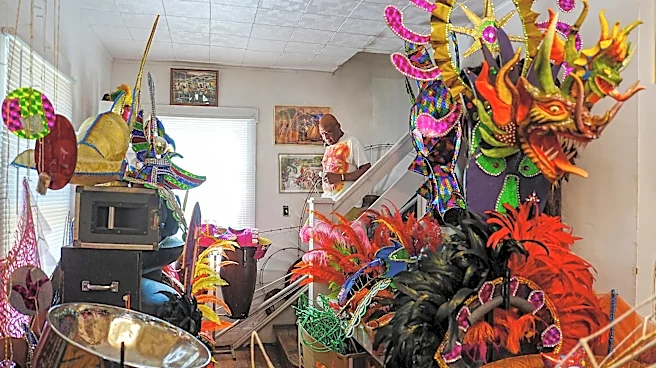









Since Robert Taylor was 9 years old, he has designed costumes for Carnival, annual celebrations held in many countries in the days leading up to Lent. Growing up in Trinidad, creating costumes is something everyone did in his neighborhood; he even won a contest at school for his designs. Taylor took that passion and never stopped creating, dreaming and believing in his craft.
As a young adult, Taylor first relied on practicality, not passion, when choosing a career path. His had uncles taught him how to weld and work on cars, which landed him jobs welding for oil companies that took him to the Bahamas and later to Detroit, where he taught auto body and manufacturing at Detroit public schools for 15 years. But Taylor’s desire to create Carnival
“mas,” or costumes, never left him. For artists, loving a craft and being paid for it are two separate battles, fought with different muscles.

Taylor, now 83 years old, says his Carnival costumes are “like icing on a cake” at any event his company, Mardi Gras Caribbean Productions, is involved with. Taylor is on the board for Marche du Nain Rouge, helping turn it into a Detroit celebration. With bright, colorful, feathered costumes accompanied by steel drum music and hip-gyrating dance moves, the event embodies the rebellious expression of freedom dating back to “Canboulay,” a banned celebration by enslaved Africans in the 18th century.

Taylor, who has received grants to assist with float and costume design for “krewes” involved with Marche du Nain Rouge, says his legacy is about preservation of Caribbean culture and that he wants to see the return of the Caribbean festival in downtown Detroit. Taylor was recognized as a Kresge Artist Fellow in 2016 and has been commissioned by Mardi Gras parades throughout the U.S. and the Caribbean.


Taylor will be showing a new piece of art at an upcoming art show on Sept. 12 at MARTK’D gallery in Detroit, whose owner also has Caribbean roots.

Things have not always been easy for Taylor, whose lease for a studio in Detroit's Islandview neighborhood was not renewed a couple years back. Now living in a small home on a forgotten street in Detroit, Taylor says his passion has not faded but has fueled his drive to do more. There is a particular drive that comes with wanting to make art for a living. It isn’t fear of failure that motivates an artist, but the drive to choose each day to keep believing in something the world has no obligation to reward.

All Taylor asks for today is that his craft is respected and recognized for the influence it has had in the world. Said Taylor: “I mean success for me is being happy on the inside, you know?”
This article originally appeared on Detroit Free Press: Robert Taylor creates Caribbean Carnival costumes that amplify Detroit