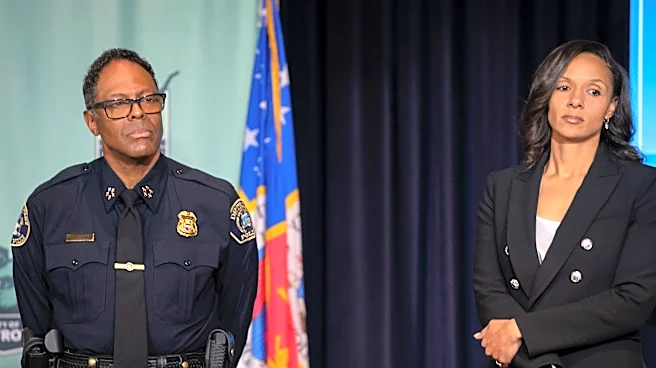






Former Detroit police chiefs don't always agree, but there's no debate among the ones I asked about current Chief Todd Bettison's decision to ask two men to remove Facebook posts featuring photos of Mayor Mary Sheffield with an old boyfriend she is now "not proud of."
"I wouldn't have done it," said one of the nine former Detroit police chiefs.
"I would not want to get involved in a personal matter like that," said another.
"I would say it was poor judgment," said a third.
"Shame on him," said another. "It's embarrassing to our city."
Bettison's conduct has been a topic of debate among current and former members of Michigan's largest police force for weeks in the wake of revelations that the chief contacted Marvin Walker on July 11 and Jahdante Smith
on Aug. 5.Bettison copped to asking them to take down romantic photos of Walker and Sheffield that were posted on Facebook.
Walker, who operated shelters for women and veterans, dated Sheffield while she was a city councilwoman. Smith is a community activist.

Bettison has told the Free Press he visited Walker and asked him to remove the photos while following up on a complaint of human trafficking at one of his shelters. The complaint did not lead to criminal charges.
The chief called Smith and made a similar request. Police later seized his phone, a move Bettison justified as part of an investigation into allegations Smith threatened or harassed a woman. That complaint has not resulted in criminal charges.
Bettison's actions were first revealed last month by Charlie LeDuff of the Michigan Enjoyer and the No BS Newshour podcast. Sheffield told the Free Press, through her spokesman, that she did not ask the chief to contact Walker or Smith.
Before we delve into the question of why the chief of a department with about 2,500 police officers would get involved in a serious but relatively routine police matter, let's get back to those former chiefs.
Detroit's top cops are no stranger to controversy or political pressure. Most of them rose through the ranks, or started their careers with DPD. It's almost impossible to become chief of police in a big city without having some talent for politics.
But several of the chiefs I spoke with said that while fighting crime was their top priority, another important part of their mission was to protect police from political meddling.
I was able to track down all but one of the former chiefs to ask for their perspective on Bettison's conduct. Some declined my invitation to comment. I granted a couple confidentiality in return for their candor. A few went on the record.
Their opinions ranged from sympathy for Bettison for getting himself embroiled in a delicate situation, to questions about whether he bowed to political pressure, to concerns that his actions would undermine officers' confidence in his leadership, to fears that the department would again get caught up in city hall controversy.
LeDuff, a resourceful reporter and master storyteller with a penchant for hyperbole, on Sept. 9 referred to Bettison as "Mary Sheffield's thug."
No one I spoke to about Bettison went that far. Only one former chief suggested that Bettison may have violated a department policy against getting involved in personal matters.
But even that police poobah wasn't sure, instead offering a perspective on Bettison's conduct that all of the chiefs I spoke to expressed: "Just because you can, doesn't mean you should."
Caught on tape
I can't tell you what Bettison and Walker discussed when they connected in July, but we know exactly what was said when Bettison called Smith last month. Smith, who has worked with the chief to combat community violence, recorded the call.
Their 24-minute exchange begins with Bettison telling Smith: "I reached out because you just sent me that text. And when you call me or reach out to me, I'll reach back out to you.
"I've seen some of the stuff that's been posted, that you posted online. And I just try to get to the root and solve things.
"I've been following the Marvin Walker story. If he's been victimizing individual women, he's doing stuff wrong, deed fraud, of course I'm going to investigate. I'm going to get to the bottom of it. I'm going to use every federal, state, local resource I can to hold him accountable. I just need people to cooperate with me."
After Bettison invited Smith to make a police report if he felt he was victimized by Walker, Smith told the chief he believed the mayor was interfering with his ability to earn money and trying to silence him. He told Bettison he wanted to speak to the mayor. And he said he knew things that would be damaging to Sheffield — and was prepared to go beyond posting them on social media.
"If I start talking about it to some of the reporters I know, it's going to be a different story," Smith said. "And a whole bigger scandal."
He did not tell Bettison what information he had, and the chief didn't ask. (Sheffield issued a statement on Aug. 26 that said, in part: "Over the past year, private photographs and communications have been used to bully, harass, and intimidate me" and vowing that she would not be "distracted from my work serving the people of Detroit.")
Bettison did tell Smith he would try to set up a meeting with the mayor.
"I will do that because you requested that," Bettison said.
When Bettison asked if Smith planned to come alone, Smith said he wanted to bring a couple local activists to discuss environmental justice issues in the city.
After a brief discussion of who might attend the meeting, and what might be discussed, Bettison said: "I did see, you know, some of the posts you made. And , um, the post, um, with Mary kissing Marvin. Some of the posts, man, I just know, I mean it's freedom, you can do what you want, but you know, I don't, I don't like it."
Smith was unrepentant. He said Sheffield knew for years that Walker wasn't, shall we say, a model citizen. And he faulted her for not warning him.
Bettison asked what could be done to get Smith and Sheffield on the same page, then asked for what he characterized as a personal favor.
"I want you to do something for me, and I'm going to work my ass off for you," Bettison told Smith. "This is my ask, and it's not a big ask at all.
"This me asking you, ain't nobody told me ... What I would like for you to do is I would like for you to take those pictures down off your Facebook page."
"I'm asking you as Todd," Bettison said. "Whether you take it down or not is not going to stop me from requesting a meeting. I'm going to do that anyway."
"You can always put it back up," the chief added.
Smith said he would think about it.
I don't believe he ever got that meeting with the mayor.
He did give interviews to multiple reporters, as well as share the recording of his chat with the chief.
Bettison did not respond to my request to speak with him about his handling of this matter.
Crossing the blue line
If Bettison thought referring to himself by his first name — Todd — when he asked Smith to take down his irksome social media posts would help him avoid being accused of misusing his position, that was just one of his many mistakes.
Former chiefs told me that, whether they liked it or not, their job was 24-7, 365.
"I'm the chief of police," James Barren told me. "The only way the person on the other end is going to look at it is I'm a person of high authority."

Barren led the department in the late 2000s under mayors Kenneth Cockrel Jr. and Dave Bing.
"I believe I would have to pass on calling this guy," he said, referring to Smith. "This has nothing to do with police work. It's an issue with the mayor and whoever this person is."
Jerry Oliver Sr., who was Kwame Kilpatrick's first police chief, agreed that it's impossible for people to separate the man from the job.

"You can never say that," said Oliver, who served as chief of police in Richmond, Virginia and Pasadena, California, as well as public safety director in Memphis, Tennessee and executive assistant chief in Phoenix, Arizona before coming to Detroit. "You're always on duty if you're the police chief."
James Craig, who led DPD from 2013 to 2021, said he was shocked Bettison called Smith in the first place.
"I have no clue and no understanding why Chief Bettison would even reach out and ask someone to take something off social media," he told me, later adding, "What business do we have injecting ourselves into this man posting pictures?"
Craig started his law enforcement career in Detroit, and joined the Los Angeles police department after he was laid off. He was chief of police in Portland, Maine and Cincinnati, Ohio before emergency manager Kevyn Orr hired him to lead Detroit's department while the city worked to emerge from bankruptcy. Craig kept the job after Mike Duggan became mayor in 2014.

During Craig's tenure, a disgruntled businessman named Bob Carmack parked an electronic billboard outside city hall and displayed video of Duggan visiting the suburban home of Dr. Sonia Hassan. Duggan's wife divorced him not long after that. Hassan and Duggan married soon after.
Carmack also hired planes to fly over major events pulling banners critical of Duggan.
Craig said Duggan never asked him to intervene — adding that even if Carmack had made threats to Duggan or his family, the most he would have done was create a police report and assign an officer to investigate.
"I never would have done it," Craig said of contacting Carmack. "For me to inject myself takes on a whole different dynamic."
Oliver and Barren said that Detroit chiefs of police have so many law enforcement matters to attend to that there isn't time to get involved in personal matters.
"Secondly," Oliver added, "if an investigation comes along, now he's tied up in it."
Current and former Detroit police told me they could not recall a chief getting as involved in an investigation as Bettison has been in the Walker and Smith matters.
The Free Press has confirmed the FBI took over DPD's investigation last month.
Detroit blues
Whatever comes of the FBI investigation, the former chiefs I spoke to said they are concerned Bettison's involvement will shake Detroit police officers' confidence in his leadership. They said it could also cause Detroiters to wonder whether they can trust the department to stay out of the city's historically problematic politics.
"The tone of any department is set from the top," Craig told me, adding that he has been fielding a flurry of calls from police and community activists wondering "What the hell is going on?"
"The decisions you make, the actions you take, affect not just an organization, it affects the entire city," Craig said.
"My main thing is to run the police department, take care of the officers there and the people of the City of Detroit," Barren said. "I don't want to get involved in something that would backfire on me, which is how this situation has gone."
Several former chiefs told me police must be independent from politics, and that a chief's duties include maintaining a wall between the two.
"This city is scarred because of what it's been through," one chief said, adding that Bettison's conduct "conjures up images of the red Navigator."
"It sounds very much like the Kilpatrick thing," Oliver told me, adding that he refused Mayor Kwame Kilpatrick's order to use police funds to lease a Lincoln Navigator for his wife.
But after Oliver resigned in 2003, Detroit police spent just under $25,000 to lease one of the luxury SUVs for Carlita Kilpatrick.
The city was mired in a budget crisis at the time. Kilpatrick initially denied using taxpayer dollars to acquire the cherry red Navigator after Steve Wilson of WXYZ-TV (Channel 7) and I revealed the deal. After my reporting forced the city to acknowledge the lease, the ensuing controversy was one of the factors that almost cost Kilpatrick re-election in 2005.
Oliver, one of the few outsiders to run the department in modern times, told me: "There's no other city like Detroit when it comes to these issues. Because the mayor is the king or queen ... there are few other people around who can hold them accountable."
Police around the country, and many savvy Detroiters, understand that almost every chief has to navigate a political minefield to keep their job.
What concerns folks here now is whether Bettison is shielding police from politics, or using his shield to play politics.
M.L. Elrick is a Pulitzer Prize- and Emmy Award-winning investigative reporter, director of student investigative reporting program Eye On Michigan, and host of the ML's Soul of Detroit podcast. Contact him at mlelrick@freepress.com or follow him on Facebook at ML Elrick and Instagram at ml_elrick
This article originally appeared on Detroit Free Press: Former top cops agree: Detroit police chief crossed the line