

With temperatures dropping this week across Michigan, the Great Lakes are entering the best season to see waterspouts form over open waters around the state.
The weather phenomena typically occurs on the Great Lakes between August and October, according to the National Weather Service when the water is still warm, but the air is cooling. And although they look like tornadoes, the phenomena don't act the same or usually carry the same punch.
The International Centre for Waterspout Research tracks waterspout sightings globally, including in the Great Lakes region, each year, and offers predictions and forecasts for when they may form.
Here's what to know about waterspout season on the Great Lakes.
When is waterspout season on the Great Lakes?
Waterspouts tend to form on the Great Lakes from August
to October, the National Weather Service said. Cool and moist air and water near its warmest lead waterspouts to form.
National Weather Service meteorologists consider forecasting waterspouts during the late summer and fall whenever large, cool air masses overspread the waters of the Great Lakes. Waterspouts become favorable when water temperatures are warm, the air is cold and moist, and wind speeds are relatively light.
What are the two types of waterspouts?
Waterspouts occur as tornadic waterspouts or fair-weather waterspouts, NOAA explained.
Tornadic waterspouts move from land to water or form over water, often with severe thunderstorms, and typically feature high winds, hail and lightning, NOAA said. They are associated with severe thunderstorms, and are often accompanied by high winds and seas, large hail, and frequent dangerous lightning, according to the NWS.
Fair-weather waterspouts form along the base of clouds, starting on the water's surface and don't typically include high winds or thunderstorms, NOAA said.
"The term fair weather comes from the fact that this type of waterspout forms during fair and relatively calm weather, often during the early to mid morning and sometimes during the late afternoon," the NWS said.
What is a waterspout?
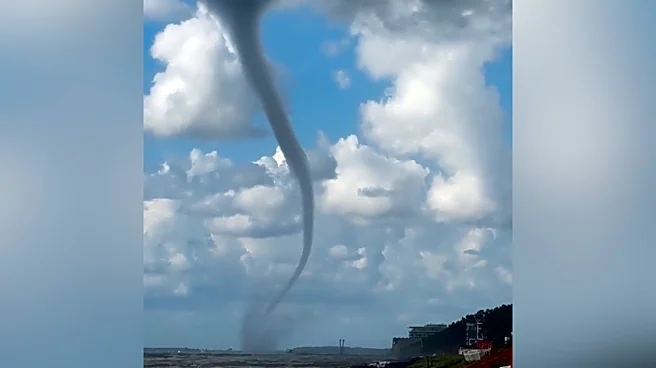
Waterspouts are spinning columns of air and water mist above bodies of water and can take two forms, according to the National Oceanic and Atmospheric Administration, either fair weather waterspouts or tornadic waterspouts.
A fair weather waterspout develops on the surface of the water and works its way upward. By the time the funnel is visible, a fair weather waterspout is near maturity. Fair weather waterspouts form in light wind conditions so they normally move very little.
Waterspouts form when cold air moves across the Great Lakes and results in large temperature differences between the warm water and the overriding cold air.
They tend to last from about 2 to 20 minutes, and move along at speeds of 10 to 15 knots, the NWS said.
What is the International Centre for Waterspout Research?
The Centre calls itself "an international organization dedicated to the study and advancement of waterspout research. It is comprised of meteorologists, researchers, storm chasers, the media and weather enthusiasts from around the world.
The ICWR provides daily updated waterspout forecasts for North America, live reports from around the world, climatology data and safety information."
Contact Jenna Prestininzi: jprestininzi@freepress.com.
This article originally appeared on Detroit Free Press: Tornado over the Great Lakes? It could be a fair weather waterspout