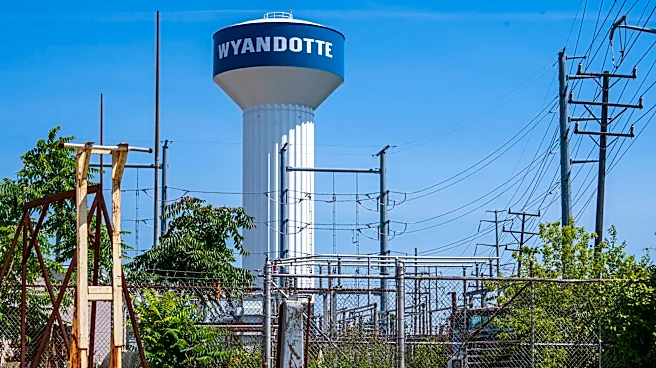




Wyandotte city and public works officials are pushing back on a local petition drive urging the city to look into moving its troubled municipal water system to the regional Great Lakes Water Authority.

"The Wyandotte Municipal Services Commission has and will continue to offer a dependable and quality waterservice to the residents and customers of the city, and any effort to cause the loss of the City’s independence,local control, and local ownership, would be a grave error," states a portion of the unsigned letter issued jointly by the city and the Municipal Services Commission and posted to the city's websiteand shared on social media by city officials on Sept. 29.
The petition, at Change.org, urges the Wyandotte City Council to request feasibility
information on connecting to GLWA infrastructure and the cost of services. "Wyandotte residents deserve to have all available information in order to make an informed decision on the source of their tap water," the petition states.
The petition is organized by Ashley Satkowski, a resident in nearby Southgate who says she and her family are frequent visitors, shoppers and diners in next-door Wyandotte. Satkowski said she became engaged in water quality and environmental pollution issues Downriver after having a child born with cancer to which environmental contamination may have contributed.
The state's environmental regulator, the Michigan Department of Environment, Great Lakes and Energy,outlined multiple "significant deficiencies" in the city's water system in an April 30, 2025, violation notice stemming from EGLE inspections of the system earlier that year and ongoing, unaddressed concerns from previous years.
"Significant deficiencies represent an immediate health risk to consumers of water and are violations of Act 399 [Michigan's Safe Drinking Water Act of 1976]," wrote Sally Castle, a water engineer in the Michigan Department of Environment, Great Lakes and Energy's Community Drinking Water section, in an April 30, 2025, "Significant Deficiency Violation Notice" letter to Wyandotte Water/Filter Plant Supervisor Justin Ptak.
Wyandotte's water intake pipe in the Detroit River is located roughly 1,700 feet downstream from where contaminated groundwater from the BASF Wyandotte chemical factory site seeps into the Detroit River. Pollutants flowing from the site include elevated levels of mercury, arsenic, cyanide and nonstick PFAS compounds. A multimillion-dollar, U.S. Environmental Protection Agency-directed cleanup plan is in the works at BASF but remains years away from stopping the pollution discharges.
"There are 17 documented carcinogens [cancer-causing chemicals] present in the Detroit River within the Critical Assessment Zone of the Wyandotte intake, present in polluted water discharging from BASF Northworks at a rate of 57 gallons per minute, 80,000 gallons per day," the Change.org petition states.
City officials, however, state Wyandotte's water is safe, and consistently meets all state and federal water quality standards.
"Wyandotte's water intake is located 1,200 feet offshore and 30 feet below the surface which is far from the shoreline and deep enough to offer natural protection from contamination. Its distance and depth significantly reduce risk, and there is no current threat to the safety of the water supply," the city's website states.
In a non-scientific survey of Wyandotte residents being conducted online and through door-to-door canvassing in conjunction with the Change.org petition, on the question of whether they trust city tap water:
- 115residents said they drink and trust the tap water.
- 105 had at least some concerns and use a home water filtration system.
- 96 don't drink the city water at all and use bottled water.
"I was surprised to hear of ⅓ of the people not trusting the water at all — surprised but validated," Satkowski said. "It's shocking."
Progress being made on city's water system deficiencies
Following the findings of significant and other deficiencies, Wyandotte's water system entered into an Administrative Consent Agreement with EGLE that includes a compliance schedule for corrective actions. As of the end of August, of 22 corrective actions required by state regulators, the city had completed 10, EGLE spokesman Scott Dean said. Three corrective actions are ongoing with EGLE receiving quarterly progress reports, and 10 are "still open," Dean said.
"EGLE remains committed to working with communities like Wyandotte to see that they are supplying customers with water that meets the requirements of the Safe Drinking Water Act," Dean said.
Castle, in the April 2025 notice of violation to the city, stated: "The City is not demonstrating the technical, managerial, and financial (TMF) capacity necessary to own and operate a water system. TMF capacity enables water systems to consistently provide safe drinking water to the public."
When asked if that assessment is still EGLE staff's belief, Dean responded, "Based on the progress to-date, we wouldn't draw that conclusion."
Wyandotte Mayor Robert DeSana and city Municipal Services Commission General Manager Paul LaManes did not respond to Free Press messages.
The city's website states that work has been completed or is under way on identified water system deficiencies including reservoir inspections and debris removal, reservoir vent repairs, cross-connection work to prevent untreated and potentially contaminated water from mixing with treated water, and alum-mixing issues to address sediment and pathogen control.
Water engineer: City should be more upfront with residents
A drinking water engineer who was instrumental in exposing the Flint water crisis had sharp criticism for city of Wyandotte officials over their water system deficiencies and their public transparency about them.

Environmental engineer Elin Warn Betanzo operates Safe Water Engineering LLC in Detroit. During a summer 2015 dinner party, Betanzo told childhood friend and pediatrician Dr. Mona Hana-Attisha that the city of Flint had switched its water source to the Flint River without proper corrosion treatment. Betanzo urged Hanna-Attisha to look at electronic medical records and blood-lead levels in Flint's children, leading Hanna-Attisha to perform the pivotal study that scientifically proved local children's blood-lead levels rose after the switch.
Although more than 15 public officials were charged over the years related to the Flint water crisis — including former Gov. Rick Snyder, former state health director Nick Lyon, and various emergency managers and environmental quality officials — the criminal cases ultimately collapsed. A federal and state civil class-action settlement worth $626 million was approved by a judge in 2021 to compensate Flint residents, property owners and children affected by lead and water contamination — though outlays of that money were still languishing well into this year.
Betanzo said she became engaged on Wyandotte water issues at the request of concerned local residents. She took particular exception to the city's Sept. 29 posting referring to the 2025 EGLE notice of significant deficiencies in the municipal water system as a "report card."
"I feel like they are misleading about what this report actually included," she said. "That is not a report card.
"I don't know what is insignificant about an immediate health threat to consumers. Any time you portray it as just a report card or not very important, that's really concerning."
While the cityhas a webpage where it describes the progress it has made on various water system deficiencies, it does not include EGLE's violation notice, communications between the city and EGLE and an accounting from the regulators on the sufficiency of progress in correcting the problems, Betanzo said.
"The residents deserve access to information about their water system," she said. "Clear, available information and not just have it all being translated through the city's public relations message."
Betanzo served as a member of EPA's National Drinking Water Advisory Council for more than five years until 2025, when she was suspended and then fired after signing a "Declaration of Dissent" along with hundreds of other EPA employees, criticizing recent EPA policies under the Trump administration that signatories believe undermined the agency's mission of protecting public health and the environment. Betanzo has filed a lawsuit in federal court against the Trump administration, alleging a violation of her First Amendment rights to free speech. That lawsuit remains pending.
Betanzo said she is not involved in the community debate on whether Wyandotte should consider joining GLWA, but she noted the city's water system "is in a very vulnerable location," with the BASF plant's known contamination; downstream from Zug Island and other current and historic polluting industries; and downstream from frequent large-volume combined sewage overflows.
"I want a water system that is above and beyond, extra proactive and has every duck in a row — that's the only water utility I want to see operating in a very vulnerable location like that," Betanzo said. "But this is a small water utility with a limited budget, limited expertise and the significant deficiency violation notice demonstrates that."
Contact Keith Matheny: kmatheny@freepress.com.
This article originally appeared on Detroit Free Press: Wyandotte officials fight citizen drive to move water to regional authority