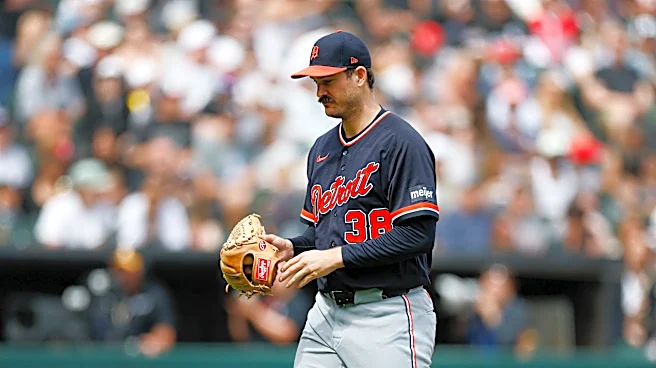






Answering the question before he could be asked, Detroit Tigers president of baseball operations Scott Harris had his answer ready as to why the 2026 season ended in disappointment.
Harris gave his end-of-season news conference on Monday, Sept. 28, at Comerica Park in Detroit, one day after the Tigers' season-ending 4-2 loss to the Pittsburgh Pirates. Harris addressed many topics, including August's Tarik Skubal trade, strategy adjustments for 2027 and how the Tigers will approach free agency. But in his opening remarks, he said he had a "pit in his stomach" about Detroit missing the playoffs for the first time since the 2023 season and took the blame for the Tigers not having enough depth.
Specifically, he took the blame for the Tigers' 6-22
record in May, one that took them from playing .500 baseball (16-16 through March and April) to 16 games below .500 at the start of June (22-38). He also highlighted it as a key reason for the Tigers missing the playoffs.
"This roster performed quite well for the five months excluding May," Harris said. "If you take a step back and you look at this roster and how it performed across the five months combined, what you'll find is, we went 70-64. We finished second in all of baseball in team ERA. We finished second in all of baseball in team wRC+, and we finished with a run differential of plus-119. That's playoff-worthy."
But is it actually "playoff-worthy?" And can the Tigers put the lion's share of blame on one particularly cruddy month?
Let's examine these statements.
Did a 6-22 May doom the Tigers?

One thing Harris got right – May was a particularly disastrous month for the Tigers.
At 6-22 – a .214 winning percentage – the Tigers had the worst record in any month for any team in the American League Central. In fact, the only team in the division who finished a single month (excluding the end-of-March opening week) with fewer than 10 wins was the Kansas City Royals, who finished 7-17 in September.
As a team, the Tigers were dead last in fWAR (minus-1.1, per FanGraphs) and last in wRC+ (69) in May, dooming an otherwise slightly below-average pitching staff that had a 4.13 ERA for the month (19th in MLB). That's the kind of month that's easy to point to as the source for Detroit's shortcomings in 2026.
But the Tigers played in other months besides May, and one could argue they weren't good enough in those months, either.
If you take the winning percentage the Tigers had in their non-May games (.522) and extrapolate it over a full season, you get a team that goes 84-78, eight games better than where the Tigers actually ended up. Perhaps some of those eight wins would have occurred against the Cleveland Guardians (who finished first in the AL Central at 85-77) or the Chicago White Sox (who finished with the final AL wild-card berth at 84-78). But if not, that's a record that only lands the Tigers at the cusp of contention. That's not exactly a winning argument for Harris.
May wasn't the only bad month for the Tigers, either; Detroit also went 11-16 in August. By winning percentage (.407) it was better than what the Tigers did in May. But it was also arguably the worst possible time to have such a bad month.
The Tigers were 60-61 after a 3-0 win over the Guardians on Aug. 13, still not at .500 but enough to get them sitting in the final wild-card berth. They were 8-3 in the month at that point, finishing off an important series win over Cleveland and about to face the first-place White Sox at home for a three-game series that could have given them the division lead.
Instead, the Tigers got swept, went 3-13 the rest of the month and saw their FanGraphs playoff odds dip from 37.4% (on Aug. 13) to 0.4% at the end of Sept. 1. For some perspective, Detroit had a 9.8% chance to make the playoffs at the end of May, making August the more disastrous of the two months, despite a slightly better record. (Though, notably, the Tigers finished April 30 with a 71.9% chance of a playoff spot, meaning May wiped out more than a 62% chunk.)
In Harris' defense, he acknowledged other reasons for the Tigers finishing the season short of expectations. But even if you broke it up into a neat little pie chart, the Tigers' record in May probably doesn't take up the biggest slice.
What else went wrong

There's no single answer for what went wrong for the Tigers in 2026, but there are some pretty clear inflection points that put the Tigers in a worse position to compete.
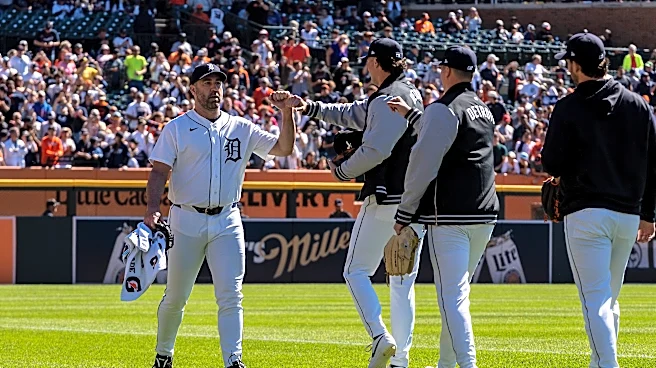
The trade deadline sticks out, certainly. After a disastrous extra-inning loss to the Baltimore Orioles on July 29 that turned out to be the last start in a Tigers uniform for lefty ace Tarik Skubal, the Tigers decided to sell at the deadline, dealing Skubal, righty Casey Mize and catcher Jake Rogers for prospects.
As it happens, the Tigers were the only AL Central team who didn't add at the deadline, sinking their chances to make the playoffs as they subtracted their two best pitchers on the roster. This isn't to say the Tigers could have made up an eight-game deficit simply by keeping Skubal and Mize around – the former produced 2.2 fWAR with the LA Dodgers, while the latter was particularly brutal with the San Diego Padres, at minus-0.7 fWAR – but it would have at least projected confidence that this roster was indeed good enough to compete.
Harris said Monday he didn't regret selling at the deadline, only regretting the he put the team "in the position where we had to trade those guys." And it may end up being the right decision. But it's not inconceivable that this team would be in the playoffs right now if Harris had just held on to its top two starters.
Another inflection point was the decision to call up prospects Max Clark, Eduardo Valencia and Ben Malgeri too late in the season. All three were good-to-great in short bursts after the trade deadline, and Harris hinted that the depth those players provided in August and September could have been utilized much earlier in May.
Turning back to the numbers, the Tigers' run differential may not tell the full story. At plus-71 runs, the Tigers had the fourth-best run differential in the American League, ahead of everyone but the New York Yankees (plus-138), the Tampa Bay Rays (plus-86) and the Boston Red Sox (plus-78). But a whopping plus-37 of the Tigers' differential came in two three-game sweeps of the (formerly Oakland) Athletics. Take out their edge over the A's, and the Tigers' run differential is a mere plus-34, or an 85-win pace over a 162-game season (rather than the 89 wins their actual run differential projects to).
Lastly, the Tigers may have been victims of some awfully bad luck. Their 17-27 record in one-run games, however, was the worst in baseball (by win percentage), admittedly with the general consensus that one-run games are a product of luck more than true talent.
Harris may not buy that, however, saying that the Tigers were good this season in low-to-medium leverage situations but struggled in high leverage. That's going to be something he and the rest of the Tigers front office will explore, and something that goes well beyond Detroit's awful May.
But even as Harris said on Monday, there were plenty of reasons why the Tigers failed to make the playoffs this season.
"You can't just sit at this stage and chop [up] the major league season and hide the bad parts," he said. "You have to play all 162 [games]. You have to add them up in the end, you have to see where you stand, and I think when we added them all up, we came up short."
Need to catch up on the news during your lunch break? Sign up for our Sports Briefing newsletter to get daily summaries of Detroit sports!
You can reach Christian at cromo@freepress.com.
This article originally appeared on Detroit Free Press: The Detroit Tigers were awful in May, but that didn't sink the season