







General Motors is looking beyond its core vehicle sales for big revenue in the future and Wall Street analysts applaud the strategy, hinting the automaker may be better positioned than its rival, Ford Motor, to win government contracts.
CEO Mary Barra told Wall Street during a second-quarter earnings call on July 21 that GM Defense and GM Insurance are on the road to becoming meaningful contributors to the company's profit stream. She even revealed that if Congress appropriates the funds, the company stands to win a $1 billion contract to build military vehicles off the Chevrolet Colorado frame.
In 2017, GM formed the subsidiary GM Defense to apply its vehicle technology to military equipment in hopes of winning lucrative government contracts
with U.S. and foreign governments. The GM Insurance program, which launched in 2024 and is only offered in certain states including Michigan, sells direct to consumer auto insurance, including liability, comprehensive and collision coverage.

Barra told auto analysts on July 21 that GM Defense revenue will grow to nearly $700 million this year and it is on target to acheive positive earnings before interest and taxes. In the next several years, she said, Barra said, GM Defense will produce double-digit profit margins.
GM's billion-dollar bet
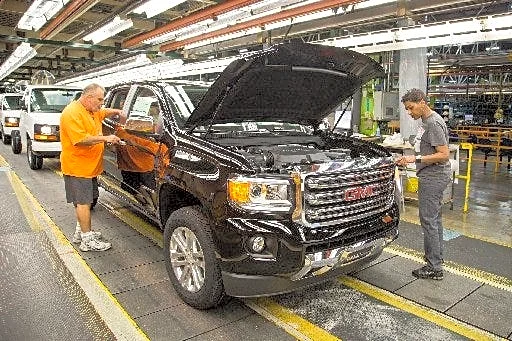
GM Defense could also win a $1 billion contract with the U.S. government to build light utility vehicles for the U.S. Army, based on the Chevrolet Colorado pickup trucks. The vehicles are dubbed ISVs for Infantry Squad Vehicles.
"After initial multiyear order of about 1,200 ISVs, the U.S. Army now plans to procure more than 10,000 if the appropriations is passed," Barra said in the call, later adding that the, "ISV awards that are expected to exceed $1 billion based on the U.S. Army's procurement objectives."
GM Defense won its first contract, worth $214.3 million, in 2020 to build the ISVs for the U.S. Army. It has won other contracts since then. In 2021, GM Defense won a $36.4 million contract from the State Department to develop large support utility commercial vehicles for the department’s Diplomatic Security Service, which is the federal law enforcement and security arm of the department.
Barra said GM Defense, which is headquartered in Washington, DC, is "building momentum with other products and customers. Those customers include the U.S. State Department and Secret Service, Canada, Qatar, Brazil, and "other allies."
"We're also supplying battery propulsion technology to Lunar Outpost, which has been awarded a $220 million NASA contract to build the next generation lunar terrain vehicle," Barra said.
In May, NASA said GM will build the battery for the next lunar terrain vehicle designed to establish the first long-term human presence on the moon. GM Defense will be a subcontractor in the development of the “Pegasus” Lunar Terrain Vehicle (LTV) to support NASA's Artemis mission in 2028 alongside prime contractor Lunar Outpost, Goodyear Tire and Leidos.
A collaboration to provide weapons
GM also is working with Lockheed Martin and other leading companies "to expand speed, scale, and resilience in the defense industrial base," Barra said.
As the Detroit Free Press reported in April, senior defense officials in the Trump administration have had discussions with Ford Motor Co. and GM about the possibility of the automakers' workforces and factories making munitions to help restock supplies depleted by wars in Ukraine and Iran.
As the Detroit Free Press reported last month, GM started collaborations with Lockheed Martin to provide strategic support and potentially munitions parts as part of a Department of War initiative to “triple or quadruple” weapons production over the next several years. Crosstown rival Ford also is in discussions with the U.S. government over defense-related projects.
Barra told investors that she sees GM Defense as an increasingly vital part of the automaker's revenue stream.
"We're focusing our efforts on strengthening supply chain management, improving manufacturing readiness, and expanding production capacity in ways that serve the United States and its allies well," Barra said. "Over time, all of this should make GM Defense a more meaningful and diversified contributor to our earnings."
GM in the 'catbird's' seat to beat Ford
Wall Street smiled favorably on the prospects.
"GM is in pole position to benefit from this massive increase in U.S. Defense spending and could be an incremental boom to the GM story," Dan Ives, partner and senior managing director at New York-based investment banking firm Yorkville Ives, told the Detroit Free Press. "Ford is also going after this piece of pie and Barra and team have strategically put GM in the catbird's seat to get Beltway deals as they are approved in the budget."
Morningstar's David Whiston told the Detroit Free Press any gains are long overdue given that GM’s various new verticals are something it has talked about since 2021.
"Defense, software and insurance are all interesting growth stories that all will likely keep growing for a while," Whiston said. "Defense and NASA may be more lumpy as that’s subject to government spending."
Whiston said GM's update on revenue from its subscriptions to OnStar and its hands-free driving technology, SuperCruise, also was interesting because they deliver higher gross profit margins than the legacy business of selling new cars.
"For now, none of these are really big relative to the total size of GM but they all have attractive option value for investors," Whiston said.
Other sources of revenue
Similarly, Barra said there is the software services growth. She said the high-profit-margin software and services revenues continue to grow rapidly with 1 million new subscriptions expected this year, contributing to more than $3 billion in recognized revenue.
Finally, she said, GM Insurance is reaching critical mass thanks to what she called GM's "unique value propositions."
"For example, when a customer purchases GM Insurance, we create a recurring revenue stream from premiums, along with incremental parts and vehicle sales, all while driving customer loyalty and higher satisfaction," Barra said. "The business has scaled from three states in early 2024 to 21 states today, making GM Insurance available to over 60% of GM's U.S. sales, and we are on track to reach over 80% in the near term."
Jamie L. LaReau is the senior autos writer for USA TODAY Co. who covers Ford Motor Co. for the Detroit Free Press. Contact Jamie at jlareau@freepress.com. Follow her on Twitter @jlareauan. To sign up for our autos newsletter. Become a subscriber.
This article originally appeared on Detroit Free Press: GM has a plan to add billions in profits, but not only from car sales