






Blue Cross Blue Shield of Michigan is changing how it covers mental and behavioral health services, saying that as of March 1, it will no longer cover counselors, therapists and social workers with limited or provisional licenses as well as temporary limited licensed psychologists working in private practice in Michigan.
As the state's biggest insurerwith about 70% of Michigan's commercial health insurance market, Blue Cross says the change comes as part of an effort to rein in waste, fraud and abuse in medical billing and to ensure its members get high-quality care.

The announcement sparked immediate backlash from people who work in the state's mental and behavioral health field, who call it a corporate cost-cutting strategy that will limit access
to care for some of Michigan's most vulnerable people and constrict an already too-narrow pipeline for new clinicians in training.
"This policy, they make it seem harmless and that it's there to protect people, but that's not what it's going to do," said Christopher DeBoer, president of the Michigan Mental Health Counselors Association.
"Limited-licensed practitioners make up roughly 20% of the behavioral health workforce in the state of Michigan. With Blue Cross Blue Shield being the largest payer in the state, that means a large portion of the behavioral/mental health workforce wouldn't be able to bill for those members at all anymore. That's a huge loss of access for thousands and thousands of Michiganders."
DeBoer was among the protesters Friday, Aug. 21, who lined Lafayette Boulevard in Detroit, carrying picket signs and chanting, "Hey, hey! Ho, ho! Corporate greed has got to go!" and "When mental health is under attack, what do we do? Stand up! Fight back!" outside Blue Cross Blue Shield of Michigan's headquarters.
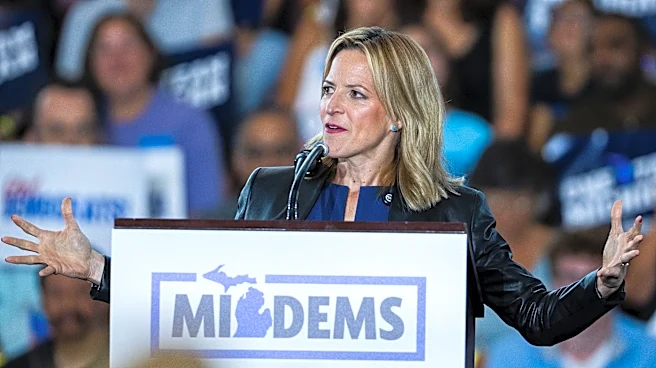
Several politicians, including Dr. Abdul El-Sayed, who is running as the Democratic candidate on the November ballot for the U.S. Senate, joined mental health providers and others to speak out on the change.
Jess Riley, the policy and advocacy manager for the National Association of Social Workers Michigan, held the microphone and told the crowd of more than 100 people that it is going to take a coalition made up of the entire mental health workforce to push Blue Cross to change its policy.
"Not a single profession is affected by this policy, and no single group is going to solve it alone," said Riley, who is macro master social worker and is working toward becoming a limited-licensed master social worker. "Together, what have we done? We've written letters. We have collected data. We've made calls. We've met with policymakers. We've organized and we've protested. And today, all of those different voices have come together here at the Blue Cross headquarters. Let them hear you!"
They heard the voice of Ashley Mosley, 42, of Muskegon, a mother of four whose husband, Brandon Mosley, died unexpectedly about year and a half ago at the age of 36 — leaving her alone to raise their daughters and manage their grief along with her own.
"Our world just kind of flipped," Mosley said. "We found Miss Heather, a limited-licensed therapist who can see us in the evening. Her schedule fits ours.

"All four have built a trusting relationship with her. They have been seeing her for almost a year now, and they can't lose another person in their life that they have built a trusting relationship with after losing their dad so unexpectedly. They cannot lose her," Mosley said through tears.
She held up a poster bearing photos of her girls — who range in age from 4 to 10 years old — and said it was worth the drive to Detroit on Friday to fight for them and do her part to ensure they will have continued access to the limited-licensed therapist who has made such a difference in their lives.
They heard the voice of Samm Heberlein, a limited-licensed professional counselor from Lansing.
"When this takes effect in March, I am potentially losing eight of my eight clients," Heberlein said. "A lot of them are dealing with a lot of trauma. I work with a lot of the queer community and they need support. They need people that look like them and are representative of them. This is going to directly impact them and me. How am I supposed to get my hours to become fully licensed if they're taking away clients for me to work with? That's why I am in this field. It's the clients."

Mental health care crisis could be on horizon
The Blue Cross policy change, DeBoer said, could cost some people their lives — as those with mental and behavioral health disorders who can't afford to pay for therapy or counseling services out of pocket will either have to find new, fully licensed providers amid a workforce shortage — or go without treatment. That could fuel a rise in mental health crises and drive up suicide rates in the state.
"We're talking about people who are among the most vulnerable in the population," said DeBoer, who also works as a licensed professional counselor at Spring Forest Counseling in Lansing. "If they have a depressive disorder or if they have some other mental or behavioral health disorder, and they get this news, it's just like, 'I tried to do everything right. I tried to get better, and then it was taken away from me.'
"Do people end up feeling hopeless from that, from care being taken away based on a bureaucratic decision? ... I would be crushed by that. I would feel as if I don't have a lot of power in my own life and can't even choose my own provider."
For small business owners with private practices or professional offices who employ newly graduated limited-licensed therapists, counselors, social workers and psychologists in training, it could affect their ability to operate.
"It's not just their bottom line, but their viability," DeBoer said.
The association conducted a survey of 2,700 Michigan mental health providers, clients and practice owners, DeBoer said, and found that many private practices would have to undergo major restructuring to remain in business after the policy change, and some would be forced to close.

"There were a few that said they were thinking about just calling it quits," he said.
Other potential downstream effects also worry DeBoer.
"When people go into crises, where do they go for help? They go to the ER. They go to community mental health centers," DeBoer said, noting that both Michigan hospitals and community mental health agencies already report being overtaxed and understaffed. "Neither of those two venues are going to be able to deal with an uptick from that."
Policy change to align Blue Cross plans, billing standards
Blue Cross said it doesn't expect the kind of fallout DeBoer described from the policy change.
If a member is getting treatment through a limited-licensed counselor or therapist and loses coverage with that person in March, Blue Cross can ensure its members can get an appointment with a different, fully licensed behavioral health professional through its network of 22,000 providers "typically within 48 hours" for online appointments and within a week for in-person care, said Julia Isaacs, the company's director of behavioral health strategy and planning.
The company has "worked really diligently over the last five years to expand access ... by over 46%" to mental and behavioral health providers, Isaacs said. It also has "more than 200" outpatient mental and behavioral health facilities in the network. "That's in addition to the hospitals and community mental health spaces that also qualify as these facility-based settings. So, there are hundreds of options for people to either transition care or transition their care to."
She told the Detroit Free Press that this Blue Cross policy change will align all of its commercial health insurance plans with long-standing Blue Care Network policy.
Blue Care Network, she said, has never covered temporary or limited-license mental and behavioral health providers — people who have completed their education but practice under the supervision of fully licensed clinicians to meet the work hours and other requirements needed to become fully licensed — only when they work in accredited, inpatient or outpatient facility-based settings.
The fully licensed supervisors who oversee their work bill Blue Cross for their services using their own National Provider Identification number, a practice called "incident-to" billing.

"This is really making sure that we have more quality standardization across our commercial products," Isaacs said. Incident-to billing for limited-license practitioners can continue after March 1 only in accredited, facility-based settings, according to the new policy. Supervising clinicians in private practices and professional offices will no longer be able to bill in that way.
Isaacs said the shift will provide Blue Cross with more transparency when it comes to claims.
"Currently, we have no line of sight to services that are being delivered incident-to," Isaacs said. "So, when we receive a claim here at Blue Cross that is submitted by one of our behavioral health providers in the network, it could be submitted by that behavioral health provider or it could be submitted by somebody else who is billing under that behavioral health provider and we have no way of knowing that.
"We are trying to balance ensuring quality standards ... oversight and accountability. We have had instances, in response to complaints or other inquiries, where we have found improper coding, lack of documentation and potential fraud for services delivered by incident-to providers. Of course, this is not everybody universally, but in one instance, we did review 176 medical records and 175 failed due to quality or incomplete recordkeeping. So, really, this is about standardizing the way we treat provisionally licensed graduates."
It's also similar to the way Blue Cross handles billing for medical residents who have recently graduated from medical school, Isaacs said.
"They are physicians, but they have to be in an accredited GME (graduate medical education) program," she said. "This is really about treating the behavioral health provider the same. They are able to continue providing those services as long as they are in an accredited facility to ensure that quality and oversight is really consistent across the network."
The company has given providers until March to either find work at an accredited inpatient or outpatient mental health facility or transition their clients to a different therapist who is either fully licensed or working at a facility with accreditation.
"We have provided a lengthy transition time to help those providers and those patients prepare," Isaacs said.
Counselors, therapists form deep bonds
Noel Spring, a licensed master social worker who practices in Detroit and uses somatic therapy as well as trauma center trauma-sensitive yoga, said it won't be easy for everyone who's getting care from a limited-licensed mental health practitioner to just switch to a new provider.
That's especially true for people who need gender-affirming care, for people of color and for those who live in rural communities where there aren't many options.
"I think a lot of people will stop therapy because it's already very difficult to find a therapist you vibe with," Spring said. "Sometimes it's really difficult to find a therapist who has the personal experience or the skills to help you. People spend a lot of time finding the right fit."
If Michiganders with Blue Cross plans are shuffled to just anyone in the company's network of 22,000 providers, Spring said they may drop out of therapy altogether.
"A lot of people, when they lose that right fit, it can be very difficult to want to go out and seek it again. So, I think a lot of people will not continue care. The populations that I'm particularly concerned about are people who hold nondominant identities. Particularly, I'm transgender. I have a supervisee, a limited-licensed social worker who I supervise right now who is a transgender woman. She specializes in gender-affirming care and over half her caseload is people with Blue Cross Blue Shield.
"She is one of a only handful of transgender women therapists in the state of Michigan. All of her people need a very specific type of care. So, where do they go?"

Pushing both limited-licensed providers and their clients toward accredited outpatient and inpatient mental health facilities also feels like a misstep, Spring said.
"Facilities are not made for people of nondominant identities," Spring said. "Those facilities are not made for queer folks. I've worked in them. It was hard for me to work in a facility. It's hard to seek help and treatment in a facility that's not made for you."
For people of color, finding a therapist who understands all of the complexities involved with racial identity also can be challenging. That's especially true in Detroit, Spring said, a majority Black city "where there are very few Black therapists practicing because of the obstacles that exist to become a therapist in the first place. Facilities and therapy in general, have a pretty extensive history of committing harm against people of color, specifically Black folks. And so a lot of Black folks won't trust facilities for very good reasons."
For Blue Cross to suggest people of color, and especially Black Michiganders, are going to receive better care at mental health facilities, Spring said, "is abjectly incorrect."
Isaacs at Blue Cross said that while it isn't ideal to ask members to find new counselors and therapists, the company is giving practitioners and facilities plenty of time to make the transition. It initially issued notice to providers in June, and the change doesn't take effect until March 1.
Noting that, on average, Blue Cross members are in psychotherapy for less than six months, and across all categories of mental and behavioral health, she said it's "somewhere in the realm of 12 to 14 months," a nine-month notice, Isaacs said, is "significant time to either complete treatment or transition care."
"There certainly could be individuals that need continued care, and it is the responsibility of the treating provider to appropriately clinically transition care. ... This happens when people move or change jobs. It is not something that is ever ideal, but it does happen, and it is important in a broader perspective to really make sure that care is being delivered in a more systematically quality-driven way."
David Sniderman, a licensed professional counselor and art therapist who specializes in working with children, teens, and adolescents, bristles when he thinks about the coming change, which feels like a cost-cutting measure to him.
"Mental health is one of their largest expenses," he said of Blue Cross. "These are appointments that you don't just do once a year, twice a year. ... It's something you do every week or every other week.
"I think they saw that people are starting to take care of themselves more often now, especially since the COVID pandemic, and more people have been going to counseling. Blue Cross is trying to create barriers to that because it's a big expense. And so they figure if they can create that barrier, people won't go."
That's an assertion Blue Cross denied, however.
"This policy is not about cutting costs," Isaacs said. "This policy is about protecting our members and ensuring standard of care."
When El-Sayed took the microphone Friday, he accused Blue Cross of putting profits over people and said he's especially concerned about what this policy change will mean for access to mental health care in rural parts of Michigan, where the options are especially limited.
"They are stuck under the health care auspices of one corporation that dominates 70% of the health insurance market in this state. ... I'm not a legislator yet ... but, God willing, with your support, I can be a legislator in just about three months.
"I'm running against a system that says corporations like Blue Cross Blue Shield, which has spent I don't know how much to beat me in the elections I've run in, cannot dictate who your politicians are. Because if they get to pick your politicians, they also get to pick your policy.
"This fight is about sustaining the critical mental health lifeline that you all offer for your patients, but it's also about the kind of politics that protects that lifeline in the first place."
Blue Cross: Private practices can become accredited
Earlier in August, Blue Cross invited mental and behavioral health practitioners to a forum to discuss the policy change, and explained that there is a way for private practice and professional offices to continue to work with limited-licensed providers and get reimbursed by Blue Cross plans after March 1, Isaacs said.
If those private practices work to become accredited outpatient psychiatric care facilities, also known as OPCs, the company said it would extend the deadline until Sept. 1, 2027.
To do so, the practice would need a board-certified or board-eligible psychiatrist on staff or contracted; a fully licensed psychologist, a master's level limited-licensed psychologist, a limited-licensed psychologist with a doctorate with a supervisory or consulting licensed psychologist either on staff or contracted; along with a licensed master's social worker.
That's just the beginning of the requirements, which also include being staffed to handle emergency services 24 hours a day, while also becoming fully accredited through one of the following organizations: the Joint Commission, the American Osteopathic Association, the Council on Accreditation of Services for Families and Children, the Commission on Accreditation of Rehabilitation Facilities or the National Council on Accreditation, or getting a certification letter for community mental health services from the state health department.
"There are certainly some practices that just don't want us to make this change, but back to kind of balancing the network quality across the entire state of Michigan. With what these requirements are and the changes we're making to this reimbursement policy, you know, we continue to think it's the right thing to do," Isaacs said.
"We have modified the outpatient model to allow for part-time, contracted psychiatrists to be part of the care team and oversee the medical care for that practice. I think this really goes back to ensuring that there's consistent quality and oversight, and having a physician as part of that model is really critical, especially for new graduates."
Spring said mental and behavioral health providers running small businesses in private practice aren't likely to be able to jump through all the hoops needed to become accredited outpatient psychiatric centers — nor will most be able to afford it.
Given the shortage of psychiatrists in the state, even if a practice could find one willing to join the staff or become a contractor, the cost would exceed $11,000 a year, Spring said.
"I can't afford that," Spring said. "Small practices can't afford that. ... Does this put small practices out of business? Yes, I absolutely think it will put a lot of small practices at risk of going out of business."
Isaacs said the Blue Cross doesn't have the resources to fully audit the depth of fraud, waste and abuse within the billing practices of mental health providers.
"What I can say is it is something that we routinely see, but I can't give you a specific number," Isaacs said. "My biggest concern is that there is this lack of oversight and established policies and procedures to ensure that clinical care is being delivered and documented properly."
Contact Kristen Shamus: kshamus@freepress.com. Subscribe to the Detroit Free Press.
This article originally appeared on Detroit Free Press: Backlash roils against Blue Cross mental health billing policy change