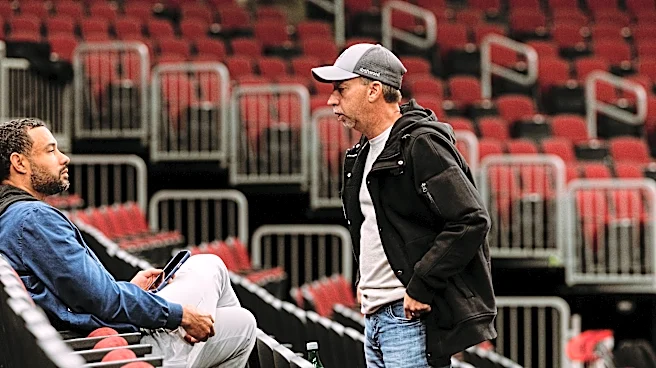







For Michael Blackstone, a cancer diagnosis started with a seemingly benign pain in his right shoulder.
The Detroit Pistons’ executive vice president of basketball operations since 2024, Blackstone was an assistant general manager with the New Orleans Pelicans when the pain began during the 2023 offseason. The team medical staff worked on it for several weeks, believing it to be an out-of-place rib.
It got worse after Las Vegas Summer League, though, prompting Blackstone to meet with his primary care physician in Florida. She ordered an x-ray, which led to a CT scan, which led to a PET scan and, finally, a biopsy that confirmed the reason behind his discomfort.

Blackstone,
who is 54 and a lifelong nonsmoker, was diagnosed with stage 4 lung cancer. It had already metastasized to his spine, hence the pain. Since July 2023, he has been in treatment at the Mayo Clinic in Jacksonville, Florida.
But as shocking as the news was, it came with a silver lining: A daily pill is keeping him alive.
His particular lung cancer mutation, EGFR, has a targeted prescription medicine – osimertinib, with the brand name of Tagrisso – that blocks a protein that causes cancer cells to grow and multiply. The median patient taking osimertinib has a progression-free survival – a measure of the length of time without the cancer spreading – of 18.9 months, according to WebMD.
Blackstone underwent one round of radiation on his lung not long after starting his medication. Unfortunately, doctors found cancerous activity in his spine earlier this year. In August, he was treated with what he calls an “Incredible Hulk”-level of radiation to try to eliminate that activity. Because it takes time for radiation to build, he expects the peak impact of the resulting fatigue to hit this week.
The ultimate goal is for his cancer to eventually become a chronic disease that can be managed, rather than a death sentence. The five-year survival rate for his type of lung cancer is 12%, according to the American Cancer Society.
“We know eventually the drug will fail,” Blackstone told the Free Press on Friday, Sept. 18. “Eventually the cancer will break through; we just don’t know how long it will be.
“You try not to pay attention to all of the bad parts of the data, but it is what it is. So I’ve had to make peace with what I have and fight, and fight with everything I have in me. And that’s what we’re doing.”
Blackstone recently made the decision to go public with his disease as a warning to other people to take their health seriously. Lung cancer is the leading cause of cancer death in the United States. Nonsmokers account for only 10-20% of cases, and though most cases occur to people over the age of 65, diagnoses in younger people have been on the rise. Because lungs lack pain-sensing nerve endings, he likely would’ve gone undiagnosed had it not metastasized to his spine, which led to the process that revealed the cancer.
“If I didn’t pay attention to the discomfort that I was having and asked a very innocent question, I wouldn't be here right now,” he said. “That’s the truth.”
His charge now is to help as many people as he can understand the dangers of lung cancer, which is becoming more common in non-smokers. Blackstone says he drew the “short straw.” He hopes others can avoid his fate.
“Pay attention to the weird pain,” he said. “Pay attention to the ‘Something’s not right.’ It’s not, every pain, go to the doctor, that’s not what I’m talking about. But you know your own body. You know. Everybody does. Something’s not right for long enough, what’s the worst thing that happens if you get it checked out? They tell you nothing’s wrong? Why not go get it checked out?”
An 'accidental' NBA career

Blackstone describes himself as an anomaly in the NBA world – one of the few front office members who can say they got there by accident.
His career started in business consulting. In 2003 he began working for Shapiro Negotiations Institute, which was founded by former baseball superagent Ron Shapiro. The San Antonio Spurs were a client, and Blackstone worked directly with Shapiro and then-Spurs general manager R.C. Buford on player contract negotiations.
Blackstone became close with several members of San Antonio’s front office – including former NBA big and Duke standout Danny Ferry, who was hired as Cleveland Cavaliers general manager in 2005. The Cavaliers became another client of the firm, and when former Cavs assistant Chris Grant replaced Ferry as GM entering the 2010-11 season, he hired Blackstone as executive director of basketball operations.
It was Blackstone’s first official NBA job, which he likens to “drinking from a fire hose” in terms of the pace at which he was forced to learn. His specialty was cap strategy and negotiations, making sure everything was lined up. With time he became an expert in the collective bargaining agreement, which is easier understood in practice rather than through reading.
“To Chris's credit back in the day, I mean, he took a chance on me, knowing that while I had consulted for teams and have a business background, a strategic mind, all that kind of stuff, he took a chance and bringing me in knowing that I hadn't worked for a team before, and we built this thing over time, built that thing over time,” Blackstone said. “It was a spectacular experience.”
One of Blackstone’s closest friends is former Pelicans executive vice president David Griffin, who joined the Cavaliers as an exec in 2010 before taking over for Grant in 2014. In 2019, Griffin was hired in New Orleans and took Blackstone with him. That’s where Blackstone became close with Trajan Langdon, who was hired as the Pelicans’ general manager in 2019; he then brought Blackstone to Detroit in 2024 after taking over as Pistons president of basketball operations.
Blackstone runs day-to-day front office operations in Detroit. While there’s still an emphasis on strategy, he also facilitates between the various wings of the organization – the scouting department, which is run by senior vice president Dennis Lindsey; the administrative side that senior vice president George David is in charge of; the coaching staff, ownership and everyone in-between.
It has been a wilder ride in Detroit than anticipated in just two seasons. They took over a 14-win team that jumped to 44 wins in Year 1 and then to an Eastern Conference-best 60 wins this past season, notching the franchise’s first playoff series win since 2008.
“The enjoyment of just watching this whole thing come back to life is really, really cool,” Blackstone said. “Like, it's one of the most gratifying, humbling things in my entire career, being able to do this here in a place like this. And there's not a single day since I've gotten here – it's certainly been a lot, obviously, to lift and it's a heavy lift that we were challenged with – but there's literally not a single day that I have woken up and not wanted to go to work. And that should probably tell you everything you need to know about how amazing it's been.”
Adjusting to a new normal
His initial reaction after receiving the diagnosis was disbelief. But the traditional stages of grief didn’t follow; rather, he has focused on fighting his disease with support from his family, including his wife, Julia, his parents, sister and friends.
He compares his diagnosis to a Category 5 hurricane, meaning there's variance even within a bad circumstance. Whether the winds are moving 200 miles per hour or 1000, it still qualifies as a Category 5 – there's no Category 6. There’s some luck, he says, in the fact that his cancer has been treatable and hasn’t spread beyond his spine.
After managing it in silence for three years, Blackstone recently made the decision to come forward with it. He informed the Pistons – Langdon and the rest of the front office, team owner Tom Gores and vice chairman Arn Tellem – and the rest of the organization last week.
In addition to telling people to take their health seriously, Blackstone has also reevaluated his relationship with time. That is to say, there isn’t enough of it. Birthdays mean more. Everything means a little more. Spending time with family and friends is a priority, not just for himself but for other members of the organization, who he wants to experience life and not just work.
In the meantime, he will follow his daily and monthly routines for his cancer, including new scans every 90 days and questions from doctors pertaining to his mental health, which he admits feel weird for him to answer.
“I don’t know how to describe to people how much I love life,” he said. “I’m one of those people, I want to live forever. I love being here. I love life. On my saddest day I’ve never thought, I want out. I just want to be here as long as I can, as long as they can keep me out of pain.”
And he’ll continue to pour himself into a career that, through it all, he still feels lucky to be able to take part in.
“The truth is, guys, if it all ended tomorrow, I have lived an amazing life,” he said. “I am so lucky with the types of things I’ve been able to do, the people I’ve met, the places we’ve gone, the friends I have, the support system, this job, the people here, all the way down the line. Of course I don’t want it to end tomorrow and nobody’s telling me it’s going to. I haven’t gotten the you have six months left or anything like that right now.
“We’ve obviously had a little bit of progression, which ain’t great, but hopefully the radiation worked and I’ll be able to keep going the way I’ve been doing until the next thing comes up. The life I’ve led, I am so, so, so lucky and fortunate about what I have done.”
[ MUST WATCH: Make "The Pistons Pulse" your go-to Pistons podcast, available anywhere you listen to podcasts (Apple, Spotify) or watch live on YouTube. ]
Contact Omari Sankofa II at osankofa@freepress.com. Follow him on X and/or Bluesky.
This article originally appeared on Detroit Free Press: Pistons' Michael Blackstone has cancer, but it's not end of his story