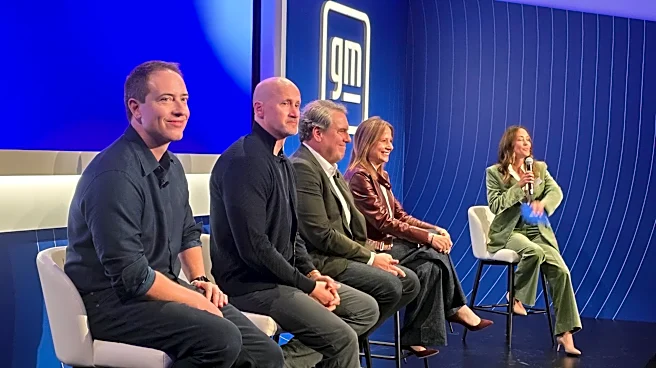






Last year, General Motors hosted its first ever GM Forward event in midtown Manhattan for media and investors, migrating news of company’s technology bets closer to Wall Street as it announced up-and-coming battery technology, in-vehicle artificial intelligence plans and large leaps in advanced-driver assistance that brings the car company closer to autonomous driving.
At this year’s conference, which is set for Oct. 21, the Detroit automaker is expected to provide updates on a series of initiatives coming to dealerships in 2028 and other company plans designed to set up General Motors for the next decade.
One of the executives that took the stage last year, veteran Apple Inc. David Richardson, who served as GM’s senior vice president of software
and services engineering, will not be present to outline the company’s software-defined strategies.
Richardson left GM one week after appearing onstage at GM Forward. Richardson now serves as vice president of cloud infrastructure engineering at Crusoe, according to his LinkedIn.

GM’s product Vice President Sterling Anderson, co-founder of autonomous trucking company Aurora, also attended last year. Since then, Anderson has been promoted, and the company revealed in a regulatory filing that he received a $40 million hiring package.
Anderson’s hiring package, a first-of-its-kind one-time deal that would be paid out through 2027, occurred before leadership restructuring that places him in charge of a slew of departments, including vehicle and manufacturing engineering, motorsports, safety, battery and propulsion systems on top of the majority of GM’s software and services product and engineering.
The increase in Anderson’s responsibilities came amid departures of several other GM execs based in Silicon Valley. Alongside Richardson, GM lost Bariş Cetinok, the automaker’s senior vice president ofsoftware and services product management, and Barak Turovsky, GM’s first-ever chief artificial intelligence officer whodeparted just eight months into the job created for him.
What we expect to learn this year:
Most advanced vehicle software yet
Product-specific news GM rolled out last year at GM Forward was largely tied to the launch of the 2028 Cadillac Escalade IQ electric SUV.
Updates on those two initiatives ― ones the automaker poured billions of dollars into achieving while tapping Silicon Valley expertise ― GM’s new architecture and most software-defined platform.
Software partnerships with Google built-in, soon to be rolled across every new GM vehicle, integrate Google Gemini as a virtual assistant. GM said last year at GM Forward that the automaker is on track to build its own proprietary AI system to take its place that is integrated directly into its vehicles connected by OnStar.
The goal of that tech, once deployed, is to have the vehicle “itself” describe new features directly to drivers, identify and explain maintenance issues, all the while providing restaurant recommendations and directions as other existing systems.
Another major leap for vehicle software would be GM’s promised launch of eyes-free driving, a progression of its advanced driver assist system Super Cruise, which currently only boasts hands-free driving in limited spaces under specific circumstances.
Eyes-free driving is the highest level of driver assistance where the vehicle can complete most driving tasks but a human must be able to take over driving at the system’s request. Today, GM’s SuperCruise allows customers to go hands free for lane-changing decisions while the vehicle follows the driver-inputted speed, but the system tracks a customer’s eyes to make sure they are awake and aware of the road at all times.
GM said in March of this year that it was testing a driving system in a limited pool of vehicles that could be considered advanced enough that a human may not need to take over driving at any point during a trip.
GM CEO Mary Barra appeared on CNBC on Oct. 12 to expand on the company’s progress toward eyes-free driving.
“I was just in a vehicle a couple weeks ago and the progress ― I was in March, and I just did it again.” Barra said. “I said, ‘I’ve got to do this every month.’ They’re making so much progress on our goal to have eyes-off, hands-off in the 2028 timeframe.”
Barra told CNBC’s Jim Cramer on “Mad Money” that the decision to cut Cruise in 2024, its robotaxi business line, and consolidate that work into progress toward placing autonomous features in its retail vehicles instead was the “right decision.”
“We think personal autonomy is going to be important. That’s where we’re focused on. We’re not in the taxi business, we’re not in the bus business ― that’s when we made the decision from a capital allocation about not continuing with Cruise,” Barra said. “It was a tough decision, but I think it was the right decision.”
The updated driving system uses AI that has been trained on a massive dataset GM said it collected through driving more than 1 million miles across 34 states.
Robots in GM plants
Another area GM may wish to keep Wall Street abreast? Learning from its robots in manufacturing plants.
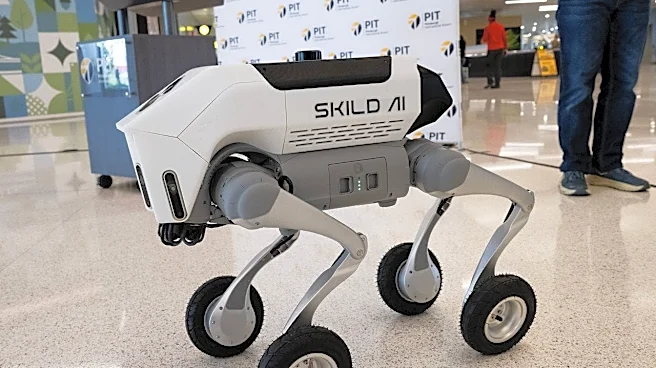
Last year, GM announced state-of-the-art robots slated for 2026 deployment in the manufacturing process. The cobots, or “collaborative robots,” were designed to work along with human employees by undertaking a single-use job function.
Components and software for the cobots, GM said, are developed at the company’s Autonomous Robotics Center in Warren and a sister lab in Mountain View, California.
So far, GM has not publicized where it has deployed its own cobots in its automotive manufacturing facilities.
In June, Crain’s Detroit Business reported that GM installed “dozens” of Fanuc-made cobots at Factory Zero, its Detroit-Hamtramck electric truck plant. The roughly 50 new Fanuc-made cobots have reportedly been installed to affix various parts onto vehicles.
GM’s event this year is slated for Oct. 21, the day after the automaker reports third-quarter earnings.
Jackie Charniga covers General Motors for the Free Press. Reach her at jcharniga@freepress.com.
This article originally appeared on Detroit Free Press: The investor tech briefing known as GM Forward is back. What to expect