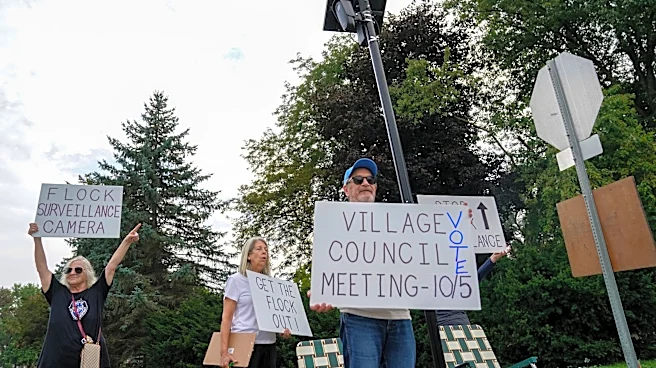








When Jeff Garner first noticed the black poles with the solar panels mounted to them along the roads near his Milford Township home, he didn't know what they were.
"I thought maybe they were boosters for your phone or something," he said.
The 71-year-old retired union carpenter later learned they were Flock cameras and he quickly got involved to oppose them. For the first time in 47 years of living in the area, Garner addressed the Village Council in June to speak up. He encouraged others to do the same.
With the council scheduled to vote Monday, Oct. 5 on whether to renew the Flock contract, Garner and others have spent their summer raising awareness in hopes of ending the use of the cameras in the area.
"We go out every Thursday and stand in front
of the Flock cameras with signs and pointing these out to people," he said. "A lot of people didn't know they were there but people are very against them. We've had people bring us gift certificates from Starbucks, bottles of water, even flowers and Cokes."

Garner's experience in Milford has been replicated across metro Detroit with residents banding together, pressing elected leaders to ditch Flock cameras in the name of civil liberties. Opposition in some areas has become so intense that critics have begun vandalizing the cameras themselves.
Lawmakers in Lansing have taken notice, too, and bills pending in the Legislature would regulate the cameras and the data they collect. Even Congress has picked up on the voter concerns. Sen. Josh Hawley, R-Missouri, last month launched an investigation into Flock and its data practices. Independent Sen. Bernie Sanders, of Vermont, has joined with Sen. Jeff Merkley, D-Oregon, and Rep. Alexandria Ocasio-Cortez, D-NY, and introduced a bill Oct. 2 that would ban federal agencies from using such technology and cutoff funding to state and local governments that use them.
The cameras are formally known as automatic license plate readers or ALPRs. Several companies provide them, though Flock appears to dominate the market. Usually installed near intersections, the cameras photograph passing vehicles and their license plate numbers, log the time, date and location, and store them in a database that police can search when looking for a car involved in a crime, a missing person or other reasons.
Police insist they help prevent and solve crime. Civil libertarians worry that unchecked, the data becomes part of a surveillance state ripe for abuse. Communities across Michigan and around the country are examining the cameras, the data implications and the concerns of residents.
St. Clair Shores has a contract that runs through 2030 with Flock but amid resident backlash, the city council voted Sept. 21 to have the cameras covered with bags so that officials could discuss how to proceed. Other communities in southeast Michigan also have ended the use of Flock cameras.
The Monroe County Board of Commissioners voted unanimously to end their use at a Sept. 1 meeting. Frenchtown Township in Monroe County, followed suit two weeks later. The debate over them has been bipartisan and has led to packed meetings of city councils and township boards.
Abuse in Eastpointe
In 2024, Eastpointe's City Council spent about $70,000 to install 18 Flock cameras.
"I was in favor of putting them in," Mayor Michael Klinefelt told the Free Press. "I work as a prosecutor in Wayne County, so I have seen how they can be very useful in investigations."
Klinefelt said the technology showed great promise, but as he learned more about it, he began to have misgivings.
"As more communities were putting them in and the network was expanding... the information they could yield grew exponentially," Klinefelt said. "So we went from, hey, we can clock a vehicle that's maybe fleeing southbound on Gratiot or something, and it turned into we're having records of how people are traveling all over our communities and that data is being stored and it can easily be looked up."
Resident opposition to the cameras grew. In August, a USA Today investigation examined Flock camera search data from police departments across the country, looking for anomalies. It found some in Eastpointe.
Police Chief Corey Haines launched an internal investigation that concluded two officers had misused the system, one for personal reasons and another by violating a policy. Those officers are being disciplined, Klinefelt said.
Residents have been vocal about the topic.
"Most of the comments I've gotten have been weighted against having Flock," he said. "There are certainly some residents who felt like it's a minimal intrusion and it's worth the police tool, but I think a majority had either a concern that it would be misused because it's not very well regulated, or they just in general felt like it's a level of surveillance that they don't want from their own government."
At a meeting Sept. 15, the Eastpointe City Council voted 4-1 to end the city's contract with Flock. Klinefelt was among those voting to end the contract. Deputy Mayor Rob Baker was the lone dissenter.
Heated debate in South Lyon
South Lyon has two Flock cameras that were installed in 2025. While the city is smaller than Eastpointe, the debate has been every bit as large and, in some cases, more bitter.
At a meeting Sept. 28, several residents from the city and neighboring communities urged council members to end the use of the cameras over concerns about privacy, data sharing and potential abuse.
Like Klinefelt in Eastpointe, South Lyon Councilwoman Lisa Dilg said the cameras seemed like a good idea when they were first proposed in late 2025.

"When I voted for it, I thought ... that we were giving a tool to the police that was going to be a great help to them," she said. "I had not heard of any of these stories yet."
The council voted 4-2 to cancel the city's contract with Flock and ordered police to cover the cameras until they could be removed. Councilwoman Lisa Popa voted against ending the contract, arguing instead for more safeguards on their use.
She said she understood critics' points, but she was alarmed by how divisive the debate had become.
"I may not agree with something someone says," she said during the meeting. "But at no point, at least from my perspective, should it lead to threats, bigotry, antisemitism, threats toward our law enforcement, rhetoric like that. That was very concerning to me. We can all have differing opinions but at no point am I going to hate someone because they may not agree with me and I hope the same would be reciprocated."
7-0 votes in Independence Township
In April 2024, Ryan Elswick of Flock Safety visited Independence Township to pitch the board of trustees on a camera system. He mentioned stories in the news around that time about South American theft gangs targeting high-end homes in Oakland County and the difficulties police face trying to catch them.
"If somebody got a vehicle description off, let say a Ring camera or whatever it might be, you’re not just stuck calling the sheriff’s office saying hey, it was a red pickup truck. That’s all we have." Elswick told the trustees, according to an online video of the meeting. "Now the Sheriff’s Office can go in and say 'Show me every red pickup that was in this area during that time frame' and that can lead them to a license plate and eventually to a suspect."
He went on to discuss the benefits of the cameras, including their ability to notify police in real time of a stolen vehicle in the community, an Amber alert, or a Silver alert for elderly motorists who get confused and lost.
Council members placed a contract with Flock on the agenda for a meeting the following month, but wanted more discussion of the cameras. At an August 2024 meeting, the two-year contract for $43,800 was on back on the agenda.
"There was some concerns about whether some people think we're going to be profiling or taking their picture at a red light, which is not true," said Jose Aliaga, the township supervisor at the time. "Nothing like that. It is to put more legal weapons for the sheriff's department to do their job."
Township Treasurer Paul Brown noted that the data from the cameras was deleted after 30 days, was not subject to Freedom of Information Act requests could only be accessed by law enforcement.

The board voted 7-0 to approve the two-year contract.
But two years later, things were different. Resident opposition to the cameras had grown and some of them were even vandalized. At a meeting Sept. 8, the township board again voted unanimously, this time to end the contract.
Current Township Supervisor Chuck Phyle II, declined an interview request from the Free Press but agreed to answer some questions via email. He said township officials had received a variety of feedback about the cameras, both positive and negative.
"While some residents viewed the technology favorably and others expressed concerns, the discussion generally centered on questions of transparency and appropriate safeguards," Phyle wrote.
"The decision was based on governance considerations. I evaluated the program's oversight framework, transparency measures, accountability mechanisms, and alignment with community expectations before determining whether participation should continue with Flock."
Contact John Wisely: jwisely@freepress.com. On X: @jwisely
This article originally appeared on Detroit Free Press: Resident backlash prompts more cities to ditch Flock cameras