








It will be a Pure Michigan moment when the 2027 NCAA Men’s Final Four returns to the Motor City April 3-5 as games again will be played on a maple hardwood floor made by Connor Sports — the 154 year-old Upper Peninsula company.
Much has changed since the last time the men’s college basketball championship was held in the Motor City 18 years ago.
At the time, Michigan and its manufacturing base had been rocked to the core economically. It took years of hard work, blood sweat and tears, but things steadily improved.
Detroit not only got its mojo back but has become a popular destination for tourists and conventions alike as it has hosted national events including the 2024 NFL draft to acclaim.
Which is why folks are thrilled college basketball's esteemed
event, to be held at Ford Field, is right around the corner. It will provide another opportunity to roll out the welcome mat, providing opportunities for small businesses and educational opportunities for young people, too.
"Much like the 2024 NFL draft, this is another opportunity to put our destination on a national stage, bringing thousands of fans to our region and generating tremendous energy and economic opportunity for our hotels, restaurants, attractions and small businesses," said Claude Molinari, president and CEO of Visit Detroit.
Dave Beachnau, CEO of Detroit Local Organizing Committee, has been helping plan festivities, which have been underway since getting the nod from the NCAA in 2022.
“We expect more than 100,000 visitors from across the country,” Beachnau said. When asked about economic impact, he added, "the most recent economic impact for a previous Men’s Final Four was $440 million in San Antonio in 2025."
He talked about the upcoming event.
“The NCAA has a full roster of free or low-cost fun fan events including open practices for all four teams at Ford Field, a Fan Fest, Music Festival with a-list talent, a Tip Off Tailgate and other things," he said.
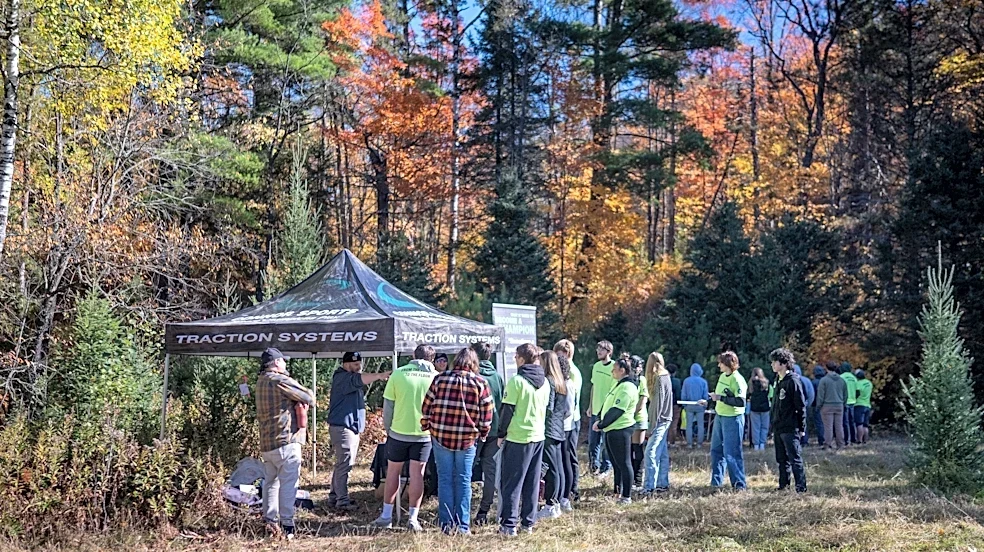
An unofficial kickoff of the 2027 event took place Oct. 5 with 500 K-12 students in the Upper Peninsula who attended an educational event in Cooks Run Forest, held by Connor Sports, with support from school districts, 2027 Men’s Final Four supporters and others.

The event focused on teaching young people about responsible forestry and also showed them what goes into making floors for basketball courts.

"We value the emphasis on the importance of the court being produced with sustainable methods as an important element of the overall focus on the environment," Beachnau said.
The business of making basketball court floors
Connor Sports was founded in 1872 and provides floors to not only the NCAA, but National Basketball Association and other global sports organizations.
Connor Sports is part of the Gerflor company and has over 125 employees at its Crystal Falls facility. I caught up with Zach Riberdy, marketing director of Connor Sports, and posed a few questions:
QUESTION: Tell me about Connor Sport’s NCAA business?
ANSWER: "Connor Sports has been crafting hardwood basketball courts for more than 110 years. We installed our first court in 1914, and we've been the official court supplier for NCAA Men’s and Women’s March Madness and the Final Four since 2006."
Q: How do you choose the trees for courts?
A: "We use sustainably harvested northern hard maple in partnership with forestry businesses in and around Michigan's Upper Peninsula. Selection follows criteria established by those professionals."
Q: How many trees does it take to building one court?
A: "It takes roughly 80 to 120 trees to produce a standard-size NCAA college basketball court, although that number can vary depending on the usable yield from each tree."
Q: What is the time line of making a court?
A: "The process begins about a year in advance. The maple is air-dried, then kiln-dried, before production. Today’s event (Oct. 5) was designed to show (the students) where the process begins and symbolizes how the story of the court starts in the forest well before it reaches the Men’s Final Four stage."
Q: How labor intensive is it?
A: "Very. There are multiple stages, from preparing and milling the maple to building the individual portable panels, inspecting them and ultimately sanding, painting, sealing and finishing the court. There is a lot of skilled craftsmanship involved. The Men’s Final Four court is 70 feet by 140 feet, around 9,800 square feet, built in panels that are assembled on site."
Q: When will you get the floor to Ford Field for the April event?
A: "We start building the panels in November (next month), then ship to our finishing partner mid to late January who begins preparing and applying the graphics provided by the NCAA. That timeline has us ready with the trucks loaded and on the way to Detroit about a week before tip off."
Q: How many courts are you making right now?
A: "This year, all the Men’s Regional courts, the Men's Final Four court, Women’s Regional courts, and the Women's Final Four court will be brand new."
Q: I heard you are also building courts for the WNBA?
A: "Yes, we have strong relationships with several teams across the WNBA. We’re in discussions with the new Detroit team, but nothing has been finalized yet. We hope that once they see what we deliver for the 2027 Men’s Final Four in Detroit, they’ll get a first hand look at our capabilities and quality."
The only thing that would provide a perfect ending to this upcoming event — to have University of Michigan and Michigan State University’s mens' teams make it to the Final Four before a home crowd.
Tom Izzo and his Spartans made it to the Final Four in 2009 — finishing second to North Carolina. MSU is serving as host institution of the upcoming event.

Can't wait for the games to begin!
Contact Carol Cain at clcain@cbs.com. She is senior producer/host of "Michigan Matters," which airs 5:30 a.m. Sundays on CBS Detroit and 9:30 a.m. Sundays on CW Detroit 50. See Bedrock CEO Jared Fleisher and business leaders Marvin Beatty, Khary Turner and Georgella Muirhead on this Sunday’s show. You can also watch the show simultaneously on the two stations' listings on Fubu, Pluto TV, YouTube TV and Apple TV.
This article originally appeared on Detroit Free Press: Why 500 kids were in the U.P. to learn about trees ahead of Final Four